Climate Food and Agriculture
All Stories
-
Save the Life of My Child
Organic diet causes pesticide levels to plummet in children, study finds If you needed that extra nudge to start feeding your kids organic grub, here it is: In a recent U.S. EPA-funded study, 23 Seattle-area youngsters were switched to an all-organic diet, and the levels of pesticides in their bodies declined to essentially zero after […]
-
Why the heavily subsidized corn harvest amounts to an annual environmental calamity
While researching my Poverty & the Environment piece on the food system, I had occasion to look closely at the corn harvest, source of so much of our cheap food.
As bad as the annual flood of cheap corn is for our health -- nutritionally worthless high-fructose corn syrup, cheap feed for confined animals pumped full of antibiotics and hormones -- it may be even worse for the environment.
-
![]()
![]()
How poultry producers are ravaging the rural South
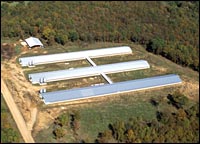
A person driving through the South might notice the chicken houses dotting the hills and flatlands. He might marvel at the larger ones, as long as a football field. He might react to their gagging stench for a moment, and then forget as he travels on. But those who live near the structures — stuffed […]
-
Biotech crops have benefited shareholders in seed giants, but nobody else
A couple of days ago, NY Times writer Andrew Pollack attempted to address the failure of biotech companies to "improve" fruits and vegetable crops -- that is, to bring a genetically altered fruit or vegetable strain (as opposed to grains like corn and legumes like soy) from seed to supermarket.
Unwittingly, the article illustrates the industry's hubris and the mainstream press's gullibility in covering the topic.
Pollack opens thusly:
-
Steve Frillmann, community-garden guru, answers questions
Steve Frillmann. With what environmental organization are you affiliated? I am the executive director of Green Guerillas, New York City’s oldest community-gardening group. What does your organization do? At Green Guerillas, we help people carry out their visions for what community gardens can be in a dense, vibrant urban area — urban farms, botanic gardens, […]
-
Crops and Robbers
Archer Daniels Midland blossoms with lots of government help Agri-biz giant Archer Daniels Midland had a barn-burner of a quarter, sending its stock price to an all-time high. Why is the “Exxon of corn” doing so well? Why, your tax dollars, of course! The federal government shovels billions of dollars of subsidies at field corn; […]
-
Wenonah Hauter, director of Food and Water Watch, answers questions
Wenonah Hauter. With what environmental organization are you affiliated? I am the executive director of Food and Water Watch, a brand-new consumer advocacy organization in Washington, D.C. What does your organization do? We’re focused on protecting two critical essentials: food and water. Our mission is to challenge the economic and political forces that are promoting […]
-
Kernel Ganders
Ethanol decent on efficiency but not on greenhouse gases, study finds The heated debate over biofuels took another sharp turn this week: New research in the journal Science claims that replacing fossil fuels with corn-based ethanol is energy-efficient (contrary to some previous studies), but doesn’t do much to cut greenhouse-gas pollution. Researchers from UC-Berkeley determined […]
-
Why the global food system isn’t kind to local farmers
 Recently, I've come across two articles that pungently demonstrate the place of small-scale farmers in a global economy geared toward long-distance trade.
 The first, a Salon-published excerpt from Charles Fishman's recent book The Wal-Mart Effect, explores what the U.S. love affair with $5/pound salmon means for Chile. (Prepare to click through a few ads to get to the story.) The other, a NY Times piece, depicts high-level hand-wringing in China over rural "land grabs by officials eager to cash in on China's booming economy."
(Thanks to Tyler Bell for alerting me to the Salon piece.)
-
Why greens should join forces with gardeners to face down the bull dozers in LA.
Even though I abandoned Brooklyn for the Appalachians, I'm no sentimental pastoralist. I'm a long-term disciple of the great urban theorist (and champion of cities) Jane Jacobs. Human history since the dawn of agriculture 10,000 years ago has been a history of cities. Cities are the future; as David Owen's superb article "Green Manhattan" (PDF) shows, they may be our only hope. The trick is to create agricultural systems within and just outside of cities, minimizing the ruinous effects of long-haul freight transit, slashing the fossil-fuel inputs embedded in food production, maximizing availability of fresh delicious food, and boosting local and even neighborhood economies.
Farmers' markets have been the most visible effort at creating sustainable urban food networks. Equally if not more important, although virtually invisible to well-heeled urban foodies who laudably support farmers' markets, inner-city gardening projects represent a vanguard in the effort to overthrow industrial food and reintroduce sustainably grown, delicious food to populations that were knocked off the land a generation or two ago.
There's been a lot of talk around here about whether or not humanity's future requires messing up Bobby Kennedy Jr.'s ocean view from "the Vineyard." (I say, the hell with him. Mess it up!) This story may be more important, though: An LA developer wants to bulldoze a 14-acre community garden, with 360 family plots, right in the middle of an industrial zone in South Central. The city should be paying these people to do what they're doing, for all the environmental and social benefits they're creating. At the very least, the city should buy the land back from the developer and make the garden permanent.
LA greens, and I know you're out there, get out and man the barricades with those brave gardeners.