I know: You’re feeling a bit blue about that anti-reform farm bill extension that Congress snuck in to the fiscal cliff deal just before the new year — the one that Grist skewered for its screwing over of sustainable farmers. You’re not alone — the big subsidy reform groups like the National Sustainable Agriculture Coalition and the Environmental Working Group were bummed, too.
But with 2013 comes a new Congress, and some agriculture reformers are now moderating their fury. As NPR reports, the 2012 Farm Bill disaster now looks more like a “stalemate.” Yes, conservation programs, fruit and vegetable subsidies, and new farmer programs weren’t included in the extension. But a controversial, massive expansion of crop insurance or the proposed “shallow-loss” income insurance program for commodity crop farmers didn’t sneak in, either.
Meanwhile, Democrats expanded their majority in the Senate with what may be the most progressive caucus in decades — one that some analysts say hearkens back to the liberal “golden age” of the 1960s. Of course, House Republicans are as crazy as ever, even if there are a few less of them.
That brings us to the great irony of the farm bill debacle. House Republicans killed the farm bill when they didn’t even engage in negotiations with the Senate (which had passed their version over the summer) to find some way to pass something. In short, Speaker John Boehner refused to bring up the farm bill for a vote after his caucus revolted over nutrition spending — which led to the expiration of huge chunks of federal farm policies.
And yet, it’s worth noting that Republicans in Congress overwhelmingly represent the very same farmers and ranchers who are most affected by the farm bill’s failure. Check out the map of 2012 election results from the House of Representatives via the New York Times:
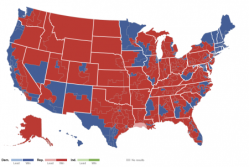
New York TimesFarms are in the red parts. Mostly.
In fact, it seems like the House members that farm country sends to Congress often put the interests of Tea Party Nation before their actual constituents. The most extreme example of this may be Kansas Republican Rep. Tim Huelskamp. A vocal opponent of farm subsidies as well as food stamps, he was considered so radical in his wingnuttery by John Boehner that he lost his seat on the House Agriculture Committee — the first time in 150 years (!!) that Kansas won’t have representation there. And yet Huelskamp ran unopposed in 2012.
I was having similar ironical thoughts as I read this article in Montana’s Billings Gazette about reform-minded ranchers who are frustrated at the Obama administration’s failure to push through new rules that would protect them from the anti-competitive practices of meat packers and processors. To quote Jerry Seinfeld: Really? Really?!
Mitt Romney won Montana by 14 percent — besting John McCain’s 2008 performance by six points. Montana’s new, sole House member is a Republican, who was elected easily — but in many ranchers’ eyes, it’s still Obama’s fault. In fact, the Obama administration made the biggest push in decades to reform meat industry rules (known as GIPSA rules, for the acronym of the agency that regulates it). And as I’ve observed in the past, that effort was defunded and effectively killed by … House Republicans. (For more on issues related to corporate consolidation in agriculture, check out my recent interview with Sea Change Radio.)
At a certain point, you have to face facts. Farmers have a problem with Washington. And it really isn’t with urban, blue-state representatives. It’s with the people rural voters are sending there. I’m not the only one who has noticed this. USDA Secretary Tom Vilsack — who seems very likely to stay on despite some reports to the contrary — tried to have a Sister Souljah moment with farmers when he declared that it was time to “have an adult conversation” about rural politics.
There are some ranchers who get it, of course. The Gazette interviewed one by the name of Ressa Charter, who is working to launch a local food system in the Billings area — complete with website, billingslocalfood.org. As he put it:
Local food isn’t going to be the answer for all of Montana’s beef and grain production but we might as well eat our own excellent meat. It’s kind of a travesty that we don’t have access to it. I think that’s the simplest reason we should build a local food system… It can be an avenue to doing an end-run around the concentrated packer end of the meat market.
And then he goes all Michael Pollan: “We can build sustainable prosperity for Montana families by reinvigorating our ‘solar harvesting’ through our great grasslands.”
Dude: Have you considered running for Congress?
A message from
Your support keeps our climate news free.
Grist is the only award-winning newsroom focused on exploring equitable solutions to climate change. It’s vital reporting made entirely possible by loyal readers like you.
At Grist, we don’t believe in paywalls. Instead, we rely on our readers to pitch in what they can so that we can continue bringing you our solution-based climate news. Donate today to keep our site free.