👋 Hi, everybody! This week, we’ve got a thought-provoking oddity to share with all of you. One of our newsletter readers recently acquired a used bookstore (what a dream), and made an interesting discovery in her inventory: a 1975 pamphlet produced by Exxon, including a section that directly addresses concerns about plastic pollution. Besides just being a fascinating relic (seriously, scroll down if you love historical artifacts), it got me thinking about how our understanding of the climate and pollution crises has evolved — and how that might change the course of the next 50 years.
I’ve also got a couple of reminders for y’all: Have you RSVP’d yet for the next gathering of the Looking Forward book club? This winter, we’re reading Under the Sky We Make, by scientist Kimberly Nicholas. We’ll meet on Wednesday, January 14 (on Zoom) to discuss the book, with Kimberly joining us for a special Q&A. And we’re also offering a chance to win a free copy of the book — RSVP by the end of TODAY (December 12) and mark, “Yes! I want a chance to win the book!” on the registration form. I’ll email the five winners on Monday. 📚
And one more: We’re still collecting reader feedback and would love to hear yours in our audience survey! What do you like about this newsletter, and Grist’s offerings more broadly? What could we do better? We truly appreciate (and use) your input, so please share.
This post originally appeared in Grist’s weekly solutions newsletter, Looking Forward. Not on our list yet? Subscribe here to get it in your inbox every Friday.
December 1975
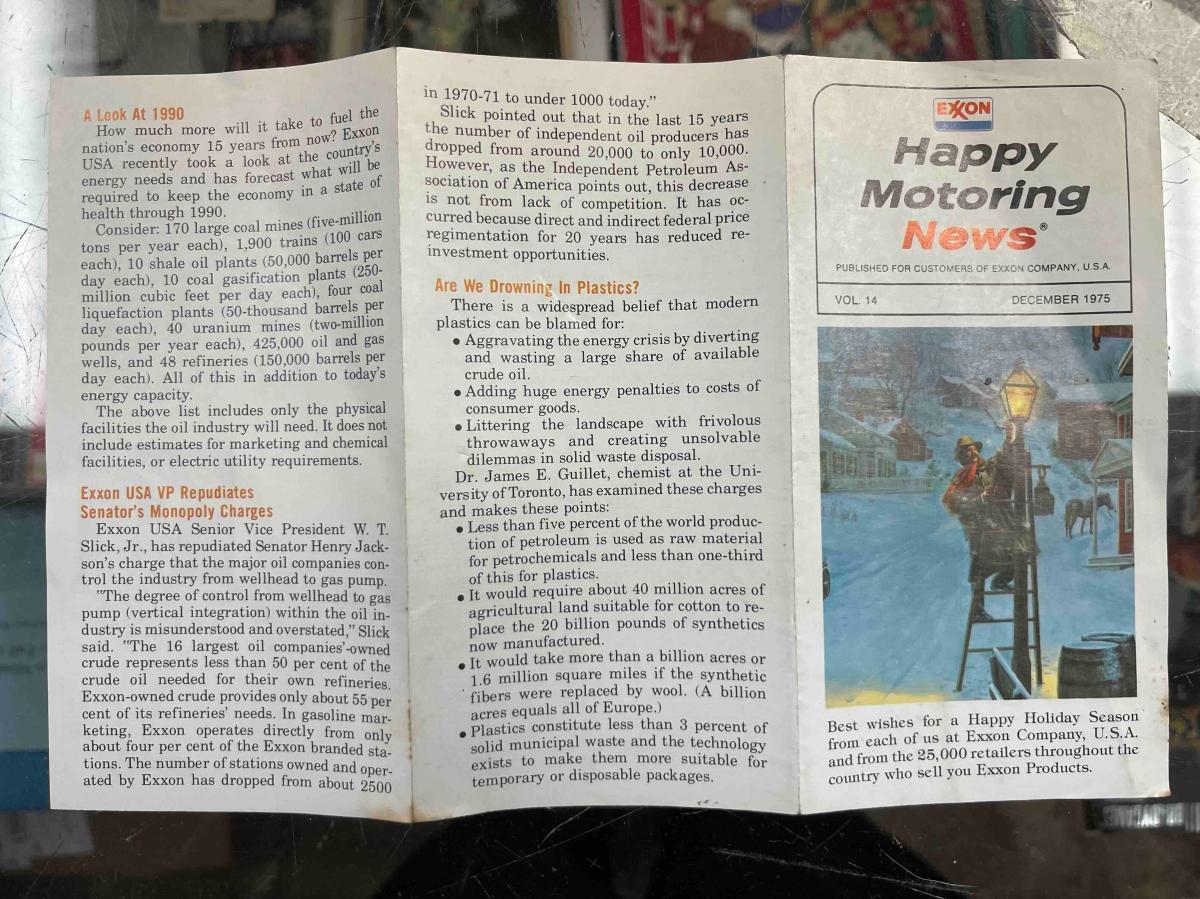
Courtesy of Becca Godwin
Earlier this year, Looking Forward reader Becca Godwin became the new owner of a used bookstore in a small Tennessee mountain town. “There’s a town square with a dozen or so businesses, and this was one of them,” she described. The small but tightly packed store had been owned by the same man for 20 years, and when he was ready to retire, Becca and her husband jumped at the chance to take over the business.
They inherited two decades’ worth of inventory — around 17,000 books, per the former owner’s estimate, as well as other print materials like sheet music. “There’s anything and everything in here,” Becca said. Among the treasures, she discovered a print newsletter from December 1975, from the company now known as Exxon Mobil.
“Best wishes for a Happy Holiday Season from each of us at Exxon Company, U.S.A.,” begins this edition of Happy Motoring News. One section of the pamphlet looks ahead to the year 1990 — 15 years in the future — forecasting that the fossil fuel industry would need significant expansion to keep up with energy demand. (The reality wasn’t too far off, but it was also a limited view; coal, for instance, did generally continue to grow through 1990 but peaked not too long after.) Another section attempts to refute the “widespread belief” that plastics are energy-intensive and create litter and pollution.
“I didn’t know Exxon ever put out anything like that,” Becca said. “When I find something that seems extremely niche or random, I like to look it up and see: Is this something that is actually very common and it’s just new to me, or is it actually something that is pretty rare and old and not well-known?”
When she searched online for more information about the newsletter, she couldn’t find much. I tried to help, reaching out to a couple of experts and to Exxon itself (Exxon didn’t respond in time for publication). No one was sure exactly how Happy Motoring News might have been distributed or how widespread it was. (If you remember seeing these in the ’60s or ’70s, please reach out to let me and Becca know!)
But we do know “Happy Motoring” is an erstwhile slogan that was also featured on Exxon’s paper maps, which at one time would have been commonly distributed at gas stations. In the 1970s, Exxon boasted over 25,000 service stations (a number cited on the pamphlet). And I found several other editions of Happy Motoring News from the ’60s and ’70s listed for sale on eBay.
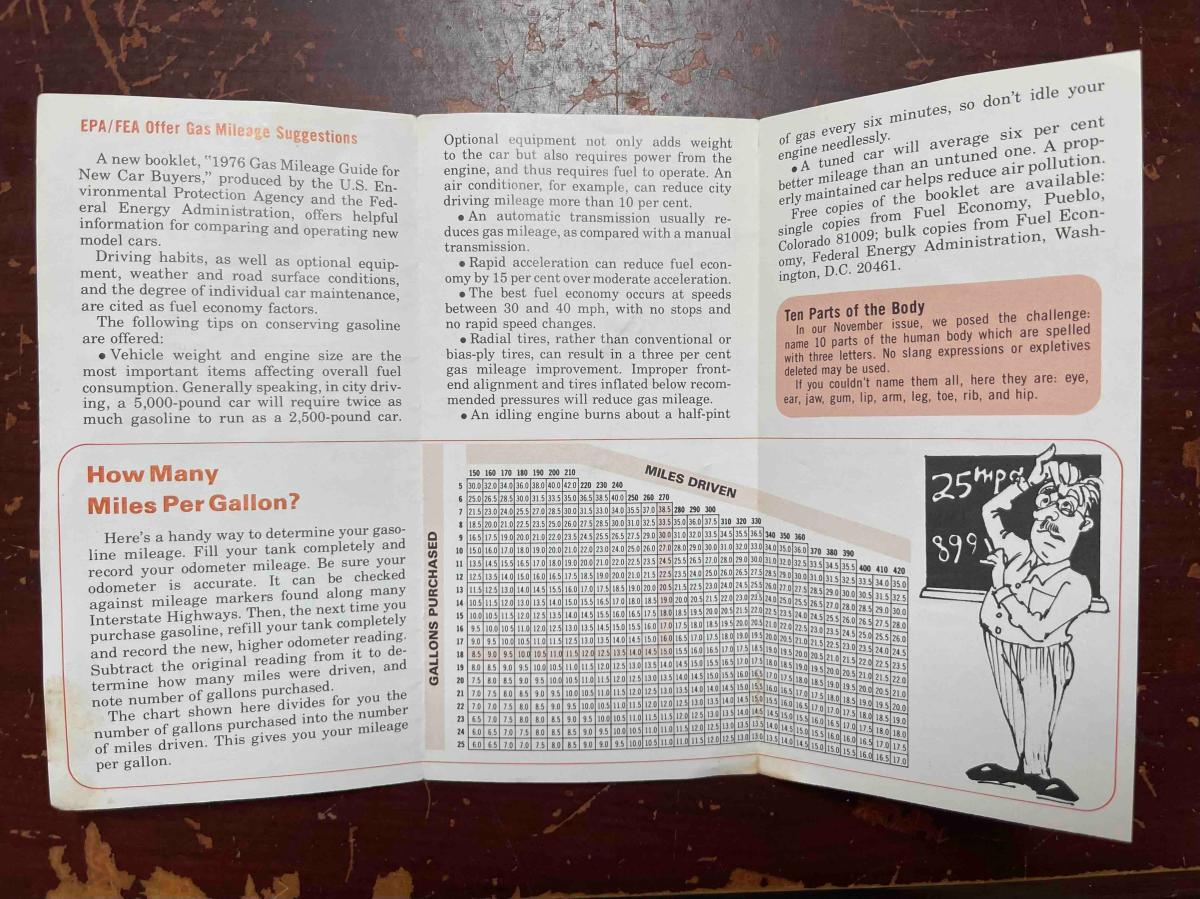
The inside fold of the 1975 newsletter. Courtesy of Becca Godwin
It’s not a huge surprise that Exxon was working to direct the conversation away from any criticism or public concern that could hurt its bottom line. We now know that Exxon had information about the dangers of climate change as early as the 1970s, but it chose to bury the science that its own researchers uncovered and continue selling products the company knew would contribute to a warming planet. We also know that fossil fuel companies have spent billions on PR to boost their reputations.
And, similarly, petrochemical companies have known for decades that recycling would not be a viable solution to the scourge of plastic waste, but they went hard on pro-recycling messaging anyway to effectively shift responsibility onto the end user.
But there’s something that feels particularly insidious about seeing that kind of propaganda framed as a friendly news handout for drivers, alongside little word games and tips for calculating your gas mileage. It’s wild to imagine an average driver picking this up and reading it, and at the same time, it really hammers home just how much some parts of this conversation haven’t changed in 50 years.
Becca noted that as someone who wasn’t alive in the 1970s, she hadn’t fully realized how much concern there already was about plastic waste at that time. “The beginning of [the plastics section] sounds like it could have been written today,” Becca said.
And yet, we are still being sold both fossil fuels and single-use plastics at a seemingly unstoppable rate — in part because of framing like Exxon’s that both underplays the impacts and overvalues the solutions, while also claiming that the alternatives are worse, leaning into inertia to combat concerns.
But one thing that has changed is that we are equipped today with more information. If it’s hard to imagine how someone could have accepted the talking points represented in this printout, that’s at least a little due to how much more the general public knows now. We have a better understanding of the science behind climate change, and we can more undeniably see its impacts. We have mounting evidence about the harms of plastic, not only to the environment but to our own health. We also know that there are actually solutions at our fingertips.
And with climate change no longer some distant future threat, we know that the world will likely look dramatically different another 50 years from today — either because we took meaningful action, or because we didn’t.
One thing that interests me about this tiny window into 1975 is thinking about turning the window in the other direction. In another half-century, what might readers think about the relics they discover from 2025? And how can we make sure they don’t look back on us the way we look back on 1970s Exxon — “They knew what was coming and they didn’t change course”?
“I can hope that 50 years from now, whatever they do find from this time, they’ll be able to look on it in a different way than I am, where I’m feeling, ‘Oh, not enough has changed since then,’” Becca said. “Hopefully they’ll be looking at it like, ‘Man, I can’t believe in 2025 things were the way they were. And not long after that is when everything started to change for the better.’”
More from Grist
❓ Climate who?
Speaking of the importance of information — Trump’s EPA recently scrubbed about 80 pages of basic scientific facts about climate change from its website. On the page explaining the causes of climate change, the EPA site now emphasizes “natural processes,” which experts said is “simply misinformation.” Government websites are an important source of info for many, and while most of them remain trustworthy, this latest purge signals a troubling shift. Read more
🌏 Moving on
The rest of the world isn’t waiting for the U.S. to get back on board the climate progress train. China is leading on clean energy growth, and has also become a leading voice in international negotiations — like the U.N. climate conference last month, where the U.S. was conspicuously absent. While countries are still navigating around the void left by the U.S., that influence may fade. Read more
🌿 Rivercane lane
A native bamboo plant known as rivercane used to flourish in the Southeast. If you’ve never heard of it, it may be because development has wiped out some 98 percent of it. But the hardy plant played a crucial role in protecting stream banks from erosion during storms and floods. Now, scientists, historians, tribes, and volunteers are working to bring it back. Read more
In other news
- The sci-fi idea of harnessing solar energy in space is getting closer to reality, with a new startup emerging from stealth mode this week (Heatmap News)
- This recently completed project highlights one promising environmental solution for all 50 US states (The New York Times)
- Over 200 environmental groups signed a letter to Congress this week urging a halt on data centers until regulation can catch up to protect communities (Inside Climate News)
- Meanwhile, lawmakers — and Republicans in particular — face mounting pressure from constituents concerned about data centers driving up utility costs (E&E News)
- Beaver dams bring benefits to river ecosystems. Artificially recreating dams has also shown some promising results — along with restoring beaver populations. (Phys.org)
And finally, looking forward to …
… a future where plastic is no longer trash, but the subject of trash talk. This felt like the perfect time to (ahem) reuse this delightful little drabble written by none other than Becca Godwin, which she first shared with me about two years ago.
👕👕👕
“Your grandy’s so ancient, they wore clothes made from PLASTIC,” one child said to another. The crowd around them burst out laughing.
“Polyester-wearing fools!” one yelled.
“Yeah? Your zizi’s so old, they predate the eradication of HOMELESSNESS,” the contender said, smirking.
Shouts of “BUUURN” ran through the crowd.
The opponent knew they had to come back strong.
“Well your zaza’s so old, they had to use synthetic tampons …”
Everybody held their breath.
“… that they purchased from a BIG-BOX STORE.”
That did them in.
The kids ran around in circles, howling. Doubling over. Some cracked up until they cried.
— a drabble by Becca Godwin
👕👕👕
A drabble is a 100-word piece of fiction — in this case, offering a tiny glimpse of what a clean, green, just future might look like. Want to try writing your own (and see it featured in a future newsletter)? We would love to hear from you! Please send us your visions for our climate future, in drabble form, at lookingforward@grist.org
👋 See you next week!