👋 Hi, everybody! Last night, we had an incredible discussion with author Nick Fuller Googins (and with one another) about his novel The Great Transition. As always, it was a delight to get to meet and hear from several of you in the intimate space of the Looking Forward book club. Thank you to all who joined.
We’ll be sharing some highlights from that conversation next week — but for now, we are eager to announce our next book club pick: Climate Wayfinding: Healing Ourselves and the Planet We Call Home, by Katharine K. Wilkinson. Some of the OGs here might recall that Katharine was the special guest at our very first book club way back in 2022, when we read All We Can Save, the anthology that she co-edited along with Ayana Elizabeth Johnson. The two of them also co-founded The All We Can Save Project, where Katharine has shaped and led programs supporting the book’s mission: “To nurture the leaderful climate community we need for a life-giving future.”
That work now has a more portable home in Climate Wayfinding. As the title would suggest, this book is about navigating our own roles in responding to the climate crisis — something I know many of you spend time thinking about. Katharine breaks down processes for looking inward with care, looking outward with curiosity, and looking forward (heya!) with courage.
We’re sharing an excerpt from the book today — including a taste of the reflection prompts embedded throughout. Be sure to RSVP for the book club gathering as well, so we can reflect together! Today, we’ve also got news for you about a geothermal debut and tick conspiracy theories — and a drabble shared by a reader.
This post originally appeared in Grist’s weekly solutions newsletter, Looking Forward. Not on our list yet? Subscribe here to get it in your inbox every Friday.
What a Hawk Can Teach Us About Climate Healing (an excerpt from Climate Wayfinding, by Katharine K. Wilkinson)

I live in the very heart of Atlanta, Georgia, affectionately called the “city in a forest.” From my desk, where I work most days, I look out onto a stand of trees. Right at canopy height, it is the perfect view for getting distracted, especially by our resident red-tailed hawk, who is strikingly visible in the loose thatching of bare winter limbs.
Sudden squirrel scatter, and she alights on the branch of a maple tree to scan for potential prey. Her fleet perch and keen watch, her grandeur of feather and hunt — it breaks through the primacy of my screen and shakes me from the fathomless digital world. Interruption gladly received.
Each time the hawk stops through these trees, I am struck by the sudden proximity of a taloned huntress to me, encased in my condo-version of captivity. More than once, I have grabbed my phone to quickly frame the hawk and catch ill-focused evidence that I too am alert and alive. Enraptured by a raptor, I have “Slacked” the flattened scene to my colleagues: Afternoon visitor! 🪶❤️ (As if icons in miniature could limn her.)
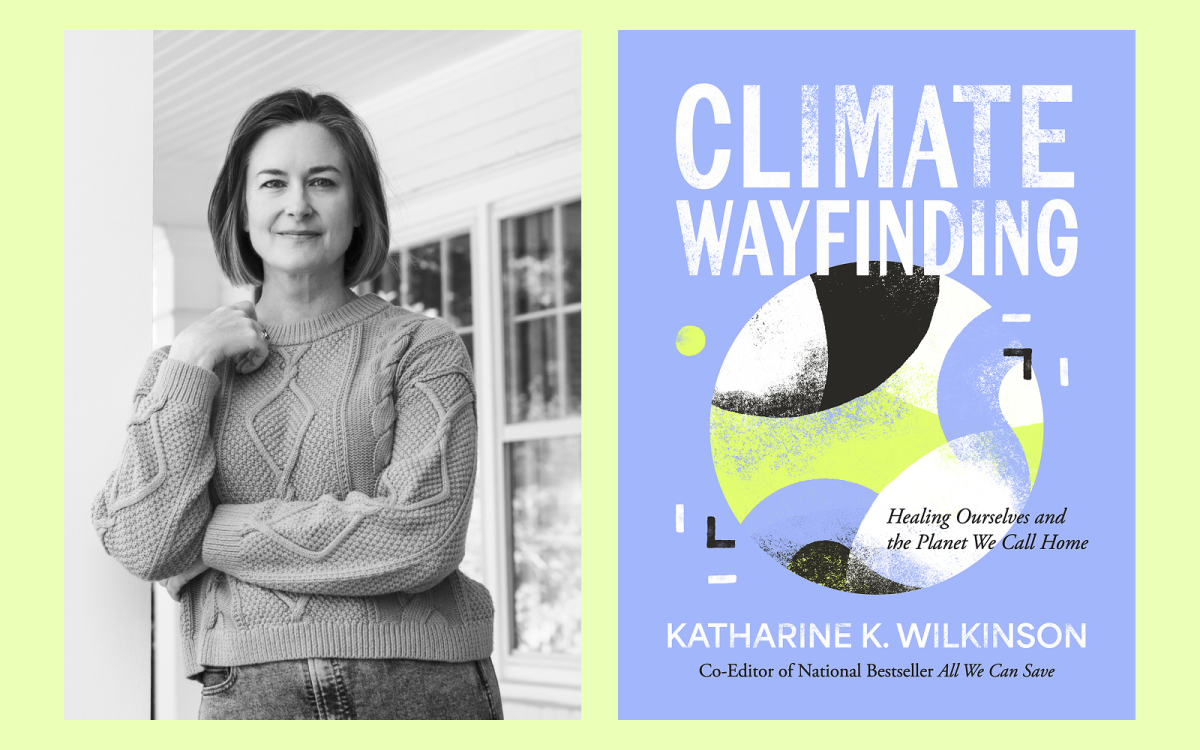
Katharine K. Wilkinson, author of Climate Wayfinding. Gabriella Valladeres
But I am struck by another proximity, too, between what the hawk does and who the hawk seems to be. Her doingness and her beingness are so close as to become one.
I suspect this hawk has never once felt the nag of the question, What can I do? Not about the climate crisis. Perhaps not about anything. What to do is something other animals seem to know innately and intimately, or perhaps don’t need to know at all.
Evolution has made things more complicated for us Homo sapiens, who ponder and puzzle. As essayist and author Margaret Renkl writes, “Every living thing — every bird and mammal and reptile and amphibian, every tree and shrub and flower and moss — is pursuing its own vital purpose, a purpose that sets my human concerns in a larger context.” As I watch the hawk’s wings lift and lower and propel her back into the air, I marvel and muse whether life itself might offer another way in.
What might open up for us if we shift the question ever so slightly — from What can I do? to Who can I be? Or, Who am I already?
The hawk, like all of us existing on this planet, is an inheritor of a 3.8-billion-year history: From single-celled organisms to plants and vertebrates, life has continued to move forward toward more life, overcoming unthinkable odds. Weighty and unwavering and in so many ways impenetrable — this dynamic defines Earth as a living planet. When we think about a hive of honeybees gathering their ingredients from flowers, or black corals siphoning plankton over centuries, or the sudden emergence of mushrooms from a shrouded fungal network, we can see this dynamic in action. Even kudzu offers testimony with its rampant return, however unwelcome, each spring.
Who can we be? One thing we already are: an expression of Earth’s life force, right here, right now, made possible by a series of miracles that have blossomed over eons. This is true simply by virtue of breathing.
Life force unfurls through each of us in such beautifully different ways. We explore the unknown and document our discoveries. We design new things and give them form. We expose what’s ruptured and source the means to mend it. We reflect, wonder, and imagine. We craft stories and art and shows. We make ritual. We convene people and foster conversation and collaboration. We care for one another. We strategize, organize, and orchestrate. We engineer and implement. We manage the details. We show up, stand up, and speak up. We share wisdom and tell jokes. We cook and sing and clean and plant and build and nap. And all of that is just the briefest inventory of human beings’ doings.
There are things we do that are so wholly connected with who we are — that spring up from within us in such an organic way — that the space between our doing and our being shrinks or even vanishes. In those moments, our small expression of the vast life force we’ve inherited and embody is especially effervescent. We may find ourselves buzzing, flowing, or sensing a particular warmth. We may be especially porous and focused both.
I imagine this is how the hawk might feel as she swoops into the circle of life. It’s how I wish many more of us to feel as we take wing to heal the climate crisis.

Prompts to Reflect, Journal, and Discuss
- Take a moment to look out your nearest window — or around you, if you’re outside. Where do you see aliveness manifest or in motion? Let it seep in.
- Close your eyes and imagine yourself doing or experiencing something that makes you feel vibrantly alive. What sensations do you notice? How does life force feel in your body?
- Is there a gift you feel called to give to help heal our planet? A generosity you might offer, simply by being who you are?
Adapted from Climate Wayfinding: Healing Ourselves and the Planet We Call Home by Katharine K. Wilkinson (Amber Lotus / Andrews McMeel 2026). Art by Ampersand.
Join the book club
RSVP here to join our book club discussion of Climate Wayfinding on July 29! We’re so excited to continue the conversation with Katharine, and explore some of the book’s reflection and discussion prompts together. We are offering five free copies of the book (with thanks to Andrews McMeel and Amber Lotus Publishing) to attendees — RSVP by next Friday, May 22, for a chance to win.
More from Grist
⚡ On the market
The geothermal energy company Fervo made its debut on Wall Street this week, becoming a publicly traded company. Its successful initial public offering, or IPO, is seen as a promising sign for the growth of clean energy more broadly. Read more
🔌 It’s electric
Building new, dense housing is a solution that enjoys broad bipartisan support. And as the condos and apartments go up, they’re also ushering in a common-sense form of decarbonization: electrification. Around 75 percent of new apartment buildings are heated with electricity. Read more
👀 Tick talk
Watch out: Early-season tick bites are on the rise. Watch out for something else, too — anti-vaccine conspiracy theorists on social media are trying to pin the surge on “human engineered biological warfare.” Scientists, meanwhile, believe the tick boom is likely driven by climate change. Read more
In other news
- This farm now hosts a first-of-its-kind water treatment system in Puerto Rico, which could boost resilience for rural communities (Inside Climate News)
- Amazon inked a multiyear deal to install a special kind of heat pump at its commercial buildings (Canary Media)
- These researchers are working to make the foundations of apple trees — known as rootstocks — more resilient to climate change (The Guardian)
- In California’s Bay Area, libraries are now lending out induction stovetops (KQED)
- This tiny straw house is the stuff of fairy tales — and it sequesters carbon (The New York Times)
And finally, looking forward to …
… embracing lower-carbon forms of transit. Did you all know today is National Bike to Work Day? Many thanks to Looking Forward reader Kathleen Spear for giving us a heads-up! And for sharing this bike-inspired drabble, titled “The New Commute.”
🚲🚲🚲
As I prepare to head home on this brilliant spring evening, I reach for my forest green bicycle helmet hanging from the peg next to my office door where my car keys once hung. My thoughts are already at the farmers market where I need to pick up produce, cheese, and baguette for tonight’s family dinner. With my home-cooked meal in mind, I pedal onto the thoroughfare for my five-block journey. I let the clean, cool air wash over my face and I relax as my movements match those of my fellow bicyclists gliding around me like a collective heartbeat.
— a drabble by Kathleen Spear
🚲🚲🚲
A drabble is a 100-word piece of fiction — in this case, offering a tiny glimpse of what a clean, green, just future might look like. Want to try writing your own (and see it featured in a future newsletter)? We would love to hear from you! Please send us your visions for our climate future, in drabble form, at [email protected]
👋 See you next week!