
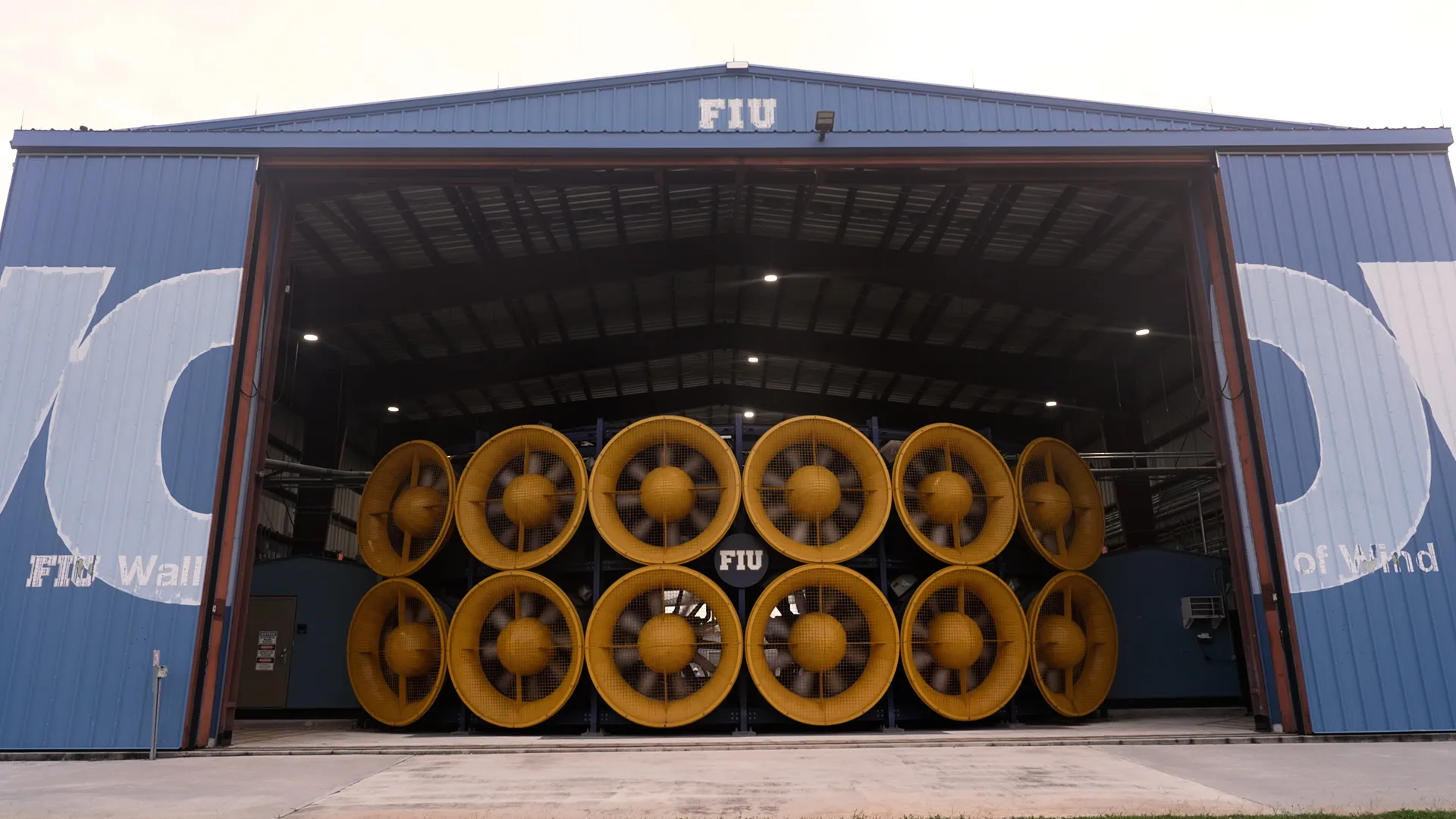
👋 Hi, everybody. This week, we’re taking a look at a unique set of experiments designed to help engineers understand how manufactured homes fare in the face of hurricane-force winds — and how relatively modest improvements might make a big difference. (These experiments were conducted in a lab. An outdoor lab featuring a 14-foot wall of fans.) The results could have an impact for millions of residents facing increasingly intense storms.
We’ve also got news for you about biodiversity, the grid, and The History of Concrete.
This post originally appeared in Grist’s weekly solutions newsletter, Looking Forward. Not on our list yet? Subscribe here to get it in your inbox every Friday.
This lab is blowing houses down — to make them safer
Reshma Kirpalani
Often, we don’t realize just how vulnerable our homes are to disasters until one hits. That’s becoming more and more true as climate change produces greater and greater extremes — and more frequent ones — testing the limits of the infrastructure that shelters us.
But some researchers are trying to get ahead of the game by testing those limits themselves. I give you: the Wall of Wind, an experimental facility at Florida International University where a 14-foot stack of 12 powerful fans can re-create the 157-mph winds experienced during a Category 5 hurricane.
In May, a team of researchers led by structural engineer Elaina Sutley brought manufactured homes (also known as mobile homes) before the Wall of Wind, for a set of tests that journalist Daniel Wolfe explored in a feature for Grist this week.
Those massive fans blew more and more air at the manufactured homes until they rocked, strained, and, in some cases, rolled right off their bases. (Daniel’s colleague Reshma Kirpalani captured film and photos of the eye-popping experiments. Daniel himself did not get to witness the spectacle in person — a disappointment, since the first test actually took place on his birthday. “I remember thinking, man, that that would be such a fun birthday,” he said.)
The point of this particular experiment was not so much to test the strength of the structures themselves as the strength of what holds them in place.
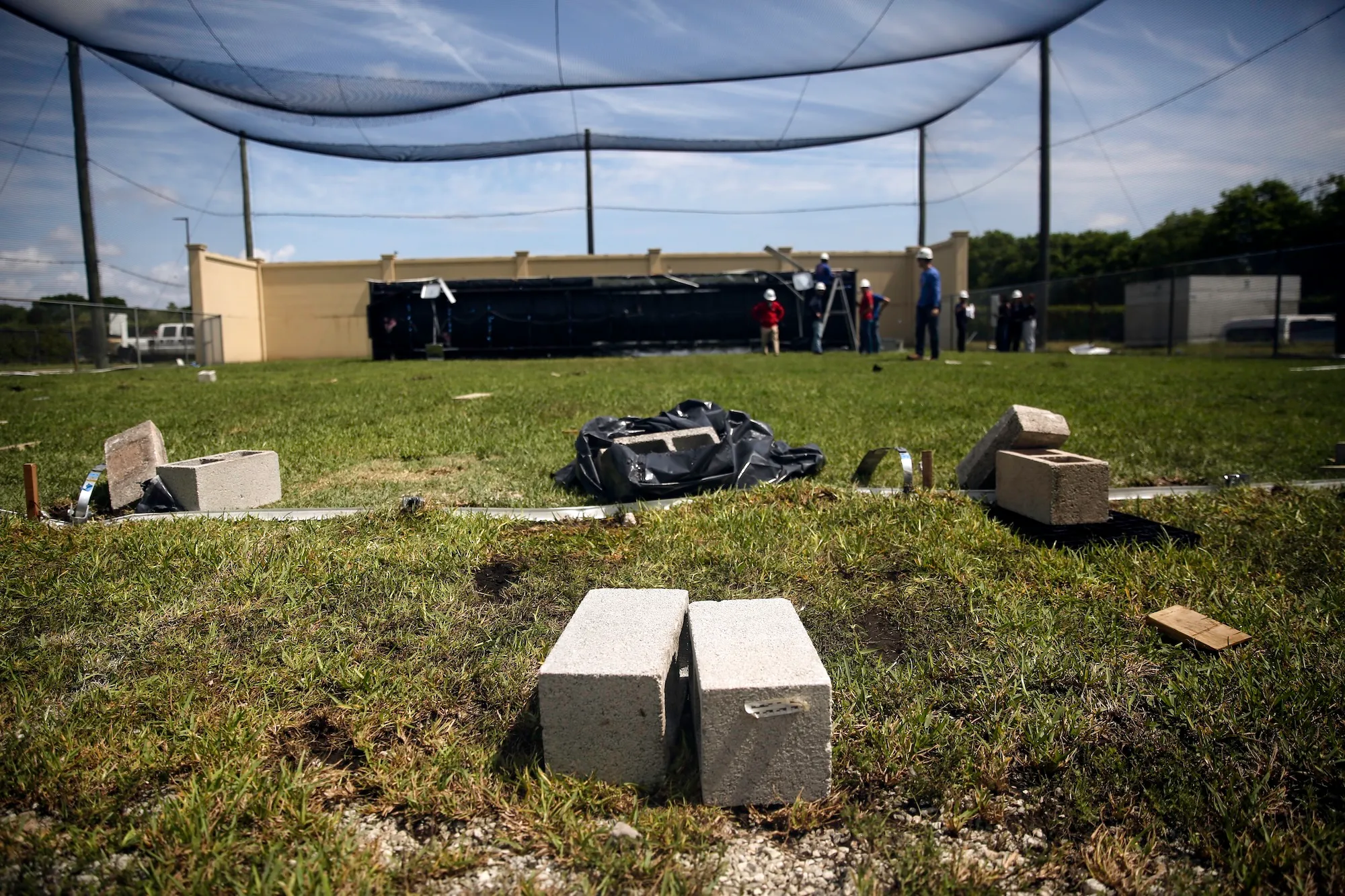
Two concrete support blocks remain in place after a manufactured home overturns during a wind test at Florida International University on May 13. Reshma Kirpalani
In the U.S., more than 20 million people live in manufactured homes — and many are being built in disaster-prone areas, like the Gulf. Unlike conventional homes, which are usually built on top of poured foundations (think of a tree with roots holding it into the ground), manufactured homes arrive ready to be installed above the ground (think more like a planter, which then needs to be bolted down for added stability).
“The first way a mobile home or manufactured home stays in place is just gravity,” Daniel told me. “It’s just heavy, and it sits on top of concrete piers.” Then there are anchors and tie-down systems that hold the home in place — but the rules for those systems depend in part on where it’s built. The Department of Housing and Urban Development, which administers the construction and safety code that governs all manufactured homes, divides the country into three regions. Wind Zone 1, where homes only need to be able to withstand winds up to 70 mph, is by far the most prevalent. The more restrictive zones 2 and 3 only apply to a relatively small subset of homes in hurricane-prone regions along the coast.
One hypothesis Sutley and her team had going into their Wall of Wind experiments was that Wind Zone 1 regulations are inadequate for the new realities of storms and winds that many areas are facing. Although they are still analyzing the data, their tests supported this.
Zone 2 and 3 regulations add vertical ties from the home to the ground, which, as Daniel told me, can go a long way toward resisting the upward lift that homes experience during extreme winds. Sutley believes that applying these stricter standards across the board could reduce the risk of homes coming unmoored — a relatively simple, and affordable fix.
“We’re not talking about pouring foundations, and we’re not talking about buying a different home or lifting it up,” Daniel said. “We’re talking about if you are anchored and bolted into the ground already, straps could be added, a system of metal struts could be put for additional bracing. These things are material costs and installation costs, they’re not additional new homes or relocation.”
Because manufactured homes are regulated by HUD, and often not subject to local building codes, a change at the federal level could be widely impactful. In his story, Daniel referenced a study that found more than half of new mobile home purchases over the past decade were going to Gulf states, especially Texas. “That’s predominantly Wind Zone 1 territory,” Daniel said. “We know from our reporting they’re experiencing a lot of flooding and higher winds and will be exposed to more storm damages in the future.
“If the code updates,” he added, “it means that this kind of blanket policy could improve millions of homes when the next storm hits.”
Sutley also plans to test manufactured homes against other types of extreme weather, Daniel said, like wildfires and seismic activity. For her, this research is personal. She had a harrowing experience living through a wave of tornadoes that swept through Alabama when she was a graduate student there.
“It really inspired me,” Daniel said. “This is a scientist who is reacting to a changing environment from firsthand accounts — not projections, but what has happened to her and her communities and what she’s seen over the years directly impacting her scientific research.”
Dive deeper:
More from Grist
🐟 Go, fish
Michigan tribes are working to restore the Arctic grayling, a culturally and economically significant fish that hasn’t been seen in local waters in nearly a century. The fish remain elusive, but tribal biologists are optimistic that their reintroduction efforts will yield results in years to come. Read more
🔋 On the grid
During a heat wave in California earlier this month, home batteries brought nimbleness to the grid, providing enough juice to power every home in San Francisco and San Jose during peak hours. It’s another sign that consumers will likely become more active participants in the grid as more people adopt tech like home solar, storage, and EVs. Read more
📽️ Set in concrete
John Wilson’s new documentary, The History of Concrete, shines a spotlight on the second-most used material on the planet — inviting us to pay attention to the banal, while also alerting us to the environmental disasters potentially waiting to happen as the short-lived material erodes around us. Read more
In other news
- UN delegates are gathering in Armenia to discuss biodiversity targets and shortcomings (The New York Times)
- A majority of Black voters support climate action. Like the high cost of living, it’s an issue close to home. (Capital B News)
- Dig into the state-level races that will matter the most for climate change this midterm cycle (Heatmap News)
- A bill to legalize balcony solar has been introduced at the federal level — though it’s unlikely to move until next year (Canary Media)
- The country just got a new national park: Chiricahua, in Arizona. But across the board, funding for parks remains low. (The Washington Post)
And finally, looking forward to …
… a resilient future for our structures and ourselves. This drabble comes from Looking Forward reader Heather Forbes.
🏡🏡🏡
Eloise programmed in increased UV protection and pressed send. The interface sent out the electromagnetic pulses that prompted the lichen structure to produce higher levels of parietin and melanin, which would help protect the structure and its associated algae and cyanobacteria. And help keep the inside cool, too.
She looked up. The morning sun was aglow through the lichen, picking out areas less full of photosynthetic cells. She stroked the wall gently. Eloise loved the lichen. In a mode of housing where the quality of your home infrastructure depended on how much attention you gave it, theirs did well.
— a drabble by Heather Forbes
🏡🏡🏡
A drabble is a 100-word piece of fiction — in this case, offering a tiny glimpse of what a clean, green, just future might look like. Want to try writing your own (and see it featured in a future newsletter)? We would love to hear from you! Please send us your visions for our climate future, in drabble form, at [email protected]
👋 See you next week!

