If you want to know what’s causing climate change and how it affects where you live, don’t turn to the Environmental Protection Agency for answers. The government agency purged basic facts about global warming from its website last week — including references to how human activity releases planet-heating carbon dioxide into the atmosphere.
The EPA’s page explaining the causes of climate change now focuses on how “natural processes,” like variations in Earth’s orbit and in solar activity, influence the climate.
“Human causes are not even on the list, which is simply misinformation. It’s false,” said Daniel Swain, a climate scientist at the University of California Agriculture and Natural Resources. “And moreover, it’s clearly deliberate, because a week ago, that page correctly reflected the scientific understanding of climate change.”
At least 80 pages related to climate change vanished from the EPA’s site in early December. It’s one of the most far-reaching removals of climate change information from government websites since President Donald Trump took office in January. “Up till now, we really had not seen hardly any changes on EPA pages,” said Gretchen Gehrke, who monitors federal websites with the Environmental Data and Governance Initiative.
While important resources have already disappeared from other government sites — including the National Climate Assessments, a series of congressionally mandated climate reports translated for public consumption — many of the previous changes were language swaps, replacing “climate change” with more innocuous phrases like “future conditions” or “extreme weather.” The EPA’s most recent overhaul represents a more radical rejection of mainstream science.
“Yes, there’s been climate information coming down, but so far it hasn’t actually necessarily been the nuts-and-bolts climate science information,” Swain said. “This is pretty fundamental physical science.” The resources on the EPA’s site were used by teachers, businesses, and local and tribal governments, as well as the public, since they translated the jargon-filled language of scientific reports into something more useful and accessible.
For example, the agency deleted a resource explaining the signals of a warming world — everything from rising temperatures and melting ice sheets to the damage toll on wildlife and human health — with more than 100 charts and maps. Also gone is a website quantifying the physical and economic risks. The effect is to isolate climate change from the issues that affect people’s lives, Gehrke said: “It’s specifically targeting the information about why we should care.”
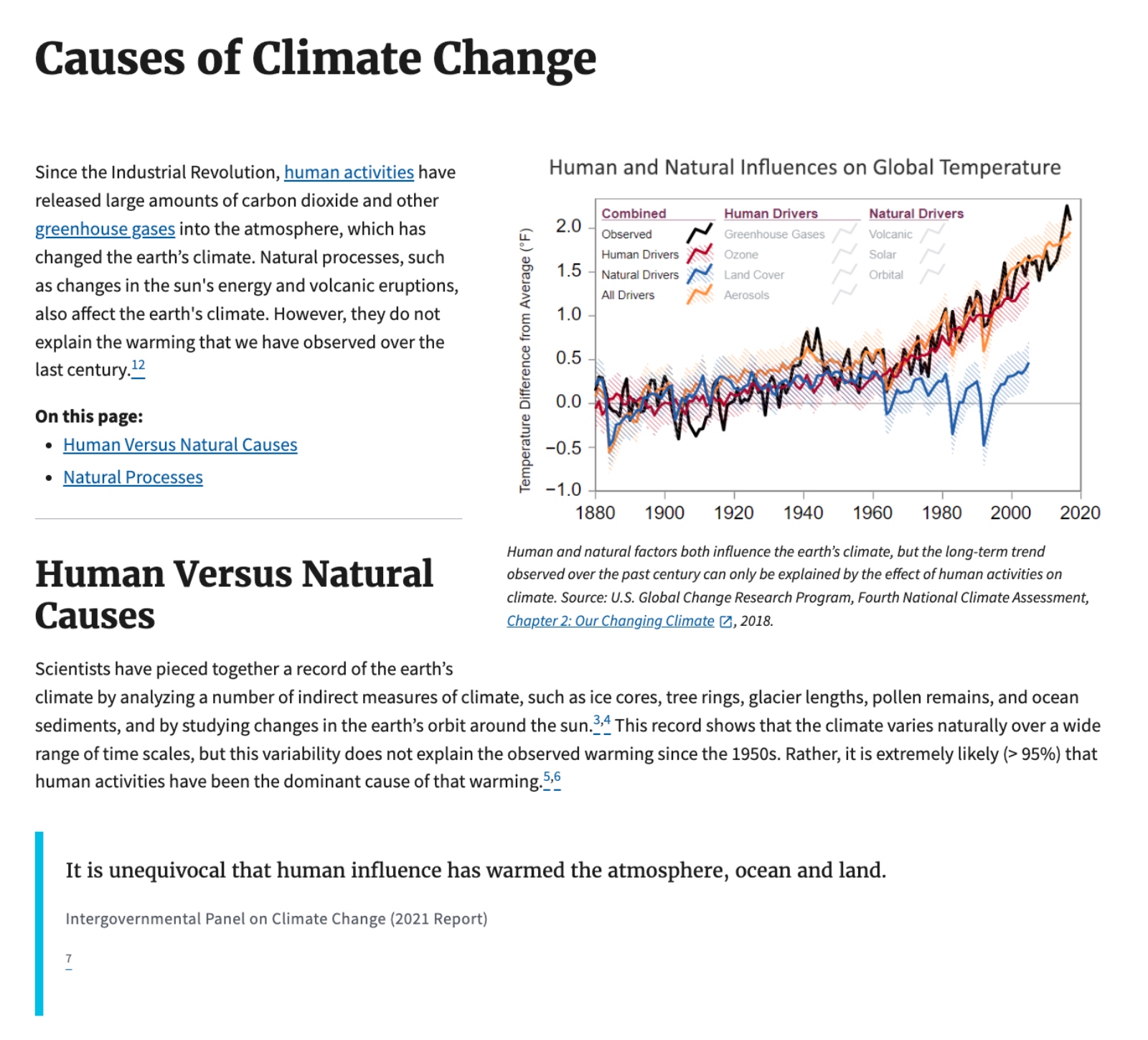
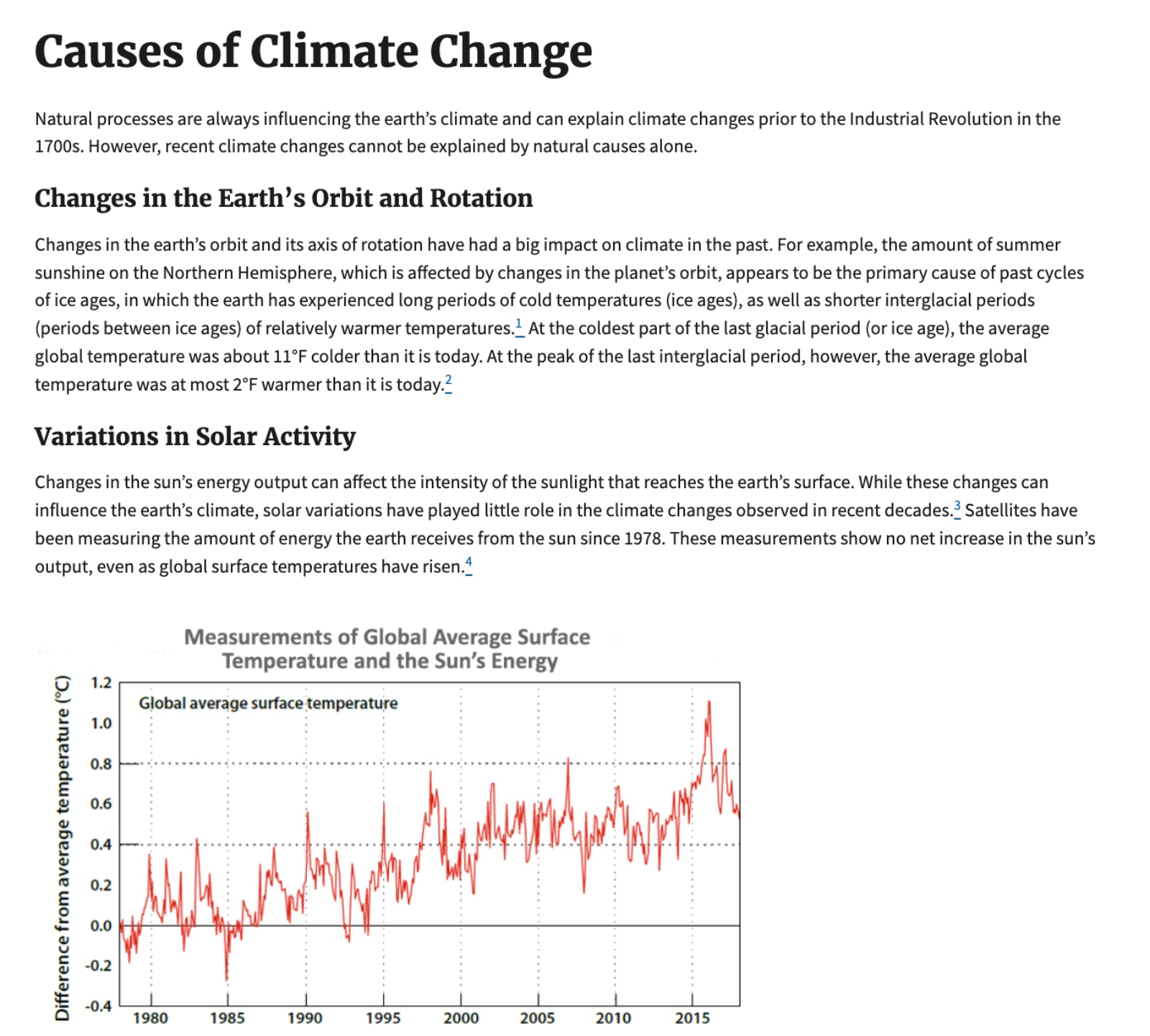
From left: An archive of an EPA webpage from October highlights how humans have contributed to climate change. By December, the EPA had updated its page on climate change to remove references to human activity. Courtesy Internet Archive; courtesy epa.gov
In response to questions about why the EPA’s climate change resources were removed, the agency said it was upholding “gold-standard science.”
“Unlike the previous administration, the Trump EPA is focused on protecting human health and the environment while Powering the Great American Comeback, not left-wing political agendas,” an EPA spokesperson said in a statement. “As such, this agency no longer takes marching orders from the climate cult.”
Swain said the changes could be a way for the EPA to bring its public-facing information in line with the proposal to reverse the agency’s own “endangerment finding,” the scientific basis that allows the EPA to regulate carbon emissions. The agency is expected to finalize the repeal soon, in what EPA Administrator Lee Zeldin has promised to be “the largest deregulatory action in the history of the United States.”
The changes to the EPA’s site are reminiscent of a report the Department of Energy released this summer, written by a group of five climate contrarians, arguing that climate change wasn’t as bad as mainstream scientists say. It can give people the impression that there’s a “debate” that climate change is a serious problem, when in fact there’s not, Swain said. If anything, the last several years suggest that the consequences of the warming that’s already arrived are worse than many scientists expected.
Official government websites used to be a source of unbiased information, but as federal agencies have altered them to align with the Trump administration’s talking points, some are becoming unreliable. The Centers for Disease Control and Prevention recently changed its stance on the relationship between vaccines and autism, with a new page saying that a link between the two can’t be ruled out — horrifying current staffers, who said their employer was spreading misinformation. Most information on government sites remains trustworthy, though. The National Weather Service, for instance, is still putting out accurate weather reports.
“Until very recently, despite all of the damage that has been done to trust in government institutions over the last several years, I would say that the government websites, agency websites, still were among the most trusted sources,” Gehrke said. “And I do worry that that is really slipping away very quickly.”
The result is that the public is left to navigate a landscape where some government agencies are sharing credible facts, while others are generating misinformation. At the same time, quality, unbiased information just isn’t as easy to access as it used to be. Search results increasingly turn up AI-generated slop, while social media algorithms serve up posts targeted to individual preferences, giving people an off-kilter picture of reality.
“Siloed information is really tearing apart society,” Gehrke said. “People are making logical choices and logical analyses based on the information they have, but they are working with completely different sets of information. And that is a real problem.”
A message from
Your support keeps our climate news free.
Grist is the only award-winning newsroom focused on exploring equitable solutions to climate change. It’s vital reporting made entirely possible by loyal readers like you.
At Grist, we don’t believe in paywalls. Instead, we rely on our readers to pitch in what they can so that we can continue bringing you our solution-based climate news. Donate today to keep our site free.