environmental justice
-
![]()
![]()
Could a Western wildfire be the country’s next Katrina?
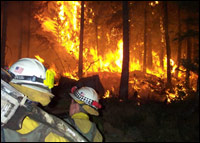
At the end of summer in southern Oregon’s Cascade foothills, when trees and brush have turned tinder dry and thunderstorms regularly roll overhead, Millie Chatterton and her neighbors start thinking about the lightning strike that could touch off disaster. The Biscuit burns in 2002. Photo: USFWS. Chatterton can’t forget the afternoon in 1987 when she […]
-
![]()
![]()
What green looks like to the world’s emerging economies
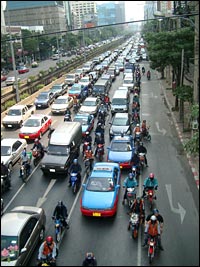
Give a child a hammer, they say, and everything is seen as a nail — or at least in need of a good pounding. Likewise, give an environmentalist a brush loaded with green paint, and she or he may set to turning everything one verdant hue. Pretty, perhaps, but problems can arise when well-off painters […]
-
Facts and figures on poverty in the United States
$35,000 — basic-needs budget for a U.S. family of four (two adults, two children), as calculated in An Atlas of Poverty in America 1 $19,157 — poverty line for a family of four (two adults, two children) in the U.S. in 2004, as established by the U.S. Census Bureau 2 $19,000 — amount spent by […]
-
Steve Frillmann, community-garden guru, answers questions
Steve Frillmann. With what environmental organization are you affiliated? I am the executive director of Green Guerillas, New York City’s oldest community-gardening group. What does your organization do? At Green Guerillas, we help people carry out their visions for what community gardens can be in a dense, vibrant urban area — urban farms, botanic gardens, […]
-
A virtual walking tour of Columbia, Miss., with Charlotte Keys of Jesus People Against Pollution
In 1977, a factory in Columbia, Miss., that had been manufacturing Agent Orange was rocked by an explosion. The owner, Reichhold Chemical Inc., shuttered the facility and abandoned or buried thousands of barrels of toxic waste near the water supply of the predominantly poor, African-American neighborhood where it had operated; flooding and leaks followed. In […]
-
Introducing a seven-week series on the intersection of economic and ecological survival
Consider this central paradox of U.S. environmentalism: In much of popular and political culture, the movement is dismissed as the pet cause of white, well-off Americans — people who can afford to buy organic arugula, vacation in Lake Tahoe, and worry about the fate of the Pacific pocket mouse. And yet, the population most affected […]
-
Evon Peter, director of Native Movement, answers questions
Evon Peter. What work do you do? I am the executive director of Native Movement. What does your organization do? Native Movement is a collective of around 15 organizers who work on a myriad of projects focusing on youth leadership development, sustainability, protection of sacred sites, and social, political, economic, and environmental justice. We work […]
-
Kipchoge Spencer of Xtracycle and Worldbike answers questions
Kipchoge Spencer. What work do you do? I’m president of Xtracycle Inc. and cofounder of Worldbike. I’m also lead singer of the Ginger Ninjas. What does your organization do? Xtracycle invented and makes car-trip-replacing, life-enhancing, sport-utility bicycles, long bikes, and the FreeRadical Hitchless Trailer — for toting your kids to school, loading up with groceries, […]
-
Jay Tutchton, head of environmental law clinic, answers questions
Jay Tutchton. What work do you do? I am the director of the Environmental Law Clinical Partnership at the University of Denver, Sturm College of Law. We introduce law students to the world of public-interest environmental litigation and train them in the basic skills of the trade, and we file the best lawsuits we can […]