living green
-
Things I don't like to see on my soap label
Warning: Trivial content ahead. Do not read if you are seeking the latest developments regarding carbon taxes, coal, or cap and trade.
My quest for a suitable hand soap has become somewhat epic in scope. Said soap must meet several criteria: a) an ingredient list that doesn't make me squirm; b) a reasonable price point; c) a scent that doesn't make my fella wince.
More often than not, my quest is shelved by the logistical hiccup known as "we ran out of soap" -- in which case I end up at the local grocery store, scouring labels and sniffing scents and getting frustrated and generally looking like a crazy old soap lady.
-
Seattle museum opens coffee exhibit, downs third cup of the day
 Photos by Andrew Waits.
Coffee culture is king in Seattle. Whether it's because of the eternally gray weather, the cool, rainy climate, or our inability to socialize outside a dimly lit café, there's no denying the importance of the caffeine bean in a Seattleite's daily life.
And certainly we've earned our rep as a highly caffeinated metropolis, with more coffee shops per capita than anywhere else in the country -- many of them artisanal roasters selling specialty coffees. But the story of your steamy mug of joe doesn't begin and end with a moody barista.
 In fact, it probably started in the hands of someone like Edwin Martinez, a third generation coffee grower who has been picking coffee beans in Guatemala with his family since he was a young boy. From there, they may have passed through a co-op set up to help small farmers process and market their beans. Then they'll move on to someone like David Griswold, the founder of Sustainable Harvest, a specialty coffee importer who bridges connections between the farmers in tropical coffee-growing nations and the roasters in, say, Seattle.
The roasting process will awaken the coffee beans' complex aromas and flavors -- and they'll soon be passed from barista to half-awake patron. And though you might be sipping on a half-caf soy latte with sugar-free vanilla syrup, you've really got the whole world in your cup.
It's this story that a new exhibit at Seattle's Burke Museum aims to tell. Opening weekend of Coffee: The World in Your Cup featured exhibit tours, coffee tastings, and informative talks by Martinez, Griswold, and University of Washington professor Max Savishinsky. "We're really putting a huge topic in a small space," said Education Director Diane Quinn.
-
![]()
![]()
From Chia to Chard
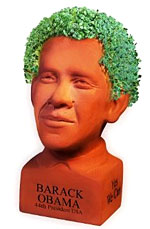
Chia leader The grass is always greener on the other side of the Atlantic. And speaking of decorative planters: It’s O-O-O-bama! She’s a poet and didn’t gnaw it Two buses diverged on a road, and I / I bit the driver of the one less traveled by / And that has made all the difference. […]
-
Images of an evolving world by artist Don Simon
These images are from a series of drawings titled “Unnaturalism” by artist Don Simon. His work examines the impact of industrialization and sprawl on ecosystems. From his artist statement: “Throughout history, particularly since the beginning of the Industrial Revolution, mankind has been less than kind to our cohabitants on the planet. We build, produce, and […]
-
Take the chill off the bad economy with a frugal, delicious vegetable soup
Photo: Library of Congress In our food system, the part of the animal that delivers the most flavor — the bones — often gets thrown away. Purveyors then sell the boneless meat at a higher price. During hard times, such wasteful practices come into relief. We explore humbler, bone-in cuts of meat and underappreciated vegetables. […]
-
Shorter work week as stimulus
Economist Dean Baker (co-director of the Center for Economic and Policy Research and one of the good guys in that dismal profession) takes up one of my pet obsessions: a shorter work week:
One innovative policy that would provide a quick boost to the economy and jobs -- and lasting gains in reduced unemployment -- is a tax incentive for shorter workweeks or work years.
...
How would this help the economy? The tax break would allow the employer to compensate workers for fewer hours up to some limit, say a maximum of $2,500 per worker. That would cut work hours but maintain staffing levels.
As a result, workers would be getting just as much money as before the reduction in hours -- but putting in 10% fewer hours. If workers have the same amount of money, then demand in the economy will be the same. At the same time, firms would then need to hire more workers to meet this demand, since they would be getting 10% fewer hours from each worker.I once did a column in Fast Company on the ecological benefits of a shorter work week. This seems like one of those things that's substantively win-win but sociopolitically completely out of reach. People have weird attitudes about work.
-
Foodie photogs, rainforest adventures, and more
Every week, we compile a guide to the greenest goings-on in our hometown. We send it by email — sign up here! — and now it’s available in Gristmill. (Not in Seattle? Not a problem — we’ve got the inside scoop for you out-of-towners, too.) —– Combo meal: Elliott Bay Books is serving up a […]
-
Toymakers bank on kids' love of trash
Announcement: you can now buy toys made from recycled items like water bottles and Styrofoam cups. Or you could ... give your kids water bottles and Styrofoam cups to play with.
-
When to change that light bulb
"Often when I'm on TV, they'll ask what are the three most important things for people to do [to stop global warming]. I know they want me to say that people should change their light bulbs. I say the number one thing is to organize politically; number two, do some political organizing; number three, get together with your neighbors and organize; and then if you have energy left over from all of that, change the light bulb."
-- writer and activist Bill McKibben