state politics
-
State illegally approves new coal-fired power plant
Update: The permit that was approved this week by the state Air Pollution Control Board does not contain the "out clause" for mercury emissions. Information from an SELC statement was incorrect, and they have apologized.
Under heavy pressure from lobbyists for Dominion Virginia Power, Virginia announced yesterday that it will permit the construction of a new coal-fired power plant, even though doing so clearly violates the law.
Just days after NASA's James Hansen testified that avoiding climate catastrophe will require immediately stopping construction of new coal-fired power plants around the world (and shutting down old ones), and just months after the Supreme Court ruled that carbon dioxide is a pollutant under the Clean Air Act, Virginia decided that what the state and the world really need is another coal fired power plant with no controls on release of carbon dioxide -- and gave Dominion the go ahead to build their "Hybrid Energy Center" in Wise County in Appalachia (hybrid because it will burn two different types of dirty coal).
That's in clear violation of the law, as Cale Jaffe, senior attorney for the Southern Environmental Law Center testified, since the Supreme Court's ruling in Massachusetts vs. EPA, states are required to implement the best technology available to control carbon dioxide -- which were the grounds Kansas used when it rejected a similar power plant proposal. And even though Virginia's decision did tighten some sulfur dioxide and other pollution limits (Chesapeake Climate Action Network's Susanna Murley has more on why this is a partial victory), it still includes an "out clause" that would permit Dominion to emit unlimited quantities of mercury -- another clear violation of the Clean Air Act.
-
Considering recycled energy will politically facilitate a national clean energy plan
There is a tendency to frame the politics of clean energy as a debate between the enlightened, forward thinkers on the coasts and the paleolithic environment-hating coal barons in the Southeast and Midwest. It makes a good sound bite, but confuses the ends and the means. Yes, there are strong vested interests in the coal belt and the rust belt that consistently resist GHG caps and clean energy policy. But so long as we frame the clean energy conversation as a wealth transfer from dirty states to clean states, our success will remain contingent upon our ability to get senators, representatives, and voters in those states to act against their near-term economic self interest.
Three maps below clarify the problem, and suggest a solution.
-
RPS distribution
Check out this map (click for a larger version). It shows states with renewable portfolio standards in orange. A swath of white goes from the southeast to the upper midwest. Tells you quite a bit about the political playing field on clean energy and how it maps to party. Taken from Senate EPW cmte. testimony […]
-
New Yale green site draws attention to state climate efforts
I think various Grist contributors have linked over there a few times already, but I’ve been remiss in not explicitly noting the debut of environment360, the new online publication from the Yale School of Forestry & Environmental Studies. It’s come out of the gate with a bang, with pieces from high-profile writers like Bill McKibben, […]
-
U.S. Senate candidate Scott Kleeb and the clean energy roundup
Fresh from an overwhelming primary victory in Nebraska's U.S. Senate race, 32-year-old rancher, Yale Ph.D., and college history teacher Scott Kleeb spoke with me on the phone about his "brand of change" for a clean energy economy and the environment.
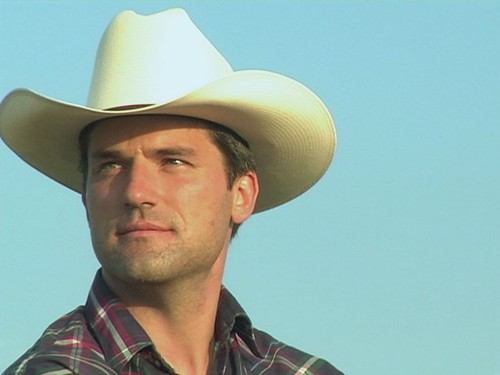
Kleeb shocked the political establishment in 2006 by getting 45 percent of the vote in Nebraska's 3rd Congressional District, one of the most Republican districts in the country. Then, as now, he ran as a clear progressive on most economic and environmental issues (while staying coy on some contentious social issues).
One of Kleeb's core concerns has been meeting the challenge of the climate crisis through a clean energy revolution on the prairie and through aggressive use of domestic and international forest and farm carbon credits. Through it all, Kleeb has been aided by a huge renewable resource of his own: megawatt good looks that won him "The Hot Rancher" award from Young Voter PAC.
Now Kleeb is hoping his unique combination of deep Nebraska roots, Ivy League cred, and movie star charm will help him overcome his opponent: President Bush's former agriculture secretary (and former Nebraska governor) Mike Johanns, who's based his career on support for Big Ag, free trade, and fossil fuels.
Q. Where do you see Nebraska's economic future, and what role do you think clean energy will play in it?
A. We've got to transform the way we produce and consume energy. There's a failure of leadership we've seen at all levels of government. We've got to figure out how to do more with less. That's true of our elected officials and true of ourselves as individuals. This is a generations-long process. We are on the cusp of it right now. Biofuels and wind energy and solar energy and algae-based energy is just the tip of the iceberg.
Nebraska's economy is going to be transformed by that revolution. Farmers will find new ways of feeding or, once we get to cellulosic ethanol, fueling the world.
Q. Recent studies have suggested that devoting American land to growing biofuels instead of food is causing massive deforestation in carbon-rich tropical forests. How can switchgrass and cellulosic ethanol be viable if it's just causing food to be grown in these highly sensitive ecosystems thousands of miles away?
-
Senate race takes shape in New Mexico
This got lost in the flap over the Climate Security Act yesterday, but via Politico, on Tuesday night Rep. Steve Pearce narrowly won the Republican Senate primary in New Mexico. He beat out Rep. Heather Wilson by a margin of 51 to 49 percent in the contest to see who will replace GOP Sen. Pete […]
-
New report calls for climate action, but not everyone’s listening
With more coastline than any state in the lower 48 and about a tenth of its economy ($65 billion a year) based on tourism, Florida has more to lose than any other state from the threats of global warming. Rising sea levels creep closer to coastal development. Warmer tropics fuel stronger hurricanes. And higher ocean temperatures kill coral and harm fish populations, threatening the state's $4.5 billion sportfishing industry.
Plenty of reasons that a report released yesterday should serve as a call to action on preparing for inevitable changes from global warming and cutting emissions now to avoid the worst impacts. Preparing for a Sea Change in Florida was produced by a broad coalition of environmental groups.
The report makes several key recommendations:
-
Great new video on state efforts to tackle global warming
Sea Studios has put together a fantastic new video called "Ahead of the Curve: States Lead on Climate Change." Check it out: You might also remember their previous video, “Ahead of the Curve: Business Leads on Climate Change.” Here it is:
-
North Carolina bill would ban burning of coal from mountaintop-removal mining
On Tuesday, North Carolina State Rep. Pricey Harrison introduced legislation in the state House that would ban the burning of coal obtained through mountaintop-removal mining. If it passes, North Carolina would become the first state in the nation with such a law. The mining method isn’t practiced in North Carolina, but 61 percent of the […]
