Climate Climate & Energy
All Stories
-
Cool idea of the day
Floating wind turbines that can be placed farther out at sea (and in heavier wind) than typical anchored offshore turbines. Next: high-altitude wind!
-
San Francisco approves giant solar incentive program
San Francisco has become the proud owner of the largest municipal solar program in the United States. The Solar Energy Incentive Program, approved by the city board of supervisors on Tuesday, will provide rebates to home- and business owners who install solar panels on their buildings. Individuals can receive up to $6,000; businesses can be […]
-
Vaccine, nut oil may cut cow belching’s contribution to climate change
The worldwide race to quell livestock belching is on! Earlier this month, New Zealand researchers came one step closer to developing a vaccine that would reduce the methane emitted from belching livestock. Ruminant livestock burp and fart significant quantities of methane — a powerful greenhouse gas that contributes to climate change. “Our agricultural research organization […]
-
Upward from the Climate Security Act
Climate Solutions Policy Director K.C. Golden has some thoughts on where to go with national climate legislation after last week's down vote on the Climate Security Act.
As thunderstorms and tornadoes ripped through the nation's capital last week, the U.S. Senate tied itself in a procedural knot, preventing a vote on the substance of the Climate Security Act -- the first meaningful climate legislation to reach the Senate floor.
Senate Majority Leader Harry Reid called it "the most important issue facing the world today." But the minority stalled -- insisting on a full reading of the nearly 500-page bill -- while the storm raged outside. Once again, the "world's greatest deliberative body" did nothing about the world's biggest problem.
Twenty years after our preeminent climate scientist Jim Hansen warned Congress of the need for immediate action, this dilly-dallying is enough to make you scream.
-
![]()
![]()
I’ve got the 450-ppm solution about right
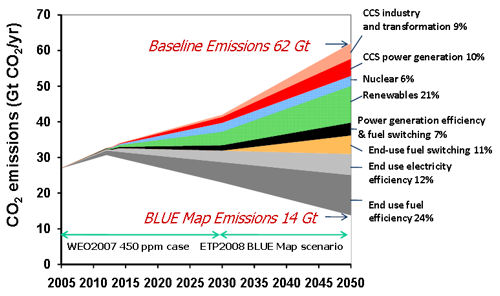
Part 1 discussed the basic conclusion of the new International Energy Agency report -- cutting global emissions in half by 2050 is not costly. In fact, the total shift in investment needed to stabilize at 450 ppm is only about 1.1 percent of GDP per year, and that is not a "cost" or hit to GDP, because much of that investment goes toward saving expensive fuel.
In this post, I will discuss the basic solution IEA is proposing. I will also start to look at how the report is too pessimistic about renewables, and thus it overestimates costs. In their business-as-usual baseline, neither solar thermal nor solar photovoltaics are ever commercially competitive. Part 3 discusses IEA's very dubious assumptions in the transportation sector. The IEA assumes the price of oil is half of current levels and is frozen at $65 a barrel from 2030 to 2050. I kid you not. That is a key reason their marginal price of CO2 is so absurdly high.
My central argument in recent months has been that stabilizing at 450 ppm requires about 14 wedges -- carbon mitigation strategies deployed over a few decades that ultimately each prevent the emission of one billion tons of carbon annually (see here). The IEA comes to almost exactly the same conclusion, and has relatively similar wedges, so I view this report largely as a vindication of my analysis.
-
ASUW student body transcends State and Federal legislators
A resolution opposing current Washington State biofuel policies (website not yet updated to reflect acceptance of resolution) passed in the University of Washington Student Senate on the third of June.
The Associated Students of the University of Washington are, to my knowledge, the first legislative body in the country to take this bold step.
The following is a brief history of how it came to be:
-
When taking pride in your roots means breathing local coal dust
May I suggest that literally sharing a part of your local history can, in fact, be taken too far? Snipped from The New York Times: “Coal is part of us,” said William Liptok, director of the county’s public works department. Not only does nearly every family in town have roots in mining, Mr. Liptok said, […]
-
Climate change, deforestation, erosion take toll on African landscape
A new United Nations atlas depicts alarming changes to Africa’s landscape. On a continent that produces a mere 4 percent of the world’s greenhouse-gas emissions, significant landmarks are taking a hit from climate change: Lake Chad and Lake Victoria are shrinking each year, and Mt. Kilimanjaro could be snow-free by 2020. The deforestation rate in […]
-
Today’s gas consumption shows that price increases are only one part of the solution
As SUV sales plummet and gasoline use finally drops, one meme spreading around is, "Looks like people respond to price after all." The implication seems to be that any demand response other than zero proves that prices are wonderfully effective.
The problem, however, is not response is or might be zero. (I can think of few who ever claimed that.) The problem is that it takes a big price increase to produce a small response.
The current data support the conventional wisdom: 40 to 50 percent long-term elasticity, low enough to discourage us from relying on price as the main means of reducing emissions, high enough encourage us to use price as one among many means. At first glance, the raw data are even more discouraging than the conventional wisdom: Inflation adjusted gasoline prices have risen almost two-and-a-half times since 2000. Gasoline demand has dropped by slightly over 20 percent. But long-term elasticity is, by definition, a delayed response -- at least three years.
Also, if we are interested in price response as opposed to income response, we have to adjust for growth in GDP. So a rough calculation yields 45 percent long-term elasticity (with some biases that probably overstate the result). Here are two graphs, the first of raw data, the second after adjustment (click for larger versions):