Climate Food and Agriculture
All Stories
-
The city that ended hunger did it by going local
What struck me in Frances Moore Lappé’s piece at Yes! on Belo Horizonte, Brazil — the city that ended hunger — was how simple the solution was: [The city] offered local family farmers dozens of choice spots of public space on which to sell to urban consumers, essentially redistributing retailer mark-ups on produce — which […]
-
The National Pork Board tries to spin Nick Kristof's MRSA column
In the wake of Nick Kristof's column on MRSA infections among hog farmers, Obamafoodorama found evidence of Big Pig (the National Pork Board) conspiring with the CDC in prepping its response. And after all that, this is the best they could come up with:
"They are making a huge leap attributing MRSA in these people to hogs," says Angela DeMirjyn, science communications manager for the National Pork Producers Council (NPPC). The pork organization has been researching MRSA for some time, says DeMirjyn, and supports the CDC's statement that most community acquired MRSA infections are caused by a different bacteria than is commonly associated with pigs or pig farms.
There. Now don't you feel better? They're all over it like flies on, well, you get the point. They have, as that nameless intelligence bureaucrat assured Indiana Jones as regards research into the Ark of the Covenant, "top men working on it right now." Top men, indeed.
But wait, there's even more rhetorical emptiness waiting for you:
"We also know that MRSA is not just staph bacteria that can be found in pigs, it also can be found in horses, dogs and even marine animals. It is not a problem that is solely related to pigs," DeMirjyn says.MRSA, in fact, can be found anywhere in nature, according to Paul Ebner, a livestock microbiologist at Purdue University. While he says there has been an increase in the number of these infections and that pigs and other animals can be carriers, the vast majority of infections come from skin-to-skin contact with infected humans.
File that under "Beside The Point."
You know, I think these folks just might be panicked. Funny, Tom Philpott and I (at Ezra Klein's blog) covered the "MRSA in pigs" issue recently - it didn't get quite this reaction. I guess the Gray Lady has life in her yet.
-
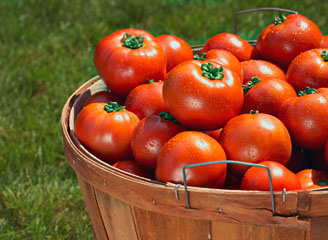
In industrial-tomato country, workers suffer squalid living conditions and even slavery
Note: Last week, I visited Immokalee, Fla., with nine other food-politics writers and activists. We were there to check out conditions in the area where 90 percent of winter tomatoes consumed in the U.S. originate. Part I of my diary is here. ——— Update [2009-3-13 15:3:13 by Tom Philpott]: After refusing for two years, Florida […]
-
Would new food-safety legislation 'criminalize organic farming'? No
The Internets are abuzz with accounts of a House bill, allegedly sponsored by Monsanto and pushed through Congress by its lackeys, that would "criminalize organic farming" and even backyard gardening. The object of frenzy: H.R. 875, known as the Food Safety Modernization Act of 2009, a bill that attempts to bolster the broken food-safety system.
Here's how one critic, whose work circulates widely on sustainable-food listservs, characterizes it:
The bill is monstrous on level after level -- the power it would give to Monsanto, the criminalization of seed banking, the prison terms and confiscatory fines for farmers, the 24 hours GPS tracking of their animals, the easements on their property to allow for warrantless government entry, the stripping away of their property rights, the imposition by the filthy, greedy industrial side of anti-farming international "industrial" standards to independent farms -- the only part of our food system that still works, the planned elimination of farmers through all these means.
Wait, did she just say "the planned elimination of farmers"?
I've been reading hysterical missives about H.R. 875 for weeks. I could never square them with the text of the bill, which is admittedly vague. For example, the bill seeks to regulate any "food production facility" which it defines as "any farm, ranch, orchard, vineyard, aquaculture facility, or confined animal-feeding operation."
But then again, the USDA already regulates farms. And "24 hours GPS tracking of ... animals"? Not in there. "Warrentless government entry" to farms? Can't find it.
More recently, reading around the web, I found more reasoned takes on H.R. 875. The bill may not be worth supporting -- and from what I hear, it has little chance of passing. But it hardly represents the "end of farming," much less the end of organic farming. The Organic Consumers Association, an energetic food-industry watchdog, recently called the paranoia around H.R. 875 the "Internet rumor of the week."
-
![]()
![]()
The case for — and against — eating those suddenly pervasive, stinging sea creatures
In Checkout Line, Lou Bendrick cooks up answers to reader questions about how to green their food choices and other diet-related quandaries. Lettuce know what food worries keep you up at night. Beach menace — or dinner? Dear Checkout Line, I’ve heard that jellyfish are plentiful and that we should eat them. I want […]
-
We need to reform America's food safety system from the farm up
Another day, another disaster...
In 1906, Upton Sinclair published his classic book The Jungle, awakening America's consciousness to the horrors of corruption in the U.S. meatpacking industry with the story of Chicago's stockyards. The Jungle so shook the American people's confidence in how their meat and food was processed, that President Roosevelt created the Food and Drug Administration to quell public outcry.
Fast-forward a hundred odd years later and all evidence points to the fact that we are living in an era of food crisis that rivals that of the turn of the last century. Regretfully, America's modern food system has become The Jungle 2.0.
Indeed, there have been prodigious grumblings from Washington, D.C., over food safety issues in the past months. Thanks to the current peanut butter fiasco from the now bankrupt Peanut Corporation of America, our nation is once again in the throes of a record food safety recall, signaling that we need a serious overhaul of our nation's food safety system and the industrial food model.
America's current food system has the potential to create an epidemic food safety crisis much larger than that even Sinclair or Teddy Roosevelt could imagine. For a variety of reasons, including the corrosive influence of agribusiness corporations and lack of government funds, staff, and training, we now live in a world where food safety in America is on the verge of facing a collapse similar to those of our recent financial, mortgage, and housing industries.
-
Popular fumigant found to be a potent greenhouse gas
Update [2009-3-14 16:17:10 by Tom Philpott]:The original version of this post, titled "Strawberry Surprise," contained errors that I regret. I had mistakenly read the below-linked account of an MIT study to mean that sulfuryl fluoride was registered for use by the EPA as a pre-planting fumigant for strawberries. Actually, the chemical is registered only for post-harvest use on food, as well as a structural fumigant for termites. I also reversed the phrases "methyl bromide" and "methyl iodide" on two occasions. Again, I regret these errors.
-----------------
Chemical fumigants are a staple of the industrial-food system. They're used to sterilize soil before planting large monocrops, and also to control pests in stored food like grain and dried fruit. The building industry, too, uses them, mainly to fight termites. In the past, fumigants have caused much environmental damage, and tend to be quite toxic for humans, too. Now comes news that the building industry's new favorite fumigant -- sulfuryl fluoride -- is a greenhouse gas 4,800 times more potent than carbon dioxide, according to a recent MIT study.
-
Paul Roberts' MoJo article on farming gets big idea right and details wrong
I like Paul Roberts. I liked his book The End of Food. But I must admit that I was a bit underwhelmed by his recent article on sustainable farming in Mother Jones, "Spoiled: Organic and Local Is So 2008." That's not to say there's nothing to recommend it. His central premise -- that we way we're farming today isn't sustainable and that no large-scale model of what sustainable agriculture would look like currently exists -- is valid and important (as anyone who hangs out around here is well aware).
And any article that gets its money quote from sustainable ag guru Fred Kirschenmann is certainly on the right track. Said Kirschenmann, "We've come to see sustainability as some kind of fixed prescription -- if you just do these 10 things, you will be sustainable, and you won't need to worry about it anymore." Which isn't true, of course.
But that title! Shouldn't it be "conventional agriculture" that's so 2008? Meanwhile, there were far too many straw men in the article for my tastes (ever eaten a straw man? Blech!) Take, for example, the thought experiment supplied by environmental scientist Vaclav Smil on the effect of totally eliminating the use of synthetic fertilizer:
Such an expansion, Smil notes, "would require complete elimination of all tropical rainforests, conversion of a large part of tropical and subtropical grasslands to cropland, and the return of a substantial share of the labor force to field farming -- making this clearly only a theoretical notion."
That's probably accurate as far as it goes. But it's unclear how he modeled this version of organic agriculture - at a minimum it appears to be a vast oversimplification. And his conclusion then becomes the basis upon which to reject the whole organic concept. Meanwhile, look at one of Smil's central assumptions -- that "dietary habits remain constant," i.e. in his experiment we're all eating as much meat, high-fructose corn syrup, and processed foods as we are now. Well, to take one example, you don't have to look far to find folks who will tell you that current meat consumption, especially red meat consumption, is the sine qua non of unsustainability -- Roberts himself held forth at length on that very point in his book. By holding that constant, you've just pre-determined the outcome of your thought experiment. And look at a crucial element in Smil's calculation -- that he's trying to determine "the extra land we'd need for cover crops or forage (to feed the animals to make the manure)." Now I don't know for sure if he presumes the forage will be pasture or cereal (aka corn), but either way that's a pretty high bar he's set.
-
![]()
![]()
The human cost of industrial tomatoes
Do you know who picks your tomatoes? As Tom Philpott discovers during a trip to Florida tomato country, farmworkers suffer low wages, squalid living conditions, and even slavery.
-
Alice Waters' move into the political sphere is hitting some bumps
I'm hesitant to step in the middle of any debate over Alice Waters' contributions to food policy. But suffice it to say that, as she moves more and more aggressively into politics, she is taking some hits. Ezra Klein sums up the Alice Waters paradox this way:
Good food -- the sort Waters features at her restaurant -- is considered a luxury of the rich rather than a social justice issue. As Waters frequently argues, no one is worse served by our current food policy than a low-income family using food stamps to purchase rotted produce at the marked-up convenience store. Her vision is classically populist: It democratizes the concrete advantages -- health, pleasure, nutrition -- that our current food system gives mainly to the wealthy. But her language is suffused with the values and the symbols of, well, the sort of people who already eat at Waters' restaurant. Thus, in promoting an agenda that benefits poor people with little access to fresh food, Waters tends to communicate mainly with rich people interested in fine dining.
She's been fighting the elitist tag for some time -- as well as a reputation for being a bit, well, overbearing. According to a recent article in Gourmet, she overwhelmed even former President Clinton years ago with her passion over a White House vegetable garden. After receiving a letter from the Clintons suggesting that a front-lawn vegetable garden wasn't in keeping with the formal landscaping of the White House, Waters couldn't restrain herself:
[S]he fired off another letter. Apologizing for "being so insistent," she begged to differ, reminding him that "L'Enfant's original plan for the capital city was inspired by the layout of Versailles, and at Versailles the royal kitchen garden is itself a national monument: historically accurate, productive, and breathtakingly beautiful throughout the year."
It was the end of their correspondence.Ouch. And the Obamas, while unfailingly polite in person, have so far resisted Waters' attempts to be pulled into their circle of informal advisors. Having nothing to do with Waters, it's well-known that hobnobbing with aesthetes can be dangerous to your electoral prospects and the fact remains that Waters is, at heart, just that.