Climber Alex Honnold is best-known for his daring feats, recently scaling Taiwan’s Taipei 101 tower live on Netflix, but he’s more typically climbing some of the world’s most challenging natural landscapes. But he’s also an advocate for renewable energy, and the foundation he started, the Honnold Foundation, supports community-led solar energy growth around the world.
How do those two interests fit together? For Honnold, the connection seems clear. “Go on enough trips like this,” he said, referencing his climbing trips to remote locations, and “you just see how much it matters.”
“A lot of these projects basically help protect the land in a way that you wouldn’t necessarily assume,” he said. “Empowering local communities is always a good way to protect the land on which they live.”
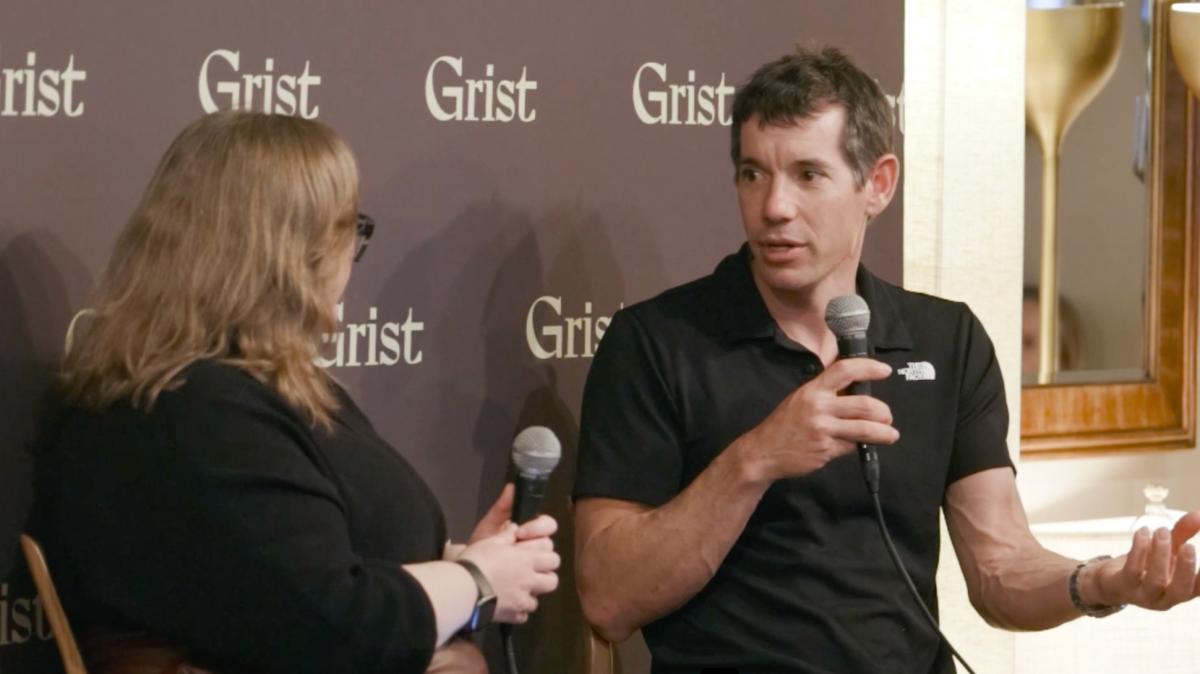
Honnold was interviewed by Grist Editor-in-Chief Katherine Bagley at Grist’s live event Turning the Tide: Stories of Climate Solutions, held during San Francisco Climate Week.
In his own climbing experience, Honnold shared, he’s seen how landscapes have changed even in the span of just a few years due to rising temperatures. “A lot of things that used to be approaches or descents up snowy couloirs … those are mostly melted out,” Honnold said. “Basically, big mountains you see change very quickly right now. It’s pretty sobering.”
But he also emphasized the need for positive stories that help people understand that progress is happening. “I personally am just not inspired by pessimism at all,” he said. “The environment has been severely degraded, we’ve lost a lot for sure, but if you were just dropped onto this planet right here, right now, and you just looked around in the natural world, you’d think, ‘This is incredible.’ There’s so much life, the natural world is still amazing, and there’s still so much to protect.”
Watch the full video of the event, including Honnold’s interview, or read a few excerpts (lightly edited for clarity) below.
Katherine Bagley: You and I are about the same age, and I remember as kids growing up in the ‘80s and ‘90s, it was like the recycling ads and the oil spills and that we had to save the ozone layer. And I’m curious when climate became part of the conversation for you.
Alex Honnold: Yeah, honestly, I’m not sure. None of those things really speak to me. I think that I was probably not that environmentally aware as a child. I mean, my parents are both professors. I grew up in Sacramento, just sort of a suburban California kid. And I think those weren’t big things in my house. I don’t think either of my parents were profound environmentalists in any way, even though we went camping and stuff, but that’s kind of different.
And so I think it really was as I started to travel as a rock climber and go on expeditions. I mean, basically I just started reading a lot more. I read a ton of environmental nonfiction and just started to care a little more and then to see a little bit more. And sort of seeing some of the links between energy access and global poverty and climate change — basically the transition to renewables. And those are all things that I was kind of interested in starting in, I guess 2009.
Basically when I started doing some of my first overseas rock climbing expeditions, I was like, “Oh, I care about the way the rest of the world works and I’m interested.” And really the more I learned, the more it was like, “Oh, this seems important. This seems like something I should be more stressed about.”
Emily [Teitsworth, executive director of the Honnold Foundation] was just talking about Kara Solar, this organization that the Honnold Foundation supports in the Ecuadorian Amazon. And this is in Guyana [referencing an onscreen photo], which is the other side of the Amazon. It’s a different river base and everything. This is called a tepui. It’s like this giant rock face. And this was an expedition for a TV show in National Geographic. But anyway, we basically took river transit boats all the way to the end of the river kind of thing, and then walked for a week through the jungle to get to these walls.
And so, I mean, I think that has really helped inform my environmental activism. Do you call it activism? Basically, the reason I care. And it’s that you go on enough trips like this and you’re kind of like, Well, we took two-stroke gas-powered boats to the end of the fricking world and then hiked for a week into the jungle to go climb this wall. And you see how these communities — basically you just see how much it matters.
* * *
Bagley: Have you noticed climate change or other environmental impacts that have impacted some of your favorite places to climb?
Honnold: Yeah, I mean, one of my favorites is Yosemite. And so you don’t really see climate change impacts in Yosemite that much. I mean, other than beetle kill and obvious things like that, where you’re sort of like, “Oh, the forests have changed composition very quickly,” and drought, and fire, and those types of impacts.
But you really see it in some places that aren’t necessarily my favorite places to climb, bigger mountains with glaciers. I don’t like ice climbing, which is a good thing, because it’s all falling down anyway. Like, that ship has sailed.
Because actually, one my last experiences in Patagonia in southern Argentina — if anyone’s ever been to some of the climbing areas in Patagonia, the key to success in Patagonia, basically the weather’s always horrible, is to always have a whole spreadsheet of objectives so that depending on the weather window, you can choose the correct objective. If you’re like, “Oh, we have one day of marginal weather in between two storms, what’s the right objective for that?” Anyway, so we had a really, really bad weather window with marginal conditions and cold temperatures. And we’re like, perfect for an ice climbing objective, let’s go in and do an ice route up this one spire.
And we hiked in. And hiking in is no joke. It’s like a couple of days to walk into the town and you get to the mountain and we get up there. Anyway, we got there and there was no ice route anymore. The whole thing had fallen down and it was gone. And we were just like, huh. Like, that’ll probably never reform. Like, that’s just gone.
You see that all over the world with glaciers and with ice features. And a lot of things that used to be approaches or descents up snowy couloirs, like basically just hike up a chute in a mountain, those are mostly melted out. And so now it’s just like a rock chute with things falling down it the whole time. Basically big mountains you see change very quickly right now.
It’s pretty sobering, because those landscapes don’t seem like they should change. Because when you look at it, you’re just like — since time immemorial, this has been these rugged mountains. And then you’re sort of like, “Oh, no, actually since four years ago, that’s completely changed.”
I mean have any of you guys been to Chamonix? Anybody skied in Chamonix? They have a whole tourist attraction with labels and dates and stairsteps to the level of the glacier so basically you can get off and you’re sort of like, in 1850 the glacier was up to here and then you go down literally hundreds and hundreds of stairs, you drop hundreds of vertical feet down to this, like, tiny, tiny little piece of ice and, like, here’s the glacier now. And you’re kind of like, “Whoa, that’s changed a lot in the last hundred years.” It’s insane.
* * *
Bagley: I feel like there would be this assumption based on your climbing and where you go that your go-to would be land conservation, but your foundation does solar energy work, and I’m just curious how that interest came about in particular.
Honnold: Well, I would actually say the energy access work in some ways is land conservation or ties in to land conservation in many ways. Just to go back to this project in the Ecuadorian Amazon, when you reduce the cost of river power transit, you know, basically when you make the boats solar, you don’t have to buy gas. It reduces the need for communities to cut roads through the forest. And so that is basically land conservation because once you cut a road to any of these communities, then those roads are jumping off points for illegal mining, illegal deforestation, basically extractive industries can easily take hold there. A lot of these projects basically help protect the land in a way that you wouldn’t necessarily assume. Basically, empowering local communities is always a good way to protect the land on which they live.
* * *
Bagley: You now go to a lot of the Climate Week events, a lot of these other kinds of events all over the country, and I think for a long time, there was this narrative of just everything is horrible. I’ve been covering climate change as a journalist for 20 years, and it’s a pretty depressing beat a lot of the time. I remember when you and I were talking the other week in preparation for this, you wanted to stress the optimism that there is actually a lot that we can do about climate change, and that doesn’t get nearly enough attention. So can you talk a little bit about the need for that narrative shift?
Honnold: So I was at New York Climate Week, six months ago or whenever, last year in New York, and there were just so many questions about existential doom and gloom, or like, “Climate, it’s a lost cause, we’ve already lost so much,” blah, blah, blah. And at a certain point, you know, maybe like two days into climate week, I just kind of snapped.
I’m personally a pretty optimistic person, and just often see the good in things, but I was kind of like: Yeah, I mean, the environment has been severely degraded, we’ve lost a lot for sure, but if you were just dropped onto this planet right here, right now, and you just looked around in the natural world, you’d think, “This is incredible.” There’s so much life, the natural world is still amazing, and there’s still so much to protect. I think we’re better off highlighting what we have and what we can save, rather than mourning what we’ve already lost. Because in a way, what’s lost is lost. You basically only have from the present moving forward. And that’s still pretty freaking great.
I interview climate folks all the time, and one of the things that I’m often struck by is I interview a lot of marine biologists and people working in ocean conservation, and when you protect reefs — basically anytime you make something a no-fishing zone or you protect it in any way, life just returns. I mean the oceans seem to recover even faster than things on land. Every time I’m just like, man, there’s such a capacity for restoration if you give nature even the slightest chance.
And I feel like to date, humans haven’t really given nature much of a chance. We haven’t really chosen to make that much effort yet. I mean, obviously in some cases, local communities can put tremendous effort into saving one river, let’s say. But at a big picture, humans haven’t really tried that hard yet. And I’m kinda like, man, humans are capable of a lot when we try. And so that keeps me pretty optimistic.
* * *
Everybody here knows more about all of this than I do. I just love rock climbing, and I’m trying to do my small part to do something useful in the world. But I do think that there’s something lost in the pessimism around environmental storytelling and all that kind of stuff. Just because at least I personally am just not inspired by pessimism at all. I’m kind of like, “Oh, well, if it’s already lost, then screw it, it’s already lost.” But if I’m making progress, if I am improving, then I’m very motivated to keep making progress and keep improving.
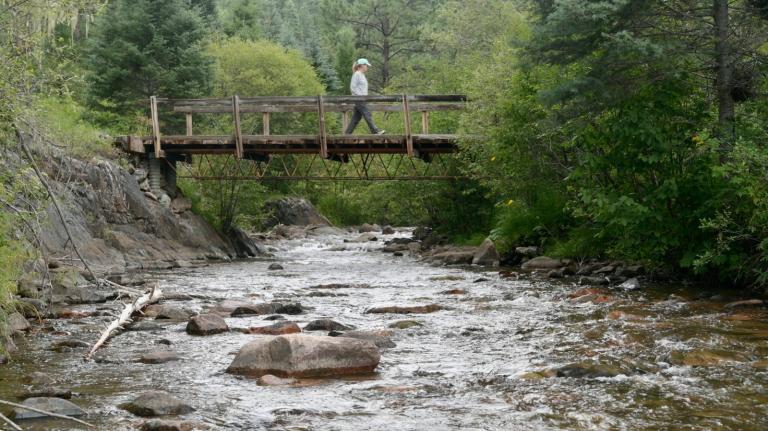
And I mean, that’s kind of a personal thing. That’s true for training, that’s true for all the things that I do in sport and climbing. If I feel like I’m making progress then it’s easy to get up and try hard and absolutely try my best. And so I feel with environmental issues, it’s like you’re better off focusing on the places that you can make progress. I mean like seeing a river restored like that and just seeing the absolute transformation in just a few years [referencing the restoration of the Klamath River after the removal of dams], that’s incredible. It’s stories like that I think are worth highlighting.