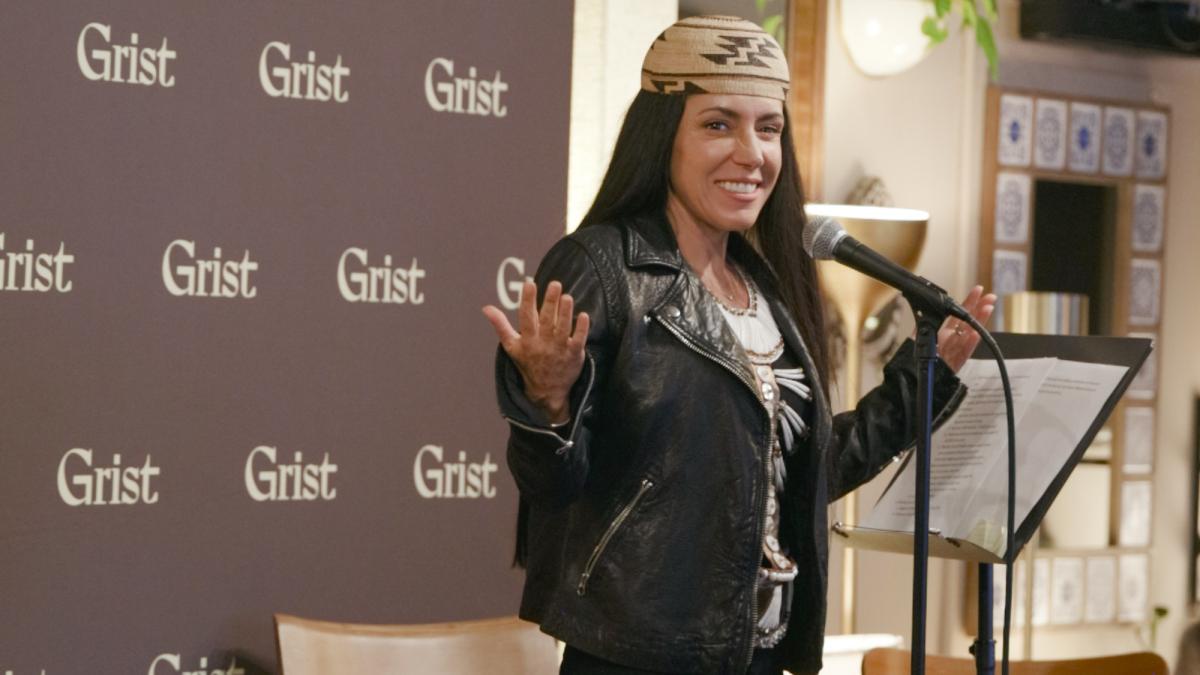
Amy Bowers Cordalis is a Yurok tribal member and attorney. She’s also a fisherwoman, civil rights activist, and conservationist. She is the co-founder of the Indigenous conservation group Ridges to Riffles, and author of the memoir, The Water Remembers. And she served as general counsel for the Yurok tribe, representing them through the Klamath Dam removal, which is what she joined Grist’s recent San Francisco event to discuss.
At Turning the Tide: Stories of Climate Solutions, a live Grist event held during San Francisco Climate Week, speakers including Cordalis shared their real life experiences of turning points that drove climate impact.
For Cordalis, one of those moments was quite explosive: “I got to blow up a dam!” But the path to the largest dam removal and salmon restoration project in U.S. history was also pragmatic — “at the end of the day, dam removal was profitable” — and deeply emotional. Remembering the day the Iron Gate Dam came down, Cordalis read from her memoir, “I stood arm in arm with Ashley, my sister, in tears. Our family had waited generations to reconnect this river.”
She sees the incredible achievement as evidence of a key principle: “There’s a way to do business, but equally value the rights of nature and Indigenous peoples. We don’t have to continue to accept the destruction of the environment or our human rights for progress. We just don’t.”
Watch the full video of the event, including Cordalis’ story, or read the transcript of her story (lightly edited for clarity) below.
Amy Bowers Cordalis: I’m really excited tonight to talk about the world’s largest salmon restoration project in history in your backyard. I was asked to talk about some moments that I knew my work had made a difference. And so I’m gonna highlight three moments: One is administrative, one is historic, and one is quite explosive.
And I want to acknowledge that these moments are not just mine. They are shared moments with the toughest people I know, which are the Indigenous peoples of the Klamath Basins and the tribal leaders there. All the moments that I’ll share, all the work that we have done has been led by these powerful people who went into places that they felt like they weren’t allowed for a long time and they didn’t have money to go. But they had a big heart, and we as Indigenous peoples had a duty to protect the world, to be stewards, and try to restore balance, and that’s what led us here.
So without further ado, I will start with my first moment, and I’m gonna read from my book, and this is really — this was one of the most powerful moments of my life.
It was 2024, and we were gathered at the base of Iron Gate Dam, which is the lowest dam on the river. We were gathered there to watch the river reconnect:
Then it happened. An excavator scooped up a large pile of red rock, lifted its arm, dumped the load, and then repeated. Then the sparkle of water appeared where only red rock had been. It was so small, it looked like a lone star above a night sky over a big city. It was barely visible, but the crowd knew it was water and gasped. Here it comes, hollered Karuk tribal member, Leif Hillman, who had been the leader of the Klamath Dam removal grassroots campaign and a former vice chair of the Karuk Nation. The excavator took a few more scoops, lowering the level of Iron Gate Dam and widening the water’s path. Gradually, the water moved further downriver over the dam. The water remembered how to flow and where to go. It slowly saturated the remaining part of the dam, heading toward the downriver channel. Finally, downriver and upriver reconnected through a brilliant stream of prosperity when the water met at the base of Iron Gate Dam for the first time in 100 years. The river was free.
The crowd roared and cheered. I stood arm in arm with Ashley, my sister, in tears. Our family had waited generations to reconnect this river. We were the lucky generation to watch it happen.
Molli Myers, Karuk tribal member and grassroots leader, whom I co-founded R2R with, hugged her colleagues in gratitude. Brian Johnson, Trout Unlimited California director and KRC board president, who had fought 20 years for dam removal, cried. Later that day, past Yurok leaders, including Auntie Sue and her husband Uncle Leonard, and my boys, came to witness. Looking down at the former Iron Gate Dam site, Uncle declared: (He has this accent too) “It was like the goddamn dams were never even there.” (That’s how he talks.)
Indeed, the dams were hardly there when considered in the time scale of the river’s life. I woke up that morning to a dammed river and fell asleep that night to a river that flowed freely for the first time in 100 years. I slept well. I expect all the dedicated people who worked on Klamath Dam removal for decades rested well too. On September 30, 2024, the Klamath River’s journey toward restoration reached a powerful milestone, the removal of all four dams. More than 441 feet of steel, rock, concrete, clay, and rebar from four different dams was removed. With Iron Gate alone, one million cubic yards of dam removal material was removed in 25,000 truckloads. This material that once blocked the river’s flows was recycled, returned to the earth, or repurposed.
Dam removal was completed on time, within budget, and consistent with the terms of our permits. With their removal, the river began to heal, restoring balance and the life ways of all those dependent upon its vitality.
Three days after Iron Gate Dam was removed, the salmon came home. Three days. The brightest minds of the scientific community for 20 years studied how long it would take the salmon to come home. They said 10 years, 20 years.
Three days. The salmon remembered.
So how did we get there? And that leads me to my second moment, my administrative moment.
I co-founded Ridges to Riffles Indigenous Conservation Group to move money and power to better serve the river and the Indigenous peoples and the salmon on the Klamath. My dad has this saying: You can’t keep putting your hand in the mousetrap and expect a different outcome. And I took that as, we can’t keep doing things the same way and expect the different outcome, right?
And so I co-founded Ridges to Riffles so that I could organize in a different way and get a different outcome. That was 2020, and by then we already had a settlement agreement, but things were really on the rocks, and we were able to make an amendment to the settlement agreement that took us to dam removal. The result, historic. A $500 million settlement agreement that equally valued the rights of nature, Indigenous peoples, and business.
At the end of the day, dam removal was profitable. And I think that’s a really important message for us all to know is that there’s a way to do business, but equally value the rights of nature and Indigenous peoples. We don’t have to continue to accept the destruction of the environment or our human rights for progress. We just don’t.
This is the model that the Klamath has shown us, and already we’re working on the Eel River, the Snake River, to do similar types of projects, and I think this is something that could be applied around the globe.
So the settlement agreement was how it all worked. But a year later, the river is fiercer, cleaner, colder, and smells sweeter than I have ever known it to be. It is remarkable. Many people thought that the river wouldn’t heal, but its recovery has been so fast. So the first year, about 7,000 salmon came back and passed the former dam sites. Last year, over 13,000 salmon came back and went further into the 400 miles of spawning habitat that they had been denied.
And I’m really happy to report that just a few weeks ago, baby salmon were spotted out migrating from behind the former dam site. So what that means is that they, and I don’t use this word, they have recolonized. They are back.
Also, fun fact, salmon only go backwards, baby salmon only go backwards on their out migrating trip. So we have spotted salmon going in reverse to the ocean. So a life cycle has started, and we’re really excited about that.
The reservoirs. There were 2,000 acres of reservoirs. And those reservoirs produced methane equivalent to 64,000 cars a year on the road. And what’s interesting is that we didn’t know that. But we teamed up with Patagonia, and a report came out recently that told us all about this. So we can’t look at hydropower as just green. We can’t.
Now that that’s gone, the area where the reservoirs once were, the river drained, it went back into its river bed, and we are restoring the area around the bed of the river. The Yurok tribe is leading these efforts and has planted 20 billion native seeds. It’s remarkable. It’s so beautiful. And with that, plants and animals are coming back, food and medicine that anchor Indigenous cultures into the future. It is awesome.
These new ecosystems have the potential to prevent over 800 metric tons of CO2 a year over time. Also a climate solution.
And then the other cool thing that’s happening is that a lot of this land is now being returned to its original stewards, the Shasta Indian Nation.
So that leads me to my third point, third moment:
5, 4, 3, 2, 1 … Fire in the hole. [EXPLOSION]
I got to blow up a dam! So, dreams come true. What else do you say?
On the Klamath, this historic effort is reminding us of a very important truth: Humans can heal nature. And when we do, it works with us too. So I invite you all to continue this work. It’s not too late. We don’t have to move to outer space.