The U.S. Army must solve a dangerous problem: Nearly five tons of lead azide — the nation’s entire stockpile of the explosive compound — has deteriorated to the point where officials say it might explode if moved, or even detonate spontaneously if left alone.
And so it plans to blow it all up Wednesday morning.
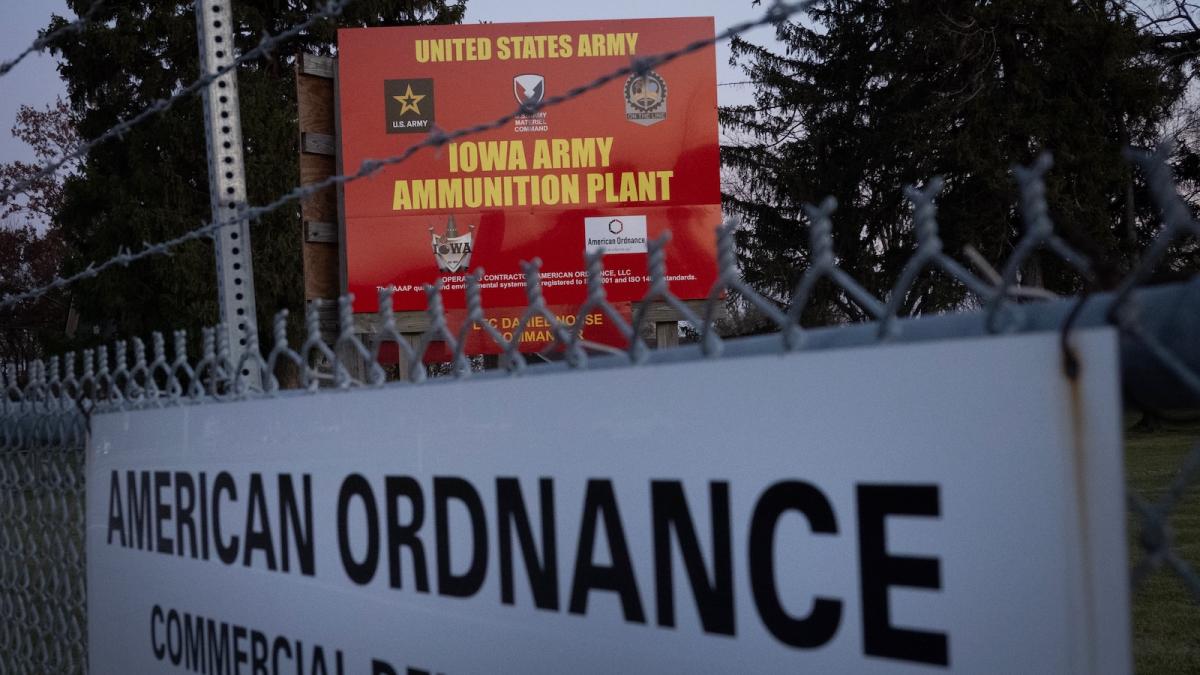
The Defense Department will detonate the material in a controlled blast at the Iowa Army Ammunition Plant in Middletown, about 10 miles from the Illinois border. Although the goal is to eliminate the risk of an accidental explosion, the detonation carries another threat: a plume of lead-laden dust that could settle over homes and farmland for miles around.
The extraordinary plan has prompted evacuations for residents up to 5 miles downwind from the plant, and people as far as 20 miles away have been warned to remain indoors. Elected officials in Iowa and Illinois have urged the government to delay the plan, and environmentalists have sued to stop it.
Here’s what to know about this unusual operation and the risk it poses.
Why is the army detonating old munitions?
Army inspectors discovered in March that 68 drums of decades-old lead azide had begun to crystallize, making it increasingly sensitive to friction, vibration, and temperature changes. Even the slightest movement could trigger an explosion.
“The lead azide has aged. It’s become unstable to the point where moving it or even allowing it to sit on the odd chance that it receives some sort of shock or friction could lead to a spontaneous explosion,” said Greg Domski, associate provost and professor of chemistry and biochemistry at Augustana College in Rock Island.
After consulting with the Environmental Protection Agency, the Bureau of Alcohol, Tobacco, and Firearms, and other agencies, the Army decided the best option is to detonate the material where it sits. The plan to do so has been ongoing in the months since.
What is lead azide?
Lead azide is a compound of lead and nitrogen, commonly used in detonators to set off other explosives. About 9,700 pounds of the material will be detonated.
Has the Army blown up lead azide before?
While the Army has destroyed weapons and materials in the past, it has never destroyed so large an amount of lead azide. This operation requires detonating 9,700 pounds of the material stored in 68 drums.
“We detonate all the time, but we have not detonated lead azide at this quantity,” said Lori McFate, public affairs specialist with the Army Sustainment Command in Bettendorf, Iowa.
The operation follows months of planning and review by the EPA’s regional office in Kansas City, Missouri. The agency issued an emergency permit for operation on November 16; a federal appeals court ruled Monday that the detonation could proceed.
When is this detonation going to happen?
The detonation is expected to take place at the Iowa Army Ammunition Plant in Middletown, Iowa at about 9 am Wednesday. The plant is about 160 miles southeast of Des Moines, Iowa, and about 230 miles west of Chicago. The nearest communities lie just 10 miles to the west across the Mississippi River.
The Army delayed the operation after elected officials in both states raised concerns about safety. Iowa Governor Kim Reynolds and governor-elect Rob Sand were joined by other politicians in calling for a delay. The environmental organization Earthjustice also sued to try to pause the detonation.
Where will the plume go?
Current forecasts based on U.S. Army modeling show the plume traveling southwest away from the Iowa Army Ammunition Plant. The modeling for the canceled Nov. 20 detonation had the plume crossing the Mississippi River and reaching as far as Illinois.
Current meteorological data for Wednesday on the site indicates Illinois is not expected to be affected. State officials said they will continue to monitor the situation. Light winds are expected from the east and northeast, pushing any plume to the south or southwest, according to the state Department of Public Health.
“It would be blowing it to the southwest across the far southeast parts of Iowa,” said Brian Pierce, a meteorologist with the National Weather Service Quad Cities forecast office. “There’s a question of how high the plume would get, which we won’t know until it actually happens.”
What are the health risks?
There is no safe level of lead exposure. The neurotoxin can damage the brain and central nervous system and is particularly dangerous to children and pregnant women. Exposure is associated with cognitive delays, heart problems and reproductive issues.
People in the plume’s path could be exposed by inhaling airborne lead particles or coming in contact with lead dust. The Army says it will test air, soil and water before and after the detonation to determine where lead has been deposited and guide any necessary cleanup.
“Lead is an element, and doesn’t break down,” said Robert Hirschfeld, director of water policy at the Prairie River Network. “Those health risks persist as long as the lead does.”
Will this affect crops or animals?
The Department of Agriculture estimates that 350 farms lie in the projected path of the plume, according to the Associated Press, and has said it will work to keep lead and other heavy metals out of the food supply. Farmers have been advised to move livestock indoors and protect hay and water supplies.
The extent of any contamination won’t be known until after the detonation, and the agricultural impacts remain unknown, Hirschfeld said.
“We’re past harvest now, and so all of that lead is going to land on bare soil and that lead will stay there and contaminate that soil,” he said.
What can people do to limit their exposure?
The Illinois Department of Public Health recommends the following safety tips:
- Stay indoors and keep windows closed for 24 to 48 hours after the detonation.
- If you have a heating, ventilation and air conditioning system that actively draws in outside air, like a school or commercial building, then you may want to temporarily close the intake and switch to recirculate.
- Use a portable air cleaner to supplement your furnace filter.
- Once the U.S. Army determines the airborne exposure period has ended, wet-clean potentially affected surfaces, including playground equipment, toys and windowsills, using soap and water. Avoid sweeping that may redistribute dust.
- If you need to drive through an area impacted by dust, set your car’s AC/heater to recirculate. Afterward, you can take your car to the car wash and replace the cabin filter, if needed. A high efficiency cabin filter will capture fine particulate matter.
- Wash your hands before eating and drinking and take your shoes off at the entrance when you enter your home.
- Visit your doctor if you have health concerns.
Chicago Public Media reporters Isabela Nieto and Misha Manjuran Oberoi contributed to this report.