👋 Hey there, everyone. Evidently, last Friday was World Mental Health Day. I’m sorry I didn’t get you anything! But mental health in the era of climate change has been on my mind of late. After our newsletter a couple weeks ago inviting people to envision the headlines they hope to read in 2050, I heard from a handful of y’all about how you struggle to find hope in the moment we’re in. A couple of you also shared visions for the future that had less to do with world news and more to do with simple self care and well-being: taking walks, picnicking on the beach, enjoying the peace of no breaking news.
So, as a belated gift, I’ve got something to share with you all today: a resource hub launched last month by the climate and mental health organization Unthinkable. We’ve also got some good news about the grid, an interesting story about language, and a drabble submitted by a reader.
This post originally appeared in Grist’s weekly solutions newsletter, Looking Forward. Not on our list yet? Subscribe here to get it in your inbox every Friday.
A hub for mental health resources

Malte Mueller / Getty Images
In 2020, Britt Wray started a Substack newsletter about “staying sane in the climate crisis.”
Wray, now a climate and mental health researcher at Stanford, was motivated to share her learnings after going through her own intense struggle with climate anxiety as she and her partner discussed whether or not to have children. “Almost overnight, I’d turned into that annoying person who manages to bring up climate trauma in every discussion,” she wrote at the time. “And when I cried about the climate, it hurt like the wind was knocked out of me. It was real deep grief, like someone I loved had died.”
Five years later, the climate crisis has only worsened — and so has the distress that people, especially younger generations, feel about living through it.
Building up our skills to tend to that internal crisis is, Wray believes, as important as developing the technical skills we need to address the external crisis we face. And so, after surveying her newsletter readers about what they needed, Wray and her team at Unthinkable launched a resource hub last month to connect people with the types of tools they need to address their unique concerns and emotions related to climate change.
The hub is intended to support “internal activism,” a term coined by psychotherapist Caroline Hickman. While taking some form of action is often recommended as an antidote to climate despair — and certainly can be a source of empowerment and community-building — internal activism is about learning to process and find strength in what we consider “negative” emotions, to sustain ourselves through increasingly challenging times.
“Getting us from the status quo to the regenerative systems that we know we need in order to protect humanity’s future is incredibly difficult work,” Wray told me. If we don’t recognize and grapple with the emotional difficulty of it all, we can burn out. In fact, she said, she’s heard from many young people who had to quit their degrees in climate or related fields because they were falling into depression — a side of the story that their courses never seemed to acknowledge.
“In an escalating planetary health crisis, we are going to be forced to bear witness to more suffering,” Wray said. “We’ve also been having a ton of political setbacks and obstacles that can be disheartening. And so we need to build our resilience to go into the uncomfortable emotions, because they are just a natural consequence of this predicament that we’re in. And there’s nothing to be ashamed of.”
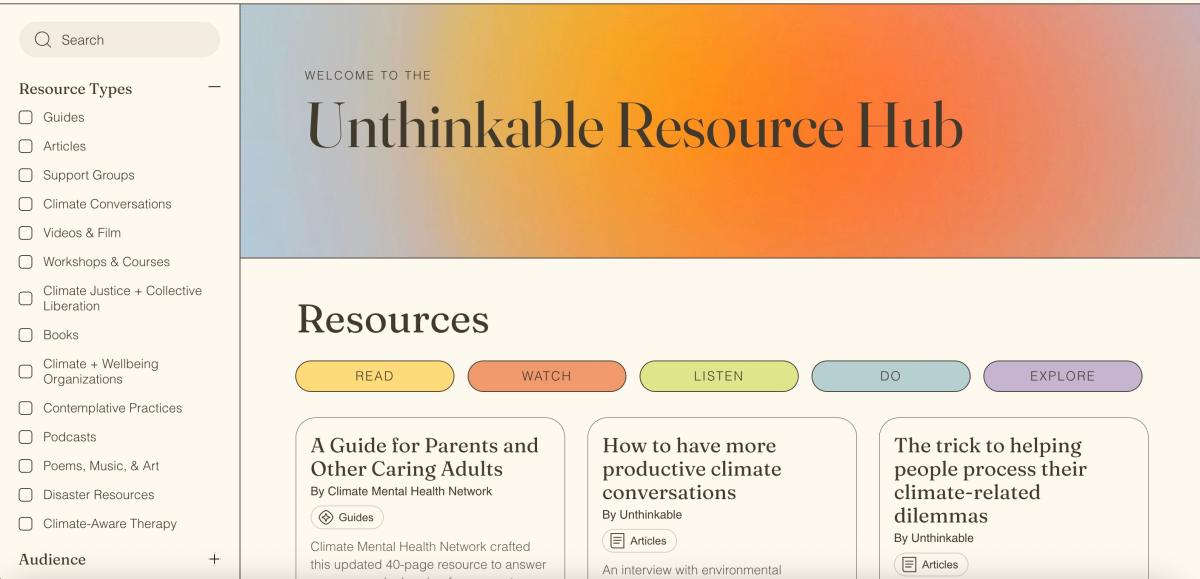
The resource hub compiles hundreds of tools — books, podcasts, contemplative practices, support groups, climate-aware therapy initiatives, and more — into one searchable database for people to find what’s most useful to them. There’s also an option to fill out a short quiz about your feelings, goals, and identity, and receive a tailored “care package” of the resources that most closely align with what you’re looking for.
I filled out the quiz, clicked around, and found myself gravitating toward a page of guided meditations from the Climate Mental Health Network, an essay about climate emotions from an ER doctor, and a link to find more information about climate cafes — something I’ve heard about but never participated in.
The team will keep adding to the database every month, Wray said, vetting additional recommendations as they come in from partners and people who use the hub. Although it is extensive, it’s not exhaustive — and none of what the hub offers claims to be a panacea for climate anxiety.
“There’s really very little evidence so far, in terms of clinical trials and robust longitudinal analysis and so on, about what is working in this space because it is so new,” she said. “Instead, there’s just a lot of people helping each other and coming up with innovations and supporting each other.” That’s what the resource hub aims to provide — a centralized space to start exploring what’s out there, and to start prioritizing your emotional health.
Read more:
More from Grist
💬 Talking points
You’ve probably heard President Trump talking about the “Green New Scam.” That phrase, along with others he frequently repeats, is part of a strategy to subtly undermine trust in science and reframe the public’s perception of climate policies. But how the public responds to these propaganda tactics is up to us. Read more
🔌 Plug and play
Maryland has launched the first residential vehicle-to-grid pilot project — wherein EV owners share some of their battery power with the grid during peak hours. V2G technology is just one example of how electrification can go hand-in-hand with a more decentralized, nimble, and affordable energy supply. Read more
💸 Flood gates
Records obtained by Grist show how a consulting firm managed to bogart a $2.9 million FEMA grant meant to help flood victims in Vermont. The mismanagement of the funds reveals how shunting responsibility for disaster recovery onto states can open up opportunities for predatory private companies. Read more
In other news
- The World Bank and International Monetary Fund are meeting in D.C. this week. A new report urges the institutions to reform their climate lending policies. (Inside Climate New)
- Less land was consumed by wildfires in the West this year compared with last — but experts warn not to get complacent (The Washington Post)
- Ohio has plans to fast-track energy development on former mines and brownfield sites, which could be a boon for renewables (Canary Media)
- In coastal communities, conservationists and volunteers are replanting a powerful carbon absorber: seagrass (Source)
- Julian Brave NoiseCat, author of We Survived the Night, discusses climate politics, Indigenous justice, and “trickster” lore (Shift Key podcast from Heatmap)
And finally, looking forward to …
… a well-informed world. I’ve been mulling over Kate Yoder’s story on the language of climate change and the president’s efforts to twist it — one quote in particular stood out to me, from communications professor Renee Hobbs: “We can’t help but be exposed to propaganda, but how we react to it is up to us.” Critical thinking and curiosity (and, ideally, access to real, reliable information) are important tools for staying sane in this world and continuing to address the crises we face.
One of Looking Forward’s readers, Daniel Chandler, sent in a very sweet drabble this week about the future of education and climate literacy — I think it fits the vibe.
📚📚📚
Twelve-year-old Bryan’s eyes lit up as he looked at the tables and banners on the Plaza. “Climate Quiz,” he read. A chance to shine.
“Climate is the average of the world’s weather.” Yes! The old guy at the table agreed. Next question: Which gases cause climate change by trapping heat? CO2, obviously, and methane because of oil well leaks. But “refrigerants that cool supermarkets?” Bryan hesitated, then remembered his grandmother talking about a report called Leaking Havoc. Aced it!
Only a little swagger as he was on to the table about cultural fire.
— a drabble by Daniel Chandler
📚📚📚
A drabble is a 100-word piece of fiction — in this case, offering a tiny glimpse of what a clean, green, just future might look like. Want to try writing your own (and see it featured in a future newsletter)? We would love to hear from you! Please send us your visions for our climate future, in drabble form, at lookingforward@grist.org
👋 See you next week!