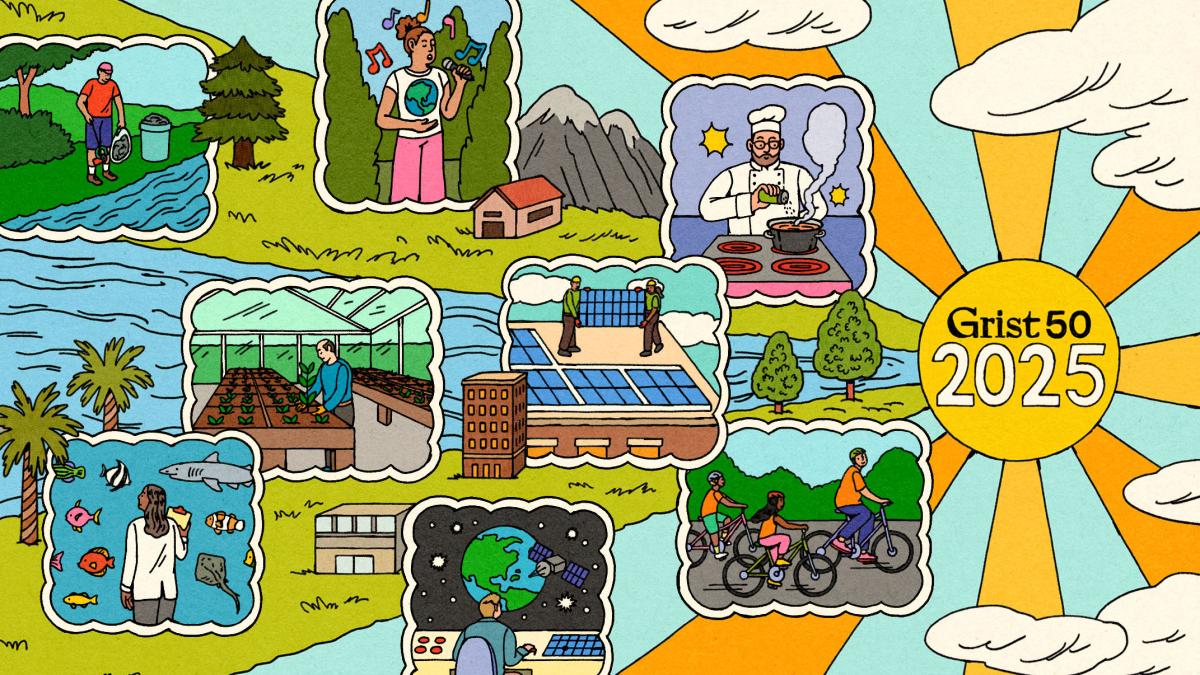
👋 Hey there, everyone! This week, I’m excited to share a project very near and dear to my heart: the annual Grist 50 list of climate leaders to watch, featuring 50 inspiring people making a difference in communities across the country. I’ve been working on the Grist 50 since my intern days at Grist, and it’s always a bright spot getting to highlight the tenacity and passion of these leaders — but especially so this year. As we wrote in the project’s introduction, the 50 stories gathered on this year’s list offer just a snapshot of the progress that is still unfolding all over the country, despite the dismantling of climate policies and funding at the federal level.
I hope you’ll get a dose of inspiration (or 50) reading about the leaders on this year’s list — I certainly did in working on it. In today’s newsletter, we’ve also got stories about reducing plastic pollution and building new solar energy, and a lovely drabble shared by a reader.
Climate progress is still happening: Meet the 2025 Grist 50
It’s no secret that 2025 has been a tough year for climate progress in the U.S. Amid federal program, funding, and personnel cuts, and the dismantling of bedrock policies and research, a lot of important climate work has been stymied.
Those headwinds are serious, and downright infuriating at a time when climate impacts are becoming more frequent and deadly. But it doesn’t mean that efforts to address climate change have stopped.
Every year, the Grist 50 list features the stories of 50 people who are doing vital, often unsung, work to build resilient ecosystems, protect and uplift communities, and ensure a liveable future. Despite the hurdles, when our team interviewed the leaders featured on this year’s list, every one of them said they’re committed to continuing their work for a better world. Some of them even talked about being galvanized by shifting political winds.
Take Lake Liao, for example — a college student who was first inspired to get involved in the climate movement when he was just 13, and stumbled across a video about the Green New Deal. After last year’s election, Liao began wondering what it would look like to build a sturdier foundation for climate policy that wouldn’t vary from administration to administration — by baking environmental protections into the law of the land.
Today, he’s focused on writing and advancing constitutional amendments that guarantee young people the right to a stable climate system. With the organization he started, Capitol Hill Academy, he and his collaborators are pushing for state-level amendments across the county and even an amendment to the U.S. Constitution, which would protect “the inherent, inalienable, and fundamental rights of all persons, including children and our posterity, to a healthy environment, clean air, pure water, and a stable climate system.”
Deneine Christa Powell is the head of the Urban Sustainability Directors Network — a group of some 3,700 municipal sustainability professionals across the U.S. and Canada. With a history of working on climate and equity for the city of Milwaukee, Powell knows how meaningful local climate action can be. And when President Donald Trump’s second administration began its assault on all things climate, her organization ramped up its efforts to support continued action at the city level.
“Local governments are one of the last lines of defense to maintain climate progress,” Powell said.
Matt Traldi, a longtime political and social justice organizer, is working to create opportunity in another area of local governance: permitting. Although a majority of U.S. residents are in favor of building more wind and solar, projects often get held up because it’s the vocal minority of opponents who are most likely to turn out to local hearings. He started an organization called Greenlight America, which uses data to pinpoint key permitting battles across the country and partners with local groups to mobilize supporters.
These efforts have already seen success in places like Erie, Pennsylvania. And according to Traldi, the energy transition will continue apace despite federal policy. “I believe the next few years are going to be record-breakers for clean energy deployment,” he said.
There are 47 more stories like these to check out on this year’s list, not just about policy, but about chefs and farmers and artists and engineers and even a former PE teacher. And that’s just 50 of the hundreds of nominations we received of other people making change around the country. For me, the list is an important reminder that none of us are in this alone, that the work continues, and that there’s a place for everyone in it.
To read all the stories, be sure to check out the full Grist 50 list here.
More from Grist
⚖️No more nurdles
A landmark legal settlement will require a plastics facility in Pennsylvania to clean up the tiny plastic pellets — known as “nurdles” — that were found to be spewing out of its stormwater and wastewater pipes. But the real achievement, advocates say, is that the settlement requires monitoring devices to prove the company isn’t releasing even a single pellet. Read more
🪨A gold mine
As the clean energy transition drives demand for critical minerals, Indigenous territories have been targeted for mining — an industry with a history of ignoring tribal consultation requirements and human rights. But last month, the Shoshone-Paiute Tribes signed a profit-sharing agreement with a mining company that advocates hope could become a new standard. Read more
🔥You get a biochar
Biochar, a substance made from heating biomass like wood chips or husks, stores lots of carbon and can boost crop yields when it’s added to soils. A new low-tech device called a “PyroTower” may help farmers in low-resource settings produce the substance from their farm waste — as an alternative to burning it or leaving it to rot. Read more
In other news
- Energy-related carbon emissions have declined, per capita, in all 50 states since 2005 — some by almost 50 percent (Utility Dive)
- Texas has had a record-breaking year for solar development, in spite of federal policy shifts (San Antonio Express News)
- California just passed a slate of new legislation to address rising energy costs, including measures aimed at reducing emissions (Canary Media)
- Through legal action, public advocacy, and data recovery, scientists are fighting the federal government’s assault on science (Nature)
- Hot cities are commissioning artists to design creative shade structures to help residents stay cool (AP News)
And finally, looking forward to …
… taking climate action in community. This drabble was shared by Looking Forward reader Jimena Cuenca. Like the Grist 50, I think it’s a perfect reminder of the fact that climate action is all about people — and to sustain action, people need relationships and support and simple comforts like a cup of tea.
🍵🍵🍵
Maybe I said too much? Or not enough? Among your scattered thoughts, you feel unmoored. Hands grip the cold smoothness of a cup, seeking some security. Silence holds its breath. Then the person beside you says, “I feel the same way.” You look up. Around the table, people nod, and someone refills your cup. The heat of the tea circles up your arms as aromas of orange and ginger embrace you like a thing with feathers.
You don’t know how you’ll feel at the end of the gathering, but you won’t go through it alone here at the climate café.
— a drabble by Jimena Cuenca
🍵🍵🍵
A drabble is a 100-word piece of fiction — in this case, offering a tiny glimpse of what a clean, green, just future might look like. Want to try writing your own (and see it featured in a future newsletter)? We would love to hear from you! Please send us your visions for our climate future, in drabble form, at lookingforward@grist.org
👋 See you next week!