👋 Hi, everybody! This week marked the one year anniversary of Donald Trump taking office for the second time. As Grist has reported extensively, this year has been characterized by unprecedented attacks on climate science and rollbacks of climate policies, protections, and pots of money — not to mention the loss of hundreds of thousands of federal jobs.
But the need to keep communities informed and safe hasn’t gone away, and in many places neither has the work — led by states, cities, organizations, and even individual people determined not to give up. In today’s newsletter, we’re looking at how some of those groups are finding new ways to continue their climate work, despite a lack of support from the federal government.
We’ve also got news for you about the growth of renewable energy, state-level progress, and how climate change is threatening the future of the Winter Olympics.
This post originally appeared in Grist’s weekly solutions newsletter, Looking Forward. Not on our list yet? Subscribe here to get it in your inbox every Friday.
After a year of federal cuts, the need for climate work — and the determination of the people who do it — isn’t going anywhere
Chip Somodevilla / Getty Images
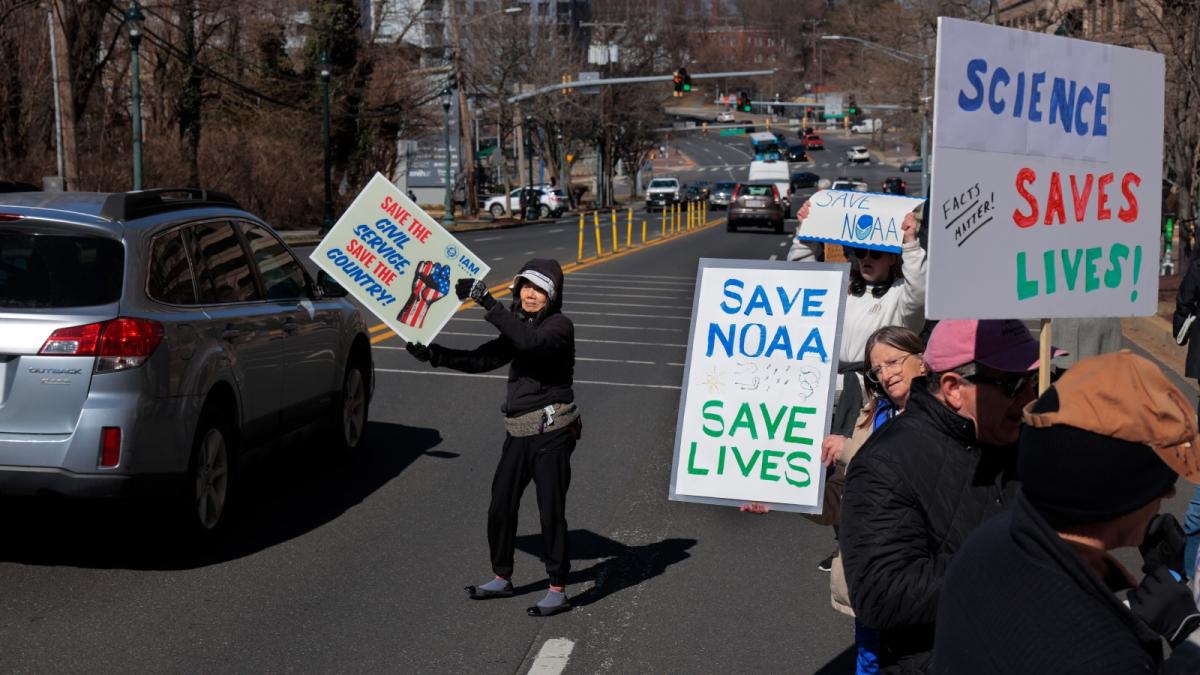
If you’ve been reading this newsletter for a while, you might remember hearing from Tom Di Liberto, a climate scientist turned communications specialist. When we spoke to Di Liberto back in May, he had recently been let go from his dream job at the National Oceanic and Atmospheric Administration, along with hundreds of his colleagues, thanks to the now-defunct Department of Government Efficiency’s sweeping cuts.
“It’s not so much about me losing a job,” Di Liberto said at the time. “It’s about this job not existing anymore.”
His job may not exist at NOAA anymore. But he’s now doing a version of it as the media director for a nonprofit called Climate Central.
“I’m still telling that climate story, and utilizing a lot of things that we still receive from NOAA,” he told me this week, when I checked in to see what’s changed for him in the past year. For instance, NOAA collects and publishes annual data about global average temperatures — something Di Liberto worked on publicizing and contextualizing when he was at the agency. “The 2025 numbers just came out. Usually there’s a press release that comes out with it,” he said. This year, NOAA released the data quietly, confirming that 2025 was Earth’s hottest year on record. But in his new role at Climate Central, Di Liberto has been able to continue communicating about that data and the implications it holds for our future.
Climate Central has also preserved other work that was discontinued at NOAA — notably, the database that tracks billion-dollar disasters in the U.S., which NOAA discontinued in May. It’s one of many examples of nonprofits stepping in to preserve data the government has abandoned or deleted.
The story of the past year is undoubtedly one of confusion and desperation for those who work in climate, or who were dependent on climate-related government funding. In addition to culling some 317,000 government positions, the administration has canceled or frozen billions in funding, with the ax directed in particular at climate-related projects and programs. Across the country, communities have lost funding for critical infrastructure projects and organizations have had to shutter or scramble for new ways to stay afloat.
But just like Di Liberto and Climate Central, many have also found creative ways to keep some of this work alive and soldier on without the federal government.
Earlier this week, my colleague Sophie Hurwitz followed up with some of the communities and organizations that lost funding last year to find out where they are now. “For many communities, they’ve been going through the stages of grief,” Zealan Hoover, who was a senior advisor to former Environmental Protection Agency Administrator Michael Regan, told Sophie. “First was disbelief, because they know the merits of these projects. They know how badly it’s needed by the community.”
Some have had to move away from vital projects like air quality monitoring or remediating contaminated drinking water, and some are still fighting back in court. But the groups Sophie talked to haven’t given up — many are cobbling together other sources of funding or redirecting their attention to other needs.
Native Sun Community Power Development, an Indigenous-led nonprofit, has done some of both. The organization had planned to install solar panels on the homes of community members in the Flandreau Santee Sioux Tribe in South Dakota, with the help of a $19.9 million grant from the EPA. The loss of the grant was a blow to the tribe and the nonprofit.
For now, the organization has paused the solar-installation work, along with another planned project to build out an intertribal EV charging network, which lost its funding from the Department of Energy. Without funding on the scale of what the federal government had been providing, Native Sun is refocusing away from costly infrastructure projects and toward renewable energy workforce development, in partnership with the state of Minnesota.
State funding has also helped keep some climate and environmental service programs alive after the end of the American Climate Corps, including in conservative areas where framing the work in terms of community needs rather than climate action has made it more palatable. In rural eastern Washington, for instance, a state grant is funding a Washington Climate Corps program to convert diesel locomotives to cleaner engines.
Replacing federal support and resources isn’t easy. “Everybody now is scrambling for the same pot of money, and there isn’t enough of it,” said Rhonda Conn, associate director of Native Sun. The nonprofit is currently operating with no permanent office space and few workers.
But Conn also told Sophie she’s determined to not only continue the organization’s current work, but get back to the programs it’s had to move away from. “We really believe in the work that we’re doing,” she said, noting that the infrastructure projects may take longer without that influx of federal cash, but they aren’t going to go away. “It’s just about where we’re balancing our energy right now.”
Read more:
- The Trump EPA ended the ‘green new scam.’ A year later, communities are still paying the price.
- After one year of Trump, is anything left of the American Climate Corps?
More from Grist
🪨 A Trump of coal
Trump has talked a big game about resuscitating the coal industry. In the past year, his administration has stepped in to prevent plants from shutting down, rolled back pollution regulations, and argued that coal should help fulfill growing energy demand. But experts say it’s at most a delay in coal’s inevitable decline — and more symbolic than anything. Read more
📈 Here comes the sun / wind
In addition to promoting fossil fuels like coal, Trump has gutted incentives for renewable energy and other clean technology like electric vehicles. But, once again, the prevailing take is that there’s only so much he can do to stall the clean energy transition. Renewables have become cost-effective. And in some places, like Florida, their growth is actually exceeding the rise in energy demand. Read more
🔨 Executive dysfunction
One more way that Trump’s power to dismantle climate action is limited: Most of his actions have been at the level of executive orders. He has actually signed fewer bills than any president in the past half a century. So while his anti-climate agenda may appear sweeping in the short term, a future president could reverse much of what he’s done. Read more
In other news
- Virginia’s new Democratic governor plans to rejoin a cap-and-trade program known as the Regional Greenhouse Gas Initiative (E&E News)
- California is considering legislation to make it easier for residents to install heat pumps and balcony solar (Canary Media)
- A startup claims it’s cracked the code on a long-hyped battery technology promising long ranges and superfast charging. Experts are skeptical. (The Washington Post)
- As athletes and organizers prepare for the Winter Olympics next month, they are also contending with an uncertain future for the games on a heating planet (The New York Times)
- The home listing site Zillow removed climate risk data from its platform last year. This policy expert is working on a plugin to bring that information back. (Inside Climate News)
And finally, looking forward to …
… enough about national politics! I’m just looking forward to a breath of fresh air — literally.
🪟🪟🪟
Your mom got this place for the roof. But the view — that came later.
As she’s fond of telling you, she used to have to limit the time she spent up here, because the air would start to make her eyes water and her throat itch. But year by year, it got better. And year by year, she could see a little farther. To the water’s edge. Then the foothills. And then all the way to the mountains in the East.
You sit here now, among the small trees and vines and vegetable beds that your mother planted, breathing deeply.
— a drabble by Claire Elise Thompson
🪟🪟🪟
A drabble is a 100-word piece of fiction — in this case, offering a tiny glimpse of what a clean, green, just future might look like. Want to try writing your own (and see it featured in a future newsletter)? We would love to hear from you! Please send us your visions for our climate future, in drabble form, at lookingforward@grist.org
👋 See you next week!