Climate Food and Agriculture

Climate + Food and Agriculture
EDITOR’S NOTE
Grist has acquired the archive and brand assets of The Counter, a decorated nonprofit food and agriculture publication that we long admired, but that sadly ceased publishing in May of 2022.
The Counter had hit on a rich vein to report on, and we’re excited to not only ensure the work of the staffers and contractors of that publication is available for posterity, but to build on it. So we’re relaunching The Counter as a food and agriculture vertical within Grist, continuing their smart and provocative reporting on food systems, specifically where it intersects with climate and environmental issues. We’ve also hired two amazing new reporters to make our plan a reality.
Being back on the food and agriculture beat in a big way is critical to Grist’s mission to lead the conversation, highlight climate solutions, and uncover environmental injustices. What we eat and how it’s produced is one of the easiest entry points into the wider climate conversation. And from this point of view, climate change literally transforms into a kitchen table issue.
Featured
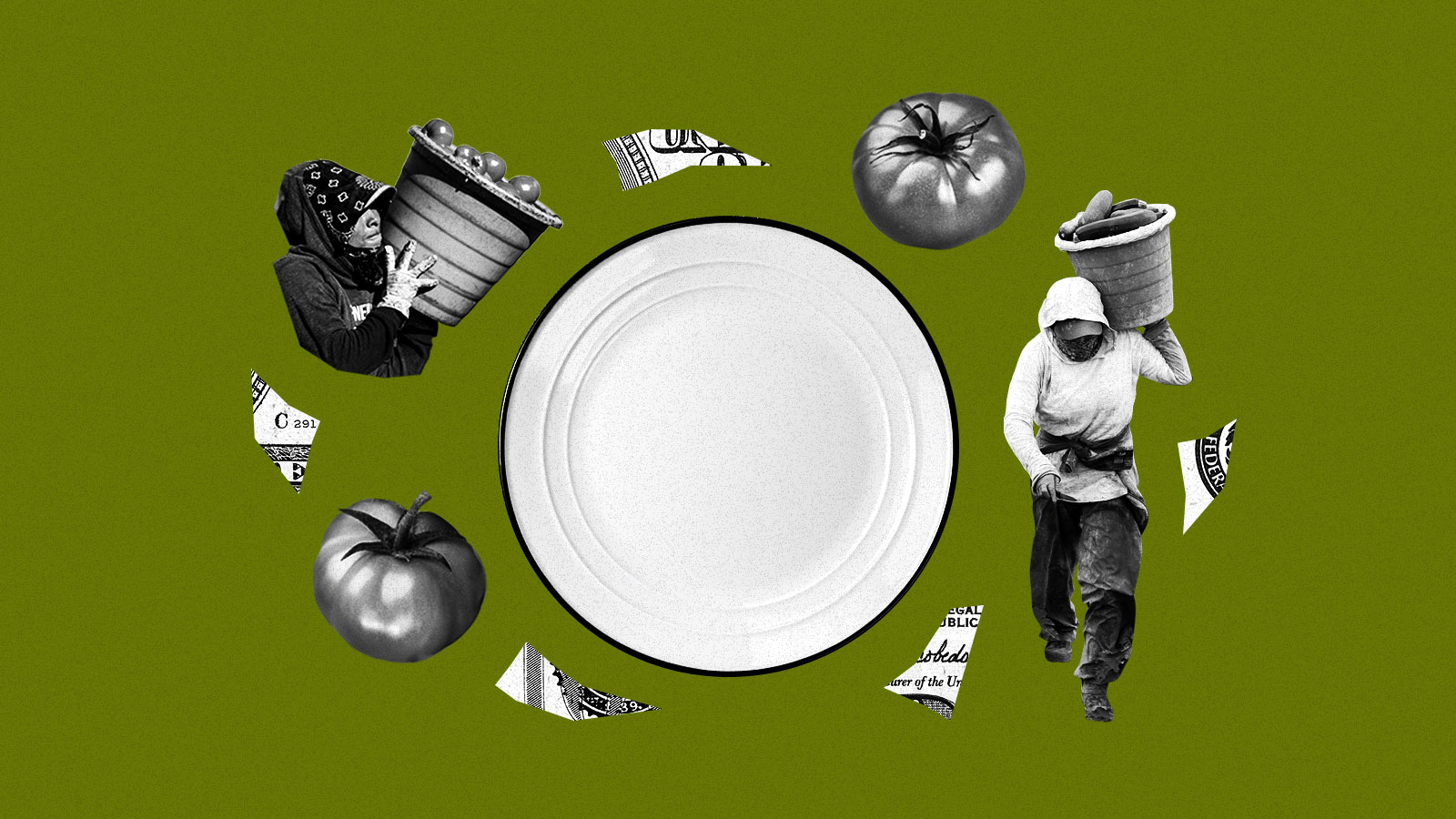
The people who feed America are going hungry
Climate change is escalating a national crisis, leaving farmworkers with empty plates and mounting costs.
Latest Articles
-
Organic farms don’t treat workers any better than other farms
 As Grist's own Amanda Griscom Little recently reported, a trade group representing Kraft and Dean Foods has been quietly pushing Congress to tweak organic labelling standards to make them more friendly to food-processing giants.
 Thankfully, the Organic Consumers Association has led a fight, so far successful, to stymie those changes.
While it's important to preserve the organic label's integrity on the supermarket shelf, it's just as important to interrogate what it means in the field. An interesting study published in UC Davis' Sustainable Agriculture Newsletter sheds much-needed light on that issue.
-
To create a truly sustainable food system, we’ll need to make some fundamental changes.
The sustainable-food movement has a class problem.
Slow Food, for example, is an essential organization, with its declaration of a universal "right to taste" and its mandate to ...
... oppose the standardisation of taste, defend the need for consumer information, protect cultural identities tied to food and gastronomic traditions, safeguard foods and cultivation and processing techniques inherited from tradition and defend domestic and wild animal and vegetable species.
The group has undeniably done important work internationally toward those goals; yet its U.S. branch tends to throw pricey events accessible only to an economic elite.
Examples like this abound.
-
Bye, Local
Organic farmers in U.S. losing business to foreign growers Organic is seen as a niche that helps smaller American farmers endure, but a sizeable chunk of the organic foods sold in the U.S. are being sourced from overseas suppliers. The U.S. Department of Agriculture estimates that as much as $1.5 billion of organic food was […]
-
‘Naked Chef’ dresses down U.S. school lunches, demands ‘real food,
Ten years after sustainable-food doyenne Alice Waters launched her innovative Edible Schoolyard program in Berkeley, U.S. school lunches remain abysmal. In cafeteria kitchens throughout the land, de-skilled workers busy themselves opening cans and zapping pre-made meals in giant microwaves. Out on the floor, kids swill soda and dig their little hands into bags of fried stuff that may have, somewhere far way, once resembled food.
Waters' effort remains laudable, but it's limited to one school. No public figure, no celebrity chef riding the waves of a Food Network show and the opening of an eponymous restaurant in Vegas, has bothered to make decent school lunches a national crusade.
Enter Jamie Oliver, the "Naked Chef" of U.K. TV and cookbook fame.
-
Fight over synthetic ingredients splits organics community
What do xanthan gum, an artificial thickener, ammonium bicarbonate, a synthetic leavening agent, and ethylene, a chemical that accelerates the ripening of fruit, have in common? These and other synthetic additives commonly lurk behind that “USDA Organic” stamp of approval you see on the organic products increasingly crowding the shelves of big-box stores and boutique […]
-
Toujours Gas
France contending with bovine-source greenhouse gases France’s 20 million cows account for 6.5 percent of the country’s greenhouse-gas emissions. Researcher Benoit Leguet of the Climate Mission of Caisse des Depots, a state-owned French bank, contends that bovine belches produce about 28.6 million tons of globe-warming gases annually, primarily methane and nitrous oxide. Cow poop (or […]
-
Who would have thought?
 When I wrote about robots months ago, it didn't occur to me that robots could be used to grow our food. And if it had, I probably wouldn't have thought they would be doing it so soon. Ah, but they are! I guess Todd is right: the future is now.
 Thanks to Wired, I give you OrganiTech:
Tens of thousands of empty storage containers are stacked in towers along I-95 across from the harbor in Newark, New Jersey. They're heaped there in perpetuity, too cheap to be shipped back to Asia but too expensive to melt down.
Where many might see a pile of garbage, Lior Hessel sees, of all things, an organic farm. Those storage containers would be ideal housing for miniature farms, he believes, stacked one upon another like an agricultural skyscraper, all growing fresh organic produce for millions of wealthy consumers. And since the crops would be grown with artificial lighting, servers, sensors and robots, the cost of labor would consist of a single computer technician's salary.
...
OrganiTech can supply a complete set of robotic equipment plus greenhouse for $2 million. A system the size of a tennis court can produce 145,000 bags of lettuce leaves per year -- that's a yield similar to a 100-acre traditional farm. According to the company, it costs 27 cents to produce a single head of lettuce with its system, compared to about 18 cents per head of lettuce grown in California fields. Factor in the transportation costs and suddenly the automated greenhouse grower saves as much as 43 cents a head. -
Hog Heaven
Indiana burg to become “BioTown” The small farming community of Reynolds, Ind., is gearing up to take advantage of its ripest renewable resource: vast amounts of stinky hog poop. Gov. Mitch Daniels (R) and the Indiana Department of Agriculture have designated the one-traffic-light burg as the world’s first “BioTown.” The plan is for its homes […]
-
And why we pay too little for well travelled food
Speaking of eating locally, I've neglected to keep you apprised of the latest developments of our heroes to the North, Alisa Smith and J.B. MacKinnon, who are living on a hundred-mile diet.
In part four, Alisa and J.B. write about the hidden costs of food, China's agro ambitions, and Vancouver's bright spots.
In part five, our dynamic duo heads oustide of their comfort zone to northern British Columbia, where they discover that following the hundred-mile diet isn't as hard as they thought it would be.
-
You Deserve a Break to Hay
City slickers go on farm vacations to get respite from modern life Overstimulated urban dwellers are taking farm vacations to get back in touch with country life — a phenomenon that may help preserve America’s rural landscape. “Agri-tourism” generates considerable, much-needed revenue for Liberty Hill Farm in Vermont; it’s one of just a few thousand […]
