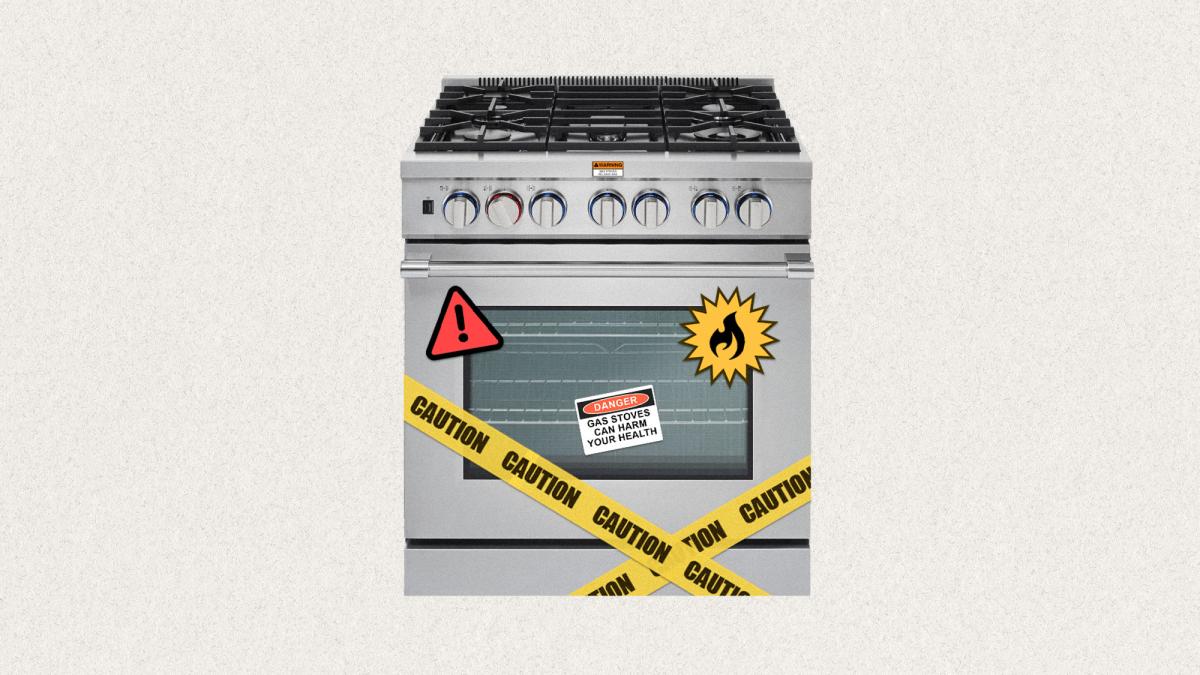
The home appliance industry would like you to believe that gas-burning stoves are not a risk to your health — and several companies that make the devices are scrambling to erase their prior acknowledgments that they are.
That claim is at the heart of a lawsuit the Association of Home Appliance Manufacturers has filed against the state of Colorado to stop it from requiring natural gas stoves, which burn methane, to carry health labels not unlike those on every pack of cigarettes. “Understand the air quality implications of having an indoor gas stove,” the warning would read.
The law was to take effect August 5 but is now on hold, and state officials did not respond to a request for comment. In its federal lawsuit, the association — whose board includes representatives of LG Electronics, BSH Home Appliance Corp. (which makes Bosch appliances), Whirlpool, and Samsung Electronics — asserts that the labeling requirement is “unconstitutional compelled speech” and illegal under the First Amendment. It calls the legislation a climate law disguised as a health law and, most strikingly, it claims there is “no association between gas stoves and adverse health outcomes.”
Yet LG, BSH, Whirlpool, and Samsung have published information on their websites directly contradicting that claim and lauded the health benefits of electric and induction stoves.
“Traditional gas appliances can emit harmful pollutants, which can compromise indoor air quality and pose health risks,” reads a blog post, titled “Life’s Good When It’s Electrified,” that LG published in May 2024. “By switching to electric appliances, these risks are substantially reduced, ensuring a cleaner and safer home environment.”
Another LG page noted that “induction surfaces remain cool to the touch and unlike gas, is better for kitchen air quality” as recently as May 25, according to an archived version of the site maintained by Wayback Machine. It was later revised to eliminate mention of gas, reading “Surfaces remain cool to the touch — no open flames or hot coils. No fumes, either, so it’s [sic] air quality-friendly.”
BSH’s page on Bosch induction cooktops notes that the devices are “safer to use because unlike other types of cooktops, they do not release indoor air pollutants during cooking.” Whirlpool wrote that induction cooktops might help “reduce indoor air pollutants.”
And until last week, a page on Samsung’s U.S. website said “induction cooktops can … help remove concerns over indoor air pollution, creating a sustainable and healthier home environment.” The page’s source code did not appear to have been updated since 2022. Samsung did not respond to multiple requests for comment, but the page was taken down shortly after Grist reached out to the company.
Itai Vardi, a researcher with the Energy and Policy Institute, was the first to notice the discrepancies between what the association said in its lawsuit and what some of its manufacturers have said in the past. “The statements coming from them directly contradict the very strong language in this lawsuit,” Vardi said. “And that, I think, deserves some scrutiny.”

In its lawsuit, the association argues that “the potential health risks of cooking with gas are no different than cooking with electricity” and that acknowledging the ways gas-burning appliances can harm respiratory health promotes “non-consensus, scientifically controversial, and factually misleading” messages. It adds that “there is scant scientific support” for disclosing health risks associated with gas appliances.
Asked for comment, the organization referred to a statement it issued August 6 saying “no study has found that gas stoves cause respiratory health issues.”
When reached for comment, a BSH representative stated that the company is as of now “in complete alignment” with the association’s position. An LG representative noted that the most pollution-acknowledging statements on their website were in fact made by the company’s U.K. branch, but did not respond to a follow-up question about whether the U.K. and U.S. divisions disagree on the risks of LG products.
“This is a troubling attempt by these companies to quickly erase their own public acknowledgment of the dangers of gas stoves,” said Vardi. “But you can scrub your website, not the fact of gas stove pollution.”
Scientific evidence that gas stoves pollute by releasing dangerous concentrations of nitrogen dioxide, benzene, and methane has piled up for the past half-century. In 1970, scientist Carl Shy showed that families exposed to high levels of nitrogen dioxide indoors are at greater risk of asthma and other respiratory illnesses than those who are not. Nine years later, scientist Bernard Goldstein identified the fuel as the likely source of all that nitrogen. A bevy of studies and papers in the decades since came to similar conclusions. One 2022 study estimated that 12 percent of American children with asthma develop that respiratory condition solely due to living in homes with gas stoves.
Appliance manufacturers and the natural gas industry are no stranger to promoting their products regardless of known health risks. “There’s been a campaign by industry to keep the science under wraps or to confuse it, deny it,” said Abe Scarr of the consumer-protection nonprofit Public Interest Working Group.
The lobbyists at the American Gas Association have worked hard to popularize gas stoves: At one point, the organization even provided the stoves Julia Child used in her popular cooking show. The campaign went beyond product placement: When information on the health risks of gas stoves began to emerge in the mid-1970s, industry lobbyists launched “Operation Attack,” a million-dollar marketing campaign to bring the stoves into even more kitchens. This worked: Today, about 40 percent of Americans cook with gas. They also funded their own research, which cast doubt on independent findings on the health risks of gas stoves.
Environmental Health Sciences professor Misbath Daouda of the University of California, Berkeley, was recently part of a pilot study replacing gas stoves in low-income New York City apartments with induction stoves. Nitrogen dioxide concentrations in those apartments, she said, dropped by over 50 percent within months — and the families who lived there liked their new cooktops better than the old ones, she said.
The association between gas stoves and adverse health outcomes, Daouda said, “is clear.”
“I’m not sure who they are referring to when they say the majority of studies” don’t support that conclusion, she said.