On a Saturday morning in September, the game shop Dice Dojo was packed. Players sat shoulder-to-shoulder at tables lining the far North Side Chicago shop with board games stacked from floor to ceiling and a giant yellow Pikachu on the wall. They were eagerly waiting to crack open boxes of the latest Magic: The Gathering trading cards and face off in a tournament.
Noel Camilotas spent most of the day pacing past rows of packed tables and helping players decipher the rules of the hotly anticipated new set. When he was done for the day, he walked out of the store with two boxes of cards.
Despite that haul, Camilotas had hoped for more.
“Some of the products I requested are not going to be available for me anytime soon,” he said. “One of the other products is not going to be available for purchase at all.”
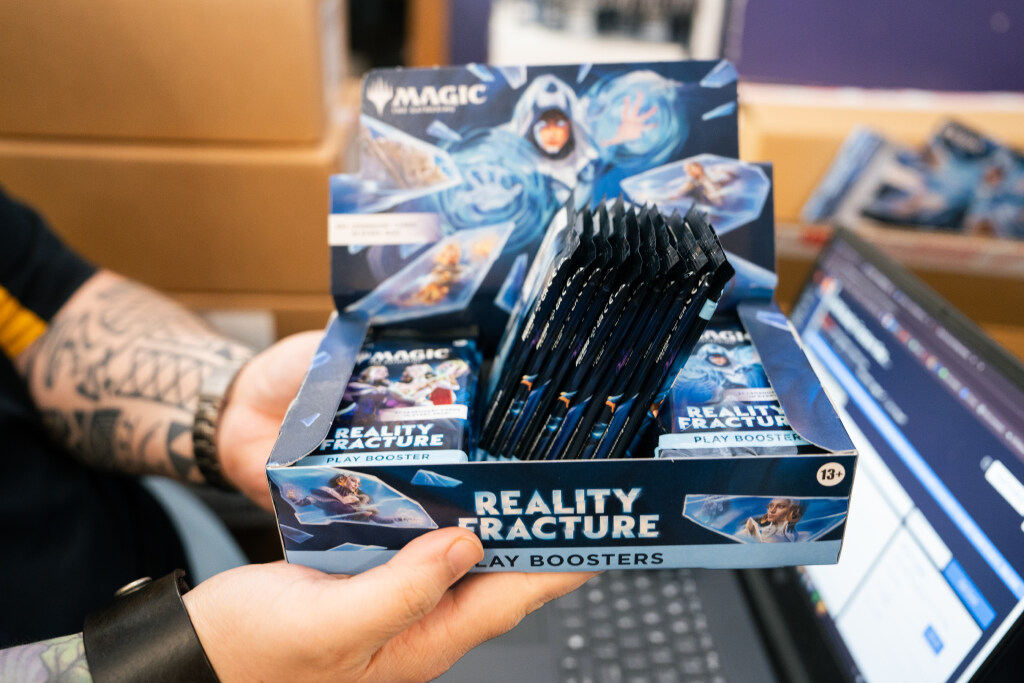
Wizards of the Coast, a division of the toy giant Hasbro, announced in August that delivery of its new set of Magic cards would be delayed throughout North America. The company pointed to a drought-powered traffic jam at the Panama Canal through which nearly 6 percent of global maritime trade and about 40 percent of U.S. container traffic pass. The drought this year has been magnified by the El Niño climate pattern, which spikes air and surface water temperatures in parts of the Pacific Ocean and sets off extreme weather like floods and drought across the globe. The phenomenon has compounded the effects of rising global temperatures, adding to drought conditions in Central America and upending international maritime traffic.
The delay is an early warning sign for how susceptible one of the world’s most important shipping lanes is in the face of a warming planet and what experts warn could be the strongest El Niño in history.
“Supply will be tighter at launch than anticipated as those boosters make their way through the logjam,” according to the card game’s website.
Magic: The Gathering has amassed more than 50 million players worldwide since its introduction in 1993. The game has birthed an entire media ecosystem as well as a robust resale market for rare cards. The rapper Post Malone reportedly purchased a one-of-a-kind card based on the One Ring from a Lord of the Rings-themed set for $2 million.
To win the game, players take the role of powerful, spell-slinging wizards and compete to see who can draw the most cards, cast the biggest spells, and defeat opponents by reducing their life points to zero. Cards are spells, and each player has an endlessly customizable deck of cards that draw on a massive catalogue that grows several times a year. New sets are released every few months.
The model has been tremendously successful. The game has made its parent company Hasbro more than $1 billion in revenue in just the first half of this year. But the trading game now faces an unexpected real-world challenge: El Niño.
“Even in our little corner of the multiverse, the supply chain affects us.”
“The result of an El Niño for Central America is a very strong drought,” said Ross Griffith, the head of Americas freight pricing at Argus Media, a U.K.-based agency tracking commodity prices. Between May and August this year, parts of Panama received rainfall about a third below the long-term average, raising concerns about water levels at the freshwater reservoirs that supply drinking water to the region and provide the water needed to lift and lower ships through the canal’s system of locks.

As a result, the Panama Canal Authority began restricting traffic, cutting daily vessel crossing slots by nearly 20 percent. That bottleneck drove up the fees shipping companies paid to cross the canal in September to as high as $5.3 million, topping the previous $4.6 million record set the previous month. Such restrictions are not new. During the last El Niño in 2023, daily crossings had dropped even lower.
El Niño is expected to last into early 2027 and could exacerbate Panama’s upcoming dry season, according to Ross, who added that the delayed Magic cards could be just the beginning of El Niño-induced knock-on effects.
“If you have drought conditions on top of a typically more dry period, even what little replenishment you were getting then is probably not coming,” he said. “That can be really dangerous.”
So, at least for now, card collectors in Chicago and beyond will likely be waiting longer than usual.
“Some products are now coming in waves,” Emma Hendren, the general manager at Dice Dojo, said on that Saturday in September. “We’re not going to have it available for sale today. We’re not certain when it’s going to arrive, unfortunately.”
Magic players are used to dealing with limited quantities or even delayed cards, but the current El Niño-powered disruption is new.
“Magic: The Gathering is all fantasy and all that stuff,” Joshua Wiltsie, who has been playing Magic for 30 years, said. “Even in our little corner of the multiverse, the supply chain affects us.”