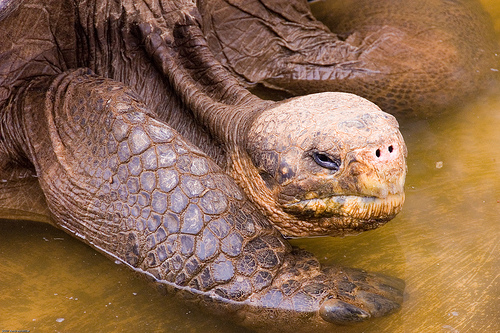
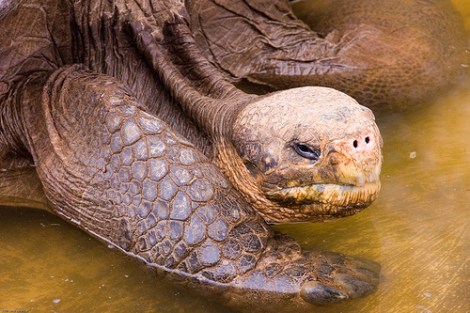
For more than a century, ever since humans introduced them to the Galapagos, rats have ruled Pinzón Island. Just one year ago, 180 million rats lived on this island, hardly seven square miles of land. And because the rats were so hungry for turtle eggs and turtle hatchlings, for years the native giant tortoises — a subspecies called Chelonoidis nigra duncanensis — had to breed in captivity and were considered extinct in the wild.
But now, John R. Platt reports at Scientific American, 118 juvenile tortoises have been let free on the island. And they may just survive — because the rats are gone.
It took, though, more than 44,000 pounds of poison to eradicate them. That’s not as bad as it sounds, Platt says:
The poisons, which dissolve after a few days, were specially designed to attract rats but repel birds and other wildlife that might accidentally consume them. The rodents quickly took the bait and Pinzón has now been tentatively declared rat-free.
And for the first time, it might be possible for these giant tortoises to live like they did before humans came, in some fashion.
A message from
Your support keeps our climate news free.
Grist is the only award-winning newsroom focused on exploring equitable solutions to climate change. It’s vital reporting made entirely possible by loyal readers like you.
At Grist, we don’t believe in paywalls. Instead, we rely on our readers to pitch in what they can so that we can continue bringing you our solution-based climate news. Donate today to keep our site free.