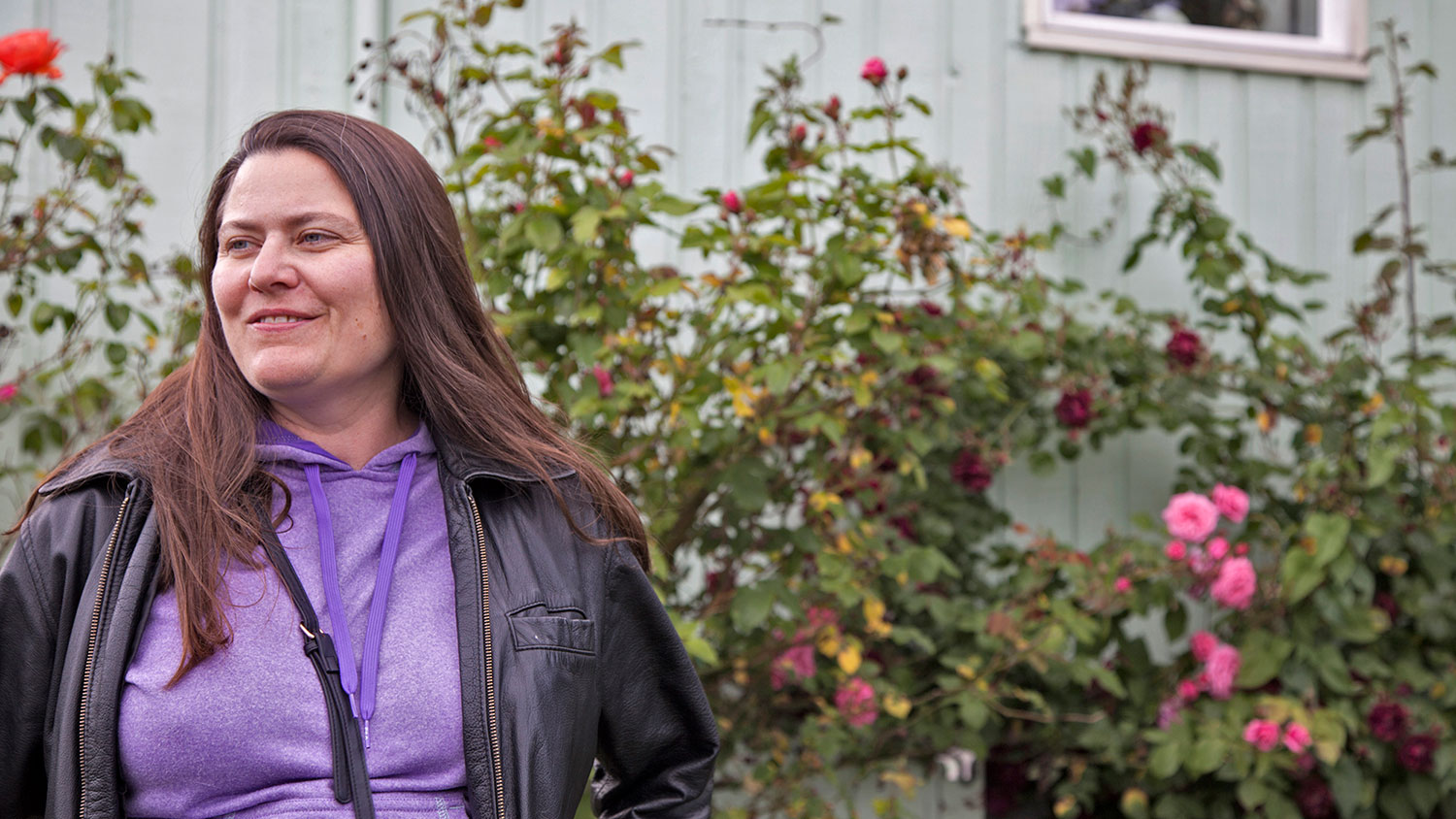
DeVona Lahrman, 49, lives in a little, green house with a double-lot yard where a tire swing hangs from a 100-year-old apple tree. In the summer, the yard is filled with neighborhood kids; they show up at the fence in the morning and stay until evening for a bite to eat. They toss around softballs, play tag, and dig in the garden where Lahrman plants herbs and organic vegetables.
In 2009, the EPA found cancer risk in port areas such as South Park are 27 times higher than the national average. In neighboring Georgetown, just across the Duwamish from South Park, health risks associated with toxic air are higher than any other area in King County.
It’s no surprise then, that Lahrman was at first less than thrilled about living here.
The family was living a remote wilderness cabin five years ago, when John fell off a ladder and broke his back. They decided to move to Seattle, where they’d be closer to services and to John’s family, but after medical expenses, and in the midst of a tanking economy with few job opportunities, their living options were limited. South Park was the cheapest option.
Lahrman had heard of South Park — before starting a family, she was a single, self-described “punk-rocker,” living in the Queen Anne neighborhood, near the iconic Space Needle — and she was horrified at the prospect of moving there. South Park, she tells me, eyes wide, “was the kind of place you’d hope to God you’d never have to go.”
Soon after moving, though, Lahrman realized that the neighborhood was more than the box-shaped houses squeezed precariously between polluting manufacturing plants. On her first morning in the little green house, she sat sipping her coffee, mourning her family’s new location. She looked out the window and caught a glimpse of Mt. Rainier glowing with morning sun. “I knew it wouldn’t be so bad after that,” she said. With the mountain in view, she had a constant reminder of the natural world beyond the concrete jungle.
Lahrman learned to appreciate South Park for its diversity and culture, too. More than 5,000 people live in South Park, an area of only 1.2 square miles. Most are Hispanic, and a slightly smaller percentage are white. There are dozens of languages spoken — Chinese, Spanish, Vietnamese, Mon Khmer, and Somali, just to name a few.
More than half of South Park families have children: 57 percent of homes are family households, compared to only 37.3 percent citywide.
But there are troubling statistics here, too. The chance of being a victim of a crime in South Park is 1 in 13. There are an average of 21.3 total crimes per 100,000 resident per day, compared to 16.9 in the city as a whole. In Lahrman’s old neighborhood, Queen Anne, there are only 6.76.
Just living in the industrial district takes a toll on a person. People who live in South Park and Georgetown die, on average, nearly eight years younger than Seattle residents living just a few miles away, according to a 2013 EPA-funded study published by the Duwamish River Cleanup Coalition/Technical Advisory Group, a nonprofit that works to protect wildlife and human health along the river, and Just Health Action, a nonprofit that works to reduce health inequities.
Environmental stresses such as pollution are partly to blame, but so is the dearth of green space. A study published in the American Journal of Preventative Medicine in 2012 found that children living in neighborhoods that promote physical activity and healthy eating while also having access to green space had 59 percent lower odds of being obese than children without those amenities.
For Lahrman and her family, health is a daily concern. Her two kids — Holland, 12, and Max, 10 — have started to complain of stomach aches and allergies. “I get sick a lot,” Holland told me. “I didn’t when we used to live up in the mountains. The air was fresh. We’d drink the spring water that would come down this creek.”
Lahrman and her husband suffer from nearly constant nasal congestion and coughing. Last year, the family won a vacation to Mexico. Shortly after arriving in Cancun, John noticed his allergies clearing up. “The second day we were there,” John said, “I thought, ‘I can breathe! I can breathe!’” But when they returned to South Park, so did his coughing, sneezing, and sniffling.
“I’ve never had allergies in my entire life,” Lahrman said. “Everyone keeps telling me I’m going through onset allergies. But I don’t think it’s allergies — it’s pollution.”