Climate Food and Agriculture

Climate + Food and Agriculture
EDITOR’S NOTE
Grist has acquired the archive and brand assets of The Counter, a decorated nonprofit food and agriculture publication that we long admired, but that sadly ceased publishing in May of 2022.
The Counter had hit on a rich vein to report on, and we’re excited to not only ensure the work of the staffers and contractors of that publication is available for posterity, but to build on it. So we’re relaunching The Counter as a food and agriculture vertical within Grist, continuing their smart and provocative reporting on food systems, specifically where it intersects with climate and environmental issues. We’ve also hired two amazing new reporters to make our plan a reality.
Being back on the food and agriculture beat in a big way is critical to Grist’s mission to lead the conversation, highlight climate solutions, and uncover environmental injustices. What we eat and how it’s produced is one of the easiest entry points into the wider climate conversation. And from this point of view, climate change literally transforms into a kitchen table issue.
Featured
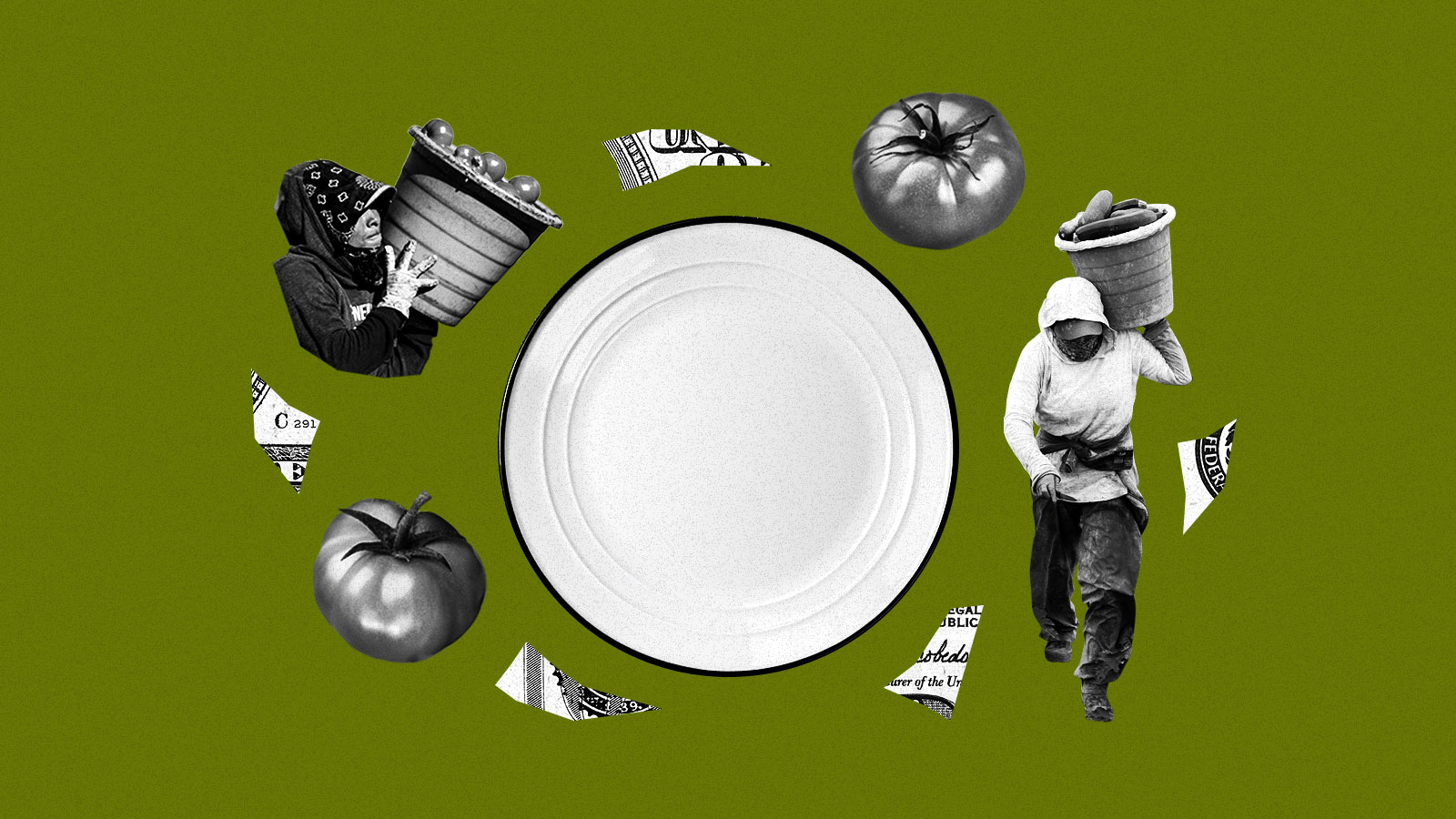
The people who feed America are going hungry
Climate change is escalating a national crisis, leaving farmworkers with empty plates and mounting costs.
Latest Articles
-
Checking out the scene in the nation's industrial-tomato capital
Tomorrow, I'm heading down to Immokalee, Florida, to check out conditions in our nation's tomato basket. During the growing season -- between December and May -- something like 90 percent of tomatoes consumed in the U.S. come from the area in south Florida anchored by Immokalee.
I'm going as part of a delegation of food-oriented writers and activists including authors Frances Moore Lappé and Raj Patel, Slow Food USA president Josh Viertel, and others.
For decades, working conditions in South Florida's prodigious tomato fields have ranged from ruthlessly exploitative to outright slavery. Even under the best conditions, wages are stagnant and workers live in poverty.
Yet workers in the area, represented by the Coalition of Immokalee Workers, have made headlines in recent years by forcing gigantic tomato buyers like Taco Bell and Burger King to pony up an extra penny a pound -- which would cost fast-food companies a tiny sliver of profit, but represent the first substantial wage gain for pickers in decades.
There's a catch: the state's growers cooperative, the Florida Tomato Growers Exchange, refuses to pass on the raise to workers. Thus workers still get 45 cents for every 32-pound basket they fill -- a wage that hasn't budged in years, eroded by steady inflation.
Immokalee is one of the hotspots of of a globalized, industrial food system. The plight of its workers -- many of them refugees from small farms in Mexico and Central America that have collapsed under the weight of that same system -- represents just another externalized cost of stocking supermarkets, fast-food outlets, and school cafeterias with "cheap" food.
For a great brief backgrounder on the Immokalee situation, check out Barry Estabrook's piece in the current Gourmet.
Look for a wrap-up of my Immokalee trip on Friday.
-
The president's budget hints at a coming battle over one kind of ag subsidy
When President Barack Obama said during his recent address to Congress that "in this budget, we will... end direct payments to large agribusinesses that don't need them," he set off a firestorm of speculation. Now that the budget outline has been published, we finally have an understanding of what he meant. Yes, as we suspected, he was indeed referring to a specific subsidy program called "direct payments." Jill Richardson explains:
Direct payments are a result of the 1996 farm bill. Prior to that, subsidies were given based on need. If you couldn't sell your crops at a price the government thought was fair, you got a subsidy to make up the difference...
If you own land where commodities were grown (by you or someone else) in the past, you get a direct payment whether you grow anything or not. You could do nothing, potentially, and still receive a direct payment. Does that sound stupid? I think so too.
Your direct payment is calculated on your "base acres." They keep a running average of how much you grew on your land (or how much somebody grew on your land if it wasn't you), and that yield determines how much you get in government cash. During the past farm bill debate, grain prices were high and farmers were doing well, but the direct payments kept flowing in.Meanwhile, the budget language looks like this [PDF]:
As part of an effort to transition large farms from direct payments provided to owners of base acres to increased income from revenue derived from emerging markets for environmental services, the President's Budget phases out direct payments over three years to farmers with sales revenue of more than $500,000 annually... Large farmers are well positioned to replace those payments with alternate sources of income from emerging markets for environmental services, such as carbon sequestration, renewable energy production, and providing clean air, clean water, and wildlife habitat.
-
A new low-carbon (if not low-carb) way to cook the Italian staple
When it comes to Italian cooking, I'm very Church of Marcella Hazan, orthodox sect.
What the exacting doyenne of Italian food tells me to do in her Essentials of Classic Italian Cooking, I do. No questions asked. In her celebrated chapter on pasta -- which I revere like Christians revere the Gospels -- Hazan had this to say about the role of water:
Pasta needs lots of water to move around in, or it becomes gummy. Four quarts of water are required for a pound of pasta. Never use less than three quarts, even for a small amount of pasta.
She also laid down the law on salt in pasta cookery.
For every pound of pasta, put in no less than 1 1/2 tablespoons of salt... Add the salt when the water comes to a boil.
For about 15 years, through literally hundreds of pounds of pasta (I conservatively estimate 650 pounds), I followed these instructions. The great results I got were like worldly riches to a Calvinist -- proof that I had chosen the right path.
Now everything has changed. Reality has been overturned. In a recent New York Times article, the eminent food-science writer Harold McGee issued a decree tantamount to a papal renunciation of the Immaculate Conception.
Turns out, you don't need "lots of water" for pasta -- two quarts will do. As for salt, two teaspoons is enough. (Although, in terms of salt-per-water, McGee's suggestion is only a little less than Hazan's.) Moreover -- this is the part that really sent a cold chill of apostasy down my spine -- you can put the pasta in the water before it boils; while it's cold, in fact.
For the non-food-obsessed, there is a green angle here.
-
Why isn’t ‘organic pesticide’ an oxymoron?
In Checkout Line, Lou Bendrick cooks up answers to reader questions about how to green their food choices and other diet-related quandaries. Lettuce know what food worries keep you up at night. Ms. Bendrick, I have a question about pesticides and organic food. I buy organic both to encourage the right kind of farming and […]
-
Kathleen Merrigan is a progressive's dream pick for the USDA
I guess this whole "activism" thing sometimes works. To have Kathleen Merrigan, one of Food Democracy Now's Sustainable Dozen, named deputy secretary of agriculture is, as Tom Philpott suggests, a huge win for progressives. Say what you will about the USDA Organic program, but Merrigan, as its author and later its enforcer, has been without question battle-tested.
In his post, Tom linked to Samuel Fromartz's perspective on Merrigan from back in November. But it's worth digging in to the comments as well. There you'll find none other than Frank Kirschenmann (another Sustainable Dozener about whom I've written) giving Merrigan his hearty endorsement.
Further down is evidence in the form of a WaPo profile from 2000 (now behind a firewall) that Merrigan didn't shy away from battles. I was particularly struck by her conflicts with the various agricultural advisory committees -- a bunch of guys who clearly lacked both social graces as well as a sense of humor:
After Merrigan was appointed in June, she immediately launched a controversial crusade to diversify those white-male-dominated advisory committees, forcing them to establish outreach plans to recruit women, minorities and disabled people. In many cases, she refused to forward their nomination slates to Agriculture Secretary Dan Glickman until she was satisfied with their commitment to diversity.
After she blocked nominations to the Florida Tomato Committee, complaining that it hadn't made a "significant effort" to attract women and minorities, the Weekly Standard, a conservative magazine, lampooned her in an article titled "Attack of the Tomato Killers." The Packer, an agricultural publication, described her crusade as "Beltway Blindness." In a nasty letter to Glickman, committee manager Wayne Hawkins said he was resigning and going into business: "I plan to find a female Afro-American who is confined to a wheelchair to be my partner. This way I will meet all of the government diversification requirements." -
Let's mend, not end, ag subsidies
"It's a dead end to try and eliminate subsidies, because then you get all of America's farmers, who have political power out of all proportion of their number, unified against change. Right now the incentives are to produce as much as possible, whatever the costs to the environment and our health. But you can imagine another set of assumptions, so that they're getting incentives to sequester carbon. Or clean the water that leaves their farm, or for the quality, not the quantity, of the food they're growing."
-- Michael Pollan, reflecting a growing consensus
-
First Lady promotes 'fresh and local and delicious' veggies at state dinner
I wish I could "friend" Michelle Obama -- in real life, not on MyFace or whatever that thing is called.
Last week, she sent a verbal Valentine to community gardens. More recently, she snuck a bunch of reporters into the White House kitchen, where she sang the praises of local food. According to a New York Times report, the First Lady served up a discourse worthy of the Berkeley sustainable-food doyenne Alice Waters:
When food is grown locally, [Obama] said, "oftentimes it tastes really good, and when you're dealing with kids, you want to get them to try that carrot."
"If it tastes like a real carrot, and it's really sweet, they're going to think that it's a piece of candy," she continued. "So my kids are more inclined to try different vegetables if they are fresh and local and delicious."Now, some wags might protest that, as the Times reports, Wagyu beef appeared on the menu that night. Was it imported all the way from Japan? Fed on grass -- or industrial corn? Why isn't the White House sourcing beef from celebrated, pastured-based nearby farms like Polyface?
All legit questions, but ... when can we come by and perform a perfection-check on your fridge and larder?
I like Ms. Obama, not just because she can wax Waters-esque about carrots. I also admire her sharp critical edge -- the one she displayed during the campaign, when she made her famous speech about being proud of America for the first time in a while.
She got pilloried by cable TV hosts and muzzled by campaign handlers, but she had a point: 30 years of stagnant wages, a Ponzi-like financial system reliant on a series of absurd bubbles, a hollowed-out education system, the buildout of a high-profit, low-nutrition, high-polluting food system, the willlful refusal to address vital issues like climate change...
As Ms. Obama finds her sea legs aboard the good ship White House, I hope she continues to explore her inner locavore -- and season it with a dash of critical political/economic thought.
-
Two visions of school lunch square off in the political playground
This year, Congress will reauthorize the Child Nutrition and WIC Act -- which either cleverly directs low-quality industrial food to our nation's most vulnerable population, or ensures the health of our most precious resource, depending on whom you ask.
Like the Farm Bill, the Child Nutrition Act comes up for review every five years. It encompasses the School Breakfast and the National School Lunch Programs, the Summer Food Service Program (SFSP), the Child and Adult Care Food Program (CACFP), and the Special Supplemental Nutrition Program for Women, Infants and Children (WIC).
If you ask me, it's geared pretty precisely to fit the needs of the processed food industry; "child nutrition" has little to do with it. That's why I was thrilled to see the recent NYT op-ed by Alice Waters and Katrina Heron called "No Lunch Left Behind." Surveying the wreckage of the school-lunch program -- declining childhood health metrics, hollowed-out school kitchens that have become centers for reheating pre-fab chicken nuggets, etc. -- Waters and Heron conclude that:
How much would it cost to feed 30 million American schoolchildren a wholesome meal? It could be done for about $5 per child, or roughly $27 billion a year [vs. current spending of $9 billion] plus a one-time investment in real kitchens.
"Yes, that sounds expensive," they continue. But does it really? The Treasury and Federal Reserve hand that much cash over to insolvent mega-banks like Citigroup before the first coffee break some days. And unlike propping up "zombie banks," a robust school-lunch program offers plenty of positive synergies, as the authors make clear: healthier children and future adults, stronger local and regional farming economies, etc.
While Waters and others push to transform school lunches, some of our nation's largest corporations and trade groups aim to keep it just the way it is. From the American News Project, here's a great video documenting lobbying efforts from the likes of Pepsico and the National Pork Producers Council.
-
Obama taps a real reformer, Kathleen Merrigan, for deputy USDA secretary
Last time a president had the occasion to name a deputy USDA secretary, I had a rhetorical cow, man. Back in 2005, President Bush chose Chuck Conner, a man who had previously worked as a flack for Archer Daniels Midland, for that position. Could Bush have made a more explicit bow to the gods of agribusiness?
President Obama suddenly seems intent on blazing a new path for USDA. Sure, he picked a farm-state governor with ties to the ethanol and biotech industries as USDA chief. But that's almost reflexive in our political system. The key question became: who would he pick as the deputy -- the official who typically gets things done and sets the tone for the department? Would he pick a corn-fed flack, like Bush did? Another go-along to get-along type in the Vilsack mode? Or a real reformer?
Obama chose Kathleen Merrigan, director of the Agriculture, Food and Environment Program at Tufts. From what I can tell at first blush, she's a real reformer.
-
USDA sees a food problem, but not the solution
Albert Einstein once said, "The significant problems we have cannot be solved at the same level of thinking with which we created them."
The same can be said of U.S. Agriculture Secretary Tom Vilsack's newfound commitment to "get Americans to eat more healthful foods while also boosting crop production to feed a growing world population." As he notes, "These two goals have often been at odds."
