Climate Food and Agriculture

Climate + Food and Agriculture
EDITOR’S NOTE
Grist has acquired the archive and brand assets of The Counter, a decorated nonprofit food and agriculture publication that we long admired, but that sadly ceased publishing in May of 2022.
The Counter had hit on a rich vein to report on, and we’re excited to not only ensure the work of the staffers and contractors of that publication is available for posterity, but to build on it. So we’re relaunching The Counter as a food and agriculture vertical within Grist, continuing their smart and provocative reporting on food systems, specifically where it intersects with climate and environmental issues. We’ve also hired two amazing new reporters to make our plan a reality.
Being back on the food and agriculture beat in a big way is critical to Grist’s mission to lead the conversation, highlight climate solutions, and uncover environmental injustices. What we eat and how it’s produced is one of the easiest entry points into the wider climate conversation. And from this point of view, climate change literally transforms into a kitchen table issue.
Featured
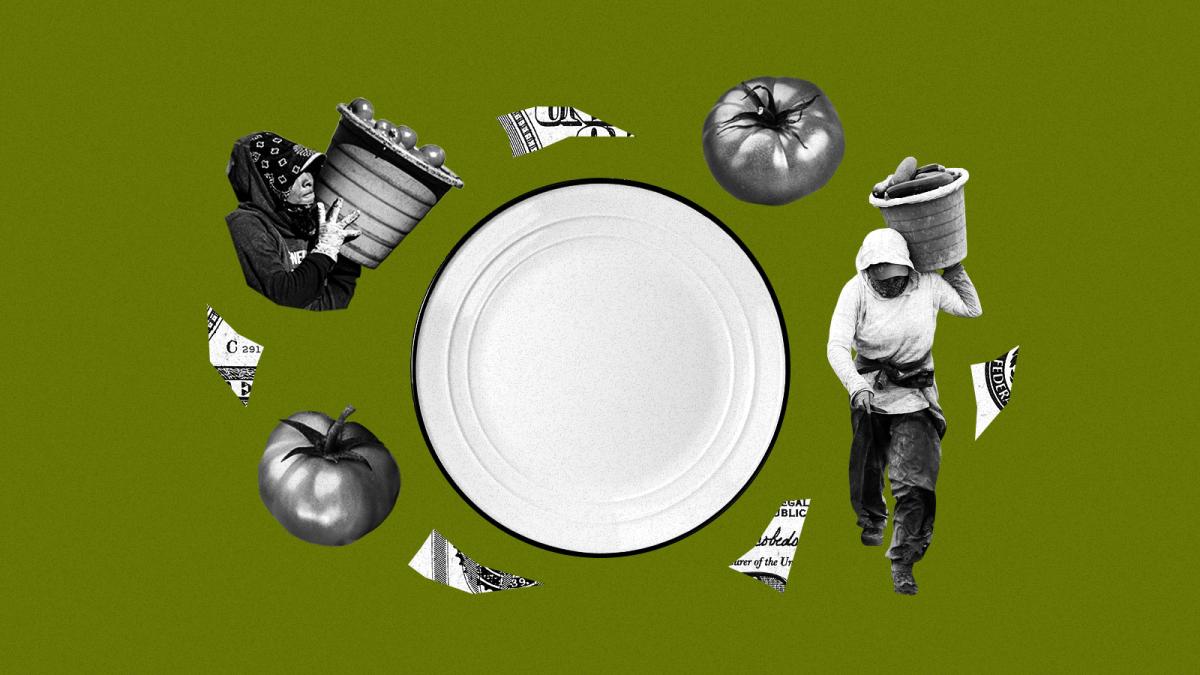

The people who feed America are going hungry
Climate change is escalating a national crisis, leaving farmworkers with empty plates and mounting costs.
Latest Articles
-
USDA chief made $100k from an Iowa power company
From an AP report:
Agriculture Secretary Tom Vilsack's income included $300,000 from the law and lobbying firm Dorsey and Whitney in Des Moines, Iowa; $100,000 consulting for MidAmerican Energy; $63,000 from Iowa State University; and $55,000 from other sources, including honoraria, a fellowship, a director's fee and consulting. In addition, he and his wife have $500,000 to $1 million in farmland that yielded $15,000 to $50,000 in rent, plus $7,552 from a U.S. Agriculture Department Conservation Reserve Program.
I've mentioned before that Vilsack recently stepped down from a partner role at Dorsey & Whitney, a corporate law firm that has represented Cargill, ConAgra, and other agribiz giants.
Some folks want to make a big deal about Vilsack making $7,552 from the Conservation Reserve Program. Not me. I'd rather see him idle land under CRP than drench it with agrichemicals to grow industrial corn.
The $63,000 from Iowa State University must be a reference to his role at that institution's Biosafety Institute for Genetically Modified Agricultural Products, where until recently he sat on the advisory board with representatives of Monsanto, Dupont's Pioneer Hi-Bred, and the World Bank. But I already knew about that.
What gets me is the $100K in consulting for MidAmerican Energy. MidAmerican Energy Holdings describes itself like this:
-
Industrially grown produce shows long-term nutritional decline
Talk to old-timers, and they'll often tell you that the tomatoes you find in supermarket produce sections don't taste anything like the ones they had in their childhoods in the '30s and '40s.
Turns out, they're probably not as nutritious, either.
In an article [PDF] published in the February 2009 issue of the HortScience Review, University of Texas researcher Donald R. Davis compiles evidence that points to declines in nutrition in vegetables and (to a lesser extent) fruits over the past few decades.
For example:
[T]hree recent studies of historical food composition data found apparent median declines of 5% to 40% or more in some minerals in groups of vegetables and perhaps fruits; one study also evaluated vitamins and protein with similar results.
He points to another study in which researchers planted low- and high-yielding varieties of broccoli and grain side-by-side. The high-yielding varieties showed less protein and minerals.
The principle seems to be that when plants are nudged to produce as much as possible -- whether through lots of synthetic fertilizers and pesticides or through selective breeding -- they deliver fewer nutrients. It evidently isn't just the flavor that's become diluted in those bland supermarket tomatoes.
This is a fascinating insight. We should reflect that for at least 50 years, the best-funded agricultural researchers are the ones work to maximize yield -- that is, gross output per acre. Even now, the Bill & Melinda Gates Foundation is expending hundreds of millions of dollars in an effort to increase yields in Africa.
Rather than isolate and fetishize yield, perhaps ag researchers should learn to take a whole-systems approach: study how communities can develop robust food systems that build healthy soil and produce nutritious food.
(It should also be noted that last year the Organic Center compiled peer-reviewed studies finding that organically grown produce tends to deliver significantly higher nutrient levels than conventional.)
-
Foodie photogs, rainforest adventures, and more
Every week, we compile a guide to the greenest goings-on in our hometown. We send it by email — sign up here! — and now it’s available in Gristmill. (Not in Seattle? Not a problem — we’ve got the inside scoop for you out-of-towners, too.) —– Combo meal: Elliott Bay Books is serving up a […]
-
Salmonella-linked Ga. peanut-butter plant had dismal sanitary record
Is it just me, or has our food-safety system lapsed into a state of decadence that might have made Caligula blush?
In the past few days, I've learned that the FDA ignored clear evidence that mercury was entering the food supply through high-fructose corn syrup; and that the FDA and USDA continue to ignore the increasingly obvious threat of antibiotic-resistant pathogens in industrial pork.
Now I hear mind-numbing news about the Peanut Corporation of America, whose Georgia plant is evidently the source of the salmonella outbreak that has sickened five hundred people, killing seven, nationwide.
Given the breadth of the outbreak and the sheer number of products infected, the company must have owned a mammoth share of the industrial peanut-butter market; its tainted paste has shown up in everything from health-food store staples like Clif Bars to supermarket fodder like Famous Amos cookies.
According to a recent New York Times report, sanitary conditions at the Georgia plant have for years approached the tragi-comic. And despite a steady stream of reproaches from Georgia health officials, the company was allowed to continue churning out peanut butter for the nation's food factories until the salmonella disaster struck. Here's a summary of the company's rap sheet:
-
The Gates Foundation's techy vision for African ag
In his first annual letter on the doings at the Bill & Melinda Gates Foundation, Bill Gates devotes a page to his foundation's efforts to boost agriculture in Africa.
Like the software wizard he once was, Gates identifies a problem and conjures up a solution. The problem is that African food production has stagnated while population has grown; the solution is to develop "new seeds" and make available "other inputs like fertilizer" so that farmers can "increase ... output significantly."
That, in a nutshell, is what happened in the U.S., Western Europe, and to a lesser extent India over the past half-century with the rise of industrial agriculture. Gates wants to repackage it for Africa, in what he calls a "new Green Revolution."
The document never considers the complex history of agriculture in Africa; nor does it mull the social and ecological effects of industrial-style agriculture in the West and India. Are we still so enamored of our food system that we feel compelled to export it to Africa?
A more robust vision for that continent's food future is laid out by the United Nation's Conference on Trade and Development and U.N. Environmental Program. Called "Organic Agriculture and Food Security in Africa" [PDF], the report emerged in 2008 with the support of more than a dozen civil-society organizations throughout Africa.
The report concludes that organic and near-organic agriculture is ideally suited for millions of marginalized smallholder farmers in Africa -- and build food security and soil fertility in unison.
The model of development that Gates favors -- essentially moving in the direction of nearly post-agricultural Western societies -- may be a relic of an era of cheap fossil energy and low awareness of ecological costs. Other ways of progress exist -- and I wish our most influential and best-funded foundation would explore them.
-
The FDA sat on evidence of mercury-tainted high-fructose corn syrup
High-fructose corn syrup rose from obscurity to ubiquity starting in the late 1970s, borne up by an informal public-private partnership between grain-processing giant Archer Daniels Midland and the federal government. For me, HFCS is at best a highly processed, lavishly subsidized, calorie-heavy, nutritional vacuum.
I recently visited a public high school in Boone, N.C. The main hall literally hummed with machines peddling variations on Coca-Cola's formula for success: fizzy water with artificial flavor, artificial color, added caffeine, and a jolt of HFCS. Other machines displayed snack "foods" tarted up with HFCS. Why are we feeding our kids this crap, again?
Now comes news that makes even an HFCS cynic like me do a spit-take over my home-brewed morning coffee. Turns out that HFCS is commonly tainted with mercury -- a highly toxic substance -- according to a peer-reviewed report published by Environmental Health (abstract here; PDF of the must-read full text here.)
The Environmental Health study draws on samples of high-fructose corn syrup taken straight from the factory. But no one drinks the stuff straight. What about, say, cookies sweetened with HFCS? The Institute for Agriculture and Trade Policy plucked HFCS-containing products from supermarket shelves and tested them for mercury. The result?
Overall, we found detectable mercury in 17 of 55 samples, or around 31 percent
Traces of mercury turned up in name-brand products from makers including Quaker, Hunt's, Manwich, Hershey's, Smucker's, Kraft, Nutri-Grain, and Yoplait.
That a ubiquitous industrial-food ingredient such as HFCS should be tainted by mercury is bad enough. But it gets worse. The FDA has apparently known about this since 2005 -- and done nothing to publicize it or change it.
-
Tainted peanut butter and our troubled food system
An email from a PR person recently hit my inbox claiming that by high-school graduation, the average American has consumed 1,500 peanut butter sandwiches. I certainly did my bit to hold up the average; to this day I revere the unctuous paste of crushed, roasted peanuts.
Now, of course, comes news that a large producer of this protein-packed national treat (widely reviled, for reasons I can't fathom, by people in other nations) has been sending out product that's tainted by a particularly nasty strain of salmonella.
The New York Times' Kim Severson has a good piece on how the suspect peanut butter moved through the industrial food system, working its way into products as diverse as Clif Bars and Famous Amos Cookies.
News accounts don't typically mention that good old peanut butter has been tainted for a while now -- by sweeteners and dodgy industrial products. Look at Jif (not implicated in the salmonella outbreak), which is owned by Smuckers, which also owns Crisco, Pillsbury, and Hungry Jack. Merely roasting peanuts and pureeing them with a little salt isn't enough for the makers of Jif peanut butter. Its ingredients include: roasted peanuts and sugar, plus "2 PERCENT OR LESS OF: MOLASSES, PARTIALLY HYDROGENATED VEGETABLE OIL (SOYBEAN), FULLY HYDROGENATED VEGETABLE OILS (RAPESEED AND SOYBEAN), MONO- AND DIGLYCERIDES AND SALT." Yuck.
Come to think of it, the PR person whose email got me thinking about this issue was actually peddling a smart solution: a high-powerd kitchen contraption that allows you to make your own peanut butter (among many other things). As our famously fragmented food-oversight system continues to fail and our industrial-food purveyors continue to pump unnecessary crap into our food, do-it-yourself solutions make more and more sense.
-
Sustainable coffee, contaminants in the Columbia, and more
Every week, we compile a guide to the greenest goings-on in our hometown. We send it by email -- sign up here! -- and now it's available in Gristmill. (Not in Seattle? Not a problem -- we've got the inside scoop for you out-of-towners, too.)
-----
A stimulating exhibit
You may have asked your barista for a half-caf soy latte with sugar-free vanilla syrup, but according to a new exhibit at the Burke Museum, you've really got the whole world in your cup. Opening this weekend, Coffee: The World in Your Cup examines the environmental and social implications of the coffee industry through a variety of media including photographs, live plants, videos, in-gallery tastings, and a wall-to-wall display of coffee bags from local roasters. On Saturday, sip coffee from local roasters while hearing from caffeine-bean experts. Return Sunday for formal coffee cuppings that will teach you how to appreciate the variety of flavors and aromas in each mug.Plan it: The Burke Museum is open daily 10 a.m.-5 p.m. Special events Saturday and Sunday, Jan. 24-25, begin at 10 a.m. and continue throughout the day. See schedule for details.
Map it: The Burke Museum, 17th Ave. N.E. and N.E. 45th St., Seattle, Wash.
Not in Seattle? Not a problem: Though it's at the Burke until June 7, this is a traveling exhibit that could be hitting a cultural museum near you. Until then, read up on which fair-trade, organic, shade-grown Central American coffee got highest praise from Grist Food Editor Tom Philpott.Read on for more Seattle news ...
-
Organic farming beats genetically engineered corn as response to rising global temperatures
This week Science published research ($ub. req'd) detailing the vast, global food-security implications of warming temperatures. The colored graphics are nothing short of terrifying when you realize the blotches of red and orange covering the better part of the globe indicate significantly warmer summers in coming decades.
The implications of the article are clear -- we need to be utilizing agricultural methods and crops that can withstand the potential myriad impacts of global climate change, especially warmer temperatures. The article significantly notes, "The probability exceeds 90 percent that by the end of the century, the summer average temperature will exceed the hottest summer on record throughout the tropics and subtropics. Because these regions are home to about half of the world's population, the human consequences of global climate change could be enormous."
Whether you believe global warming is part of a "natural cycle" or a man-made phenomenon is irrelevant. The bottom line is that our earth is rapidly warming, and this is going to drastically affect our food supply. We must undertake both the enormous task of reducing our carbon emissions now to avert the worst, while at the same time adapting our society to the vast and multitudinous effects of unavoidable global climate change. Failing to do either will, as the Science article indicates, have dire effects on a large portion of our world's population.
Determining the best course of action for ensuring food security in the face of global climate change remains a challenging task. Recognizing that climate change is slated to affect developing countries and small-scale farmers the most is a crucial point. Such understanding enables people to realize that viable solutions must be accessible, affordable, and relevant to the billions of small-scale farmers in the developing world. Unfortunately, it appears that some of the solutions on the table fail to meet these criteria.
Last week, Monsanto made a big public relations splash by filing documents with the FDA regarding a drought-tolerant GM corn variety it is developing with a German company, BASF. Monsanto claims that in field trials, the corn got 6-10 percent higher yields in drought-prone areas last year, but the release is extremely short on details. Regardless of the reality, Monsanto is presenting the corn as a way to help improve on-farm productivity in other parts of the world, notably Africa.
Yet, absent from the media hype were the many technical and social problems with Monsanto's corn.
-
Why conventional popcorn sucks, and what you can do about it
Dear Lou,
What about popcorn? Is it safe, healthy, and free of pesticides? What exactly is in the artificial butter flavor?
Thanks,
Greenee Trailer Trash from Mississippi
