Climate Food and Agriculture

Climate + Food and Agriculture
EDITOR’S NOTE
Grist has acquired the archive and brand assets of The Counter, a decorated nonprofit food and agriculture publication that we long admired, but that sadly ceased publishing in May of 2022.
The Counter had hit on a rich vein to report on, and we’re excited to not only ensure the work of the staffers and contractors of that publication is available for posterity, but to build on it. So we’re relaunching The Counter as a food and agriculture vertical within Grist, continuing their smart and provocative reporting on food systems, specifically where it intersects with climate and environmental issues. We’ve also hired two amazing new reporters to make our plan a reality.
Being back on the food and agriculture beat in a big way is critical to Grist’s mission to lead the conversation, highlight climate solutions, and uncover environmental injustices. What we eat and how it’s produced is one of the easiest entry points into the wider climate conversation. And from this point of view, climate change literally transforms into a kitchen table issue.
Featured
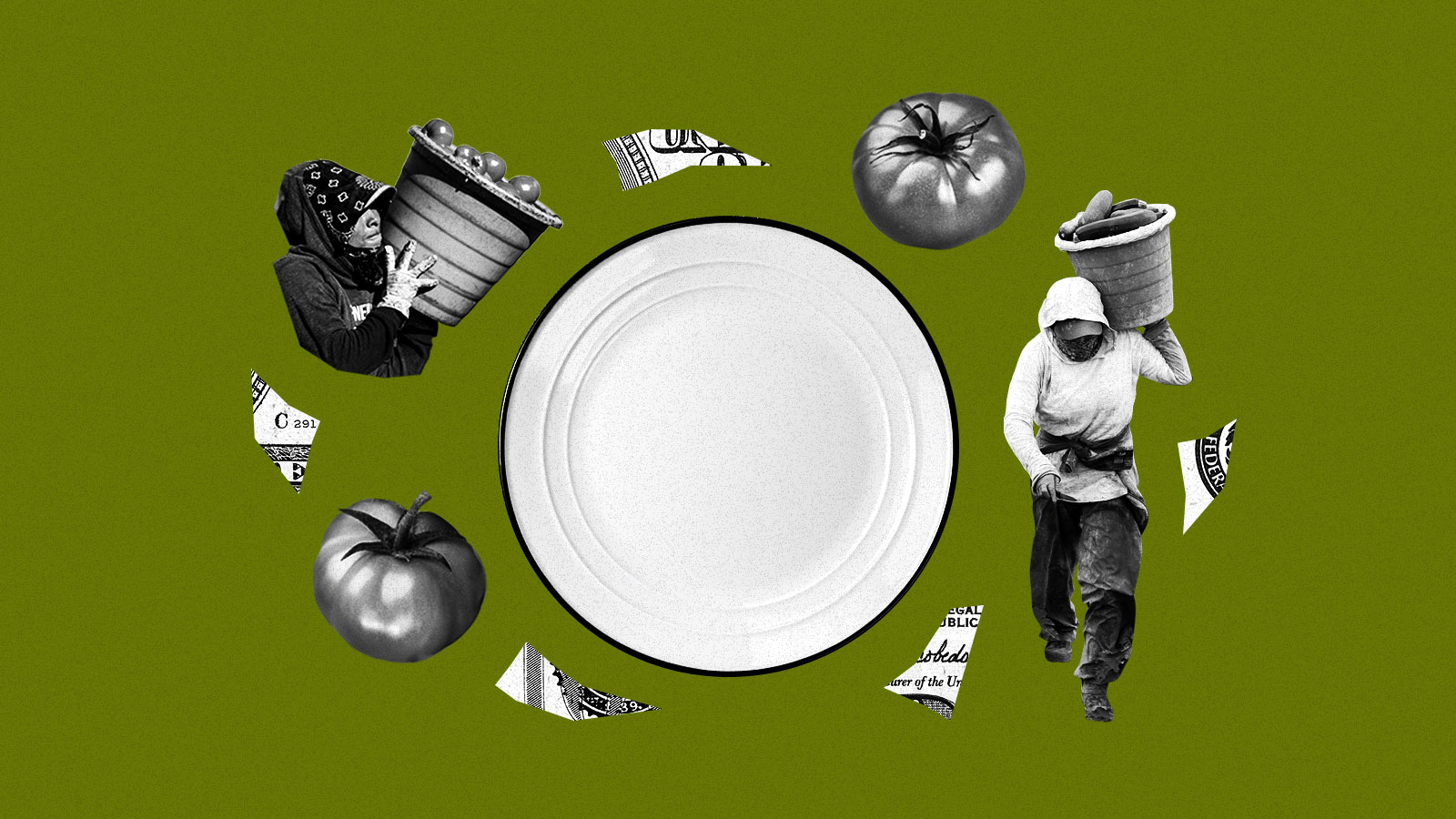
The people who feed America are going hungry
Climate change is escalating a national crisis, leaving farmworkers with empty plates and mounting costs.
Latest Articles
-
Tips for low-carbon merrymaking
 See that green line on the map? Study it closely, boozehounds. Those of you to the right of it can enjoy a nice French Bordeaux. Those to the left should be getting your Pinot from Napa.
So concludes Dr. Vino in his excellent -- and topical! -- study, "Red, White and 'Green': The Cost of Carbon in the Global Wine Trade."
The paper is nicely readable in addition to being thorough. Few details go unconsidered. Dr. Vino cares about the CO2 produced from the breakdown of sugar during the fermentation process. He mulls the land-use implications of grape production. He knows his screw caps from his corks.
All of these factors (well, not the corks) feed into a model that allows the paper's authors to compute the carbon content of different bottles of wine drunk in various points in the U.S. Some conclusions:
-
Our challenge: surviving the rule of economists
"Ending famine simply by ignoring the experts" heads the encouraging story of Malawi's turnaround on hunger ...
What's strange is that the "experts" in the piece are U.S. and British economists who advocated the standard imperial liberal solution (grow cash crops for export to us, and buy your food from us). Thankfully, the people of Malawi ignored such expertise and concentrated instead of the physical reality before them.
There is very little time for us to stop seeing our manifest crises in the physical and biological world through the lenses of "experts" who are themselves totally untrained in those fields of study.
-
The global nature of global warming
This is my formal rebuttal to Brooke Coleman (director of the Renewable Energy Action Project), specifically to comments found in Tom Philpott's latest corn ethanol article. I'm using my access to the bully pulpit to pull it out of comments, like I did the last time a corn ethanol enthusiast joined the discussion.
Welcome to the best environmental blog on the planet, Brooke. You don't seem to have a very high opinion of this community, but maybe you'll warm up to us. I don't speak for the whole community of course, I'm just one of the many who come here to learn and engage in reasoned debate.
You seem to think that anything is better than oil. But believe it or not, in the real world, we sometimes have to pick between the lesser of two evils, at least until something better comes along.
Plowing under the world's remaining grasslands and forests to grow industrial agrofuels dwarfs the damage done by oil spills. What happens when you take grain off the world food market and stuff it into American gas tanks? I'll tell you. Someone somewhere on this planet takes advantage of the high prices to plant more of it to fill the hole in the human food chain. Where is the arable land they need to do that? It is under an existing carbon sink or has another crop on it already. The second leading cause of global warming is deforestation. How hard is that concept to understand? Global warming is global. What we do here screws everybody.
-
Pesticide use on crops drops in California, but fumigant use up
Agricultural pesticide use dropped by 10 million pounds in California last year — a bit of progress offset by an increased use of fumigants by strawberry growers. In addition, application of commercial pesticides for uses such as landscaping and mosquito control increased. California “works hard to promote least-toxic pest management” says Mary-Ann Warmerdam of the […]
-
Organic bourbon
The New York Times says that bourbon is having its day in the sun, with small-batch, high-end distillers popping up all over the place. They’re shooting for the young connoisseur crowd, the same folks buying specialty cheeses, specialty breads, specialty coffee, specialty chocolates, etc. You know what would really attract that hip young crowd? An […]
-
Genetically modified sugar beets expected to be in widespread use in U.S. soon
The U.S. sweetener industry may soon have a new sugar daddy as it gears up for the widespread rollout of genetically modified sugar beets. GM sugar beets have been approved by the U.S. Department of Agriculture since 2005, but resistance from end-users such as chocolatiers Hershey’s and Mars had disrupted their widespread use. But now […]
-
Food prices going up, along with everything else
From an article in the Telegraph by Ambrose Evans-Pritchard (Hat tip to Gristmill reader KO):
What has abruptly changed is the twin revolution of biofuel politics and Asia's switch to an animal-protein diet. Together, they have shattered the fragile equilibrium.
Investors who want to take advantage of agflation must tread with care, both for moral reasons and questions of timing.Riiiight ... moral reasons.
The way I see it, you can go the PETA route and call the closest thing the environmental movement has to a hero (Nobel Laureate Al Gore) a hypocrite for eating meat, replete with a bulbous-nosed, pot-bellied caricature, or you can admonish your politicians to stop supporting biofuels. I suppose you could do both. I'm concentrating my firepower on the biofuel side of the equation.
Industrial agrofuels are still in their infancy. They have to be stopped now, before it's too late. As consumers, voters, and peaceful protesters, we have a measure of power. Let's start using it. Find an effective way to convince humanity to eat fewer animal products and I'll support that effort also.
More quotes from the article under the fold:
-
Europe may ban two types of genetically modified corn
Europe may end up sans two types of genetically modified corn, as E.U. environment officials have proposed a ban on the seeds. Officials say the GM corn, made by powerful biotech companies DuPont Pioneer, Dow Agrosciences, and Syngenta, could harm wildlife and disrupt food chains. E.U. Environment Commissioner Stavros Dimas said the genetically modified corn […]
-
The NYT gets its hands dirty
In Italy and France, people don’t love small farms just for the delicious food they produce. They also prize them for their looks — small-scale diversified agriculture is pleasing to the senses. So city dwellers often head out to the country on the weekend and hang out on farms, and support them with their tourist […]
-
Have an organic, free-range, local Thanksgiving
If you’ve waited ’til the last minute to buy ingredients for your Thanksgiving feast, allow us to suggest that you seek out turkeys of the organic, grass-fed, free-range, local, and/or heritage variety. Because no one’s thankful for pesticides in their gristle (or for butylated hydroxytoluene, for that matter). Apples, celery, and potatoes are all high […]
