This coverage is made possible through a partnership between Grist and BPR, a public radio station serving western North Carolina.
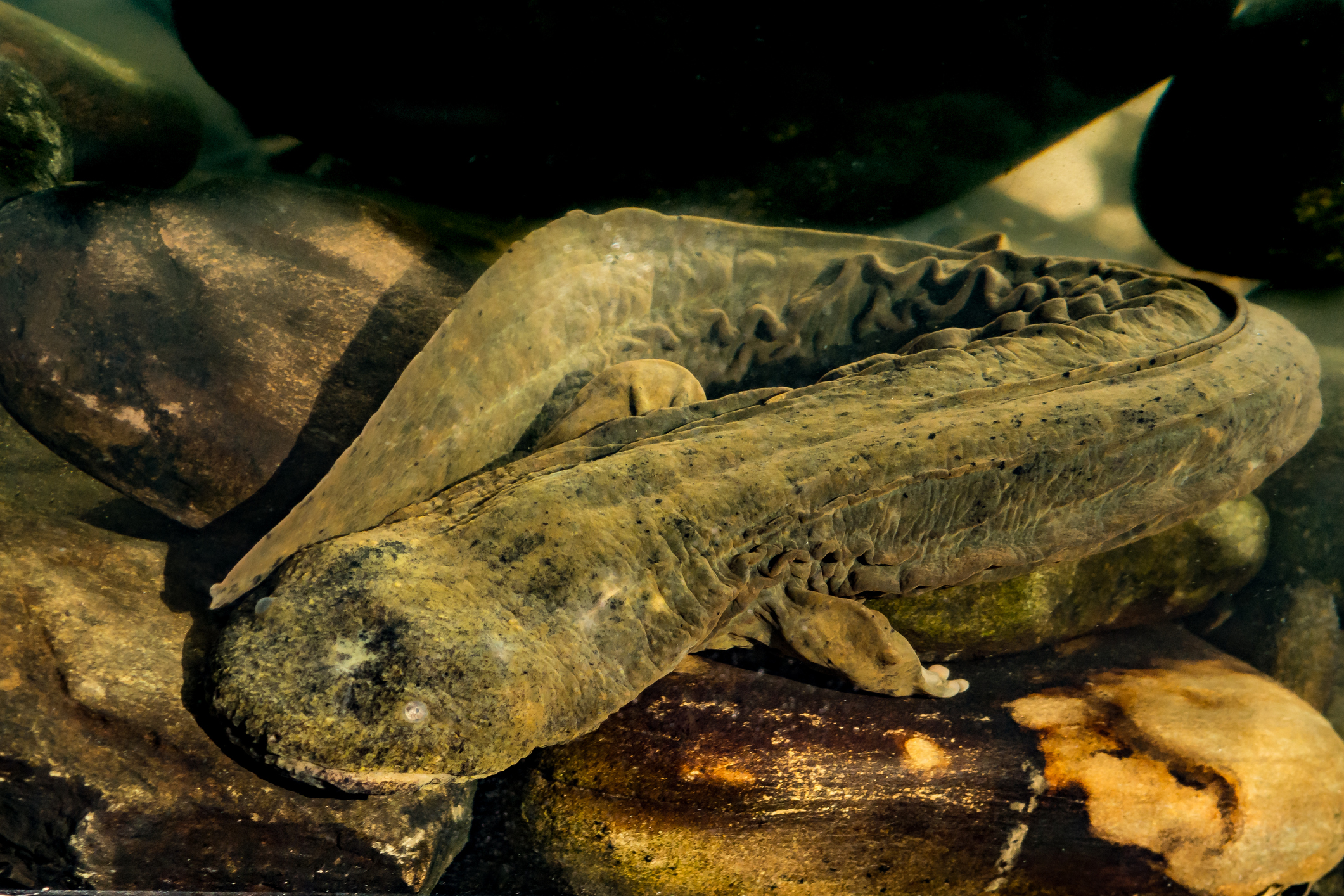
Andy Hill keeps a wetsuit and snorkel in his car at all times. Sometimes, when he’s driving around Watauga County, North Carolina, he’ll see a particularly clear, swift stream, pull off, suit up, and go looking for an elusive neighbor: the hellbender, a slimy, graceful, and rare salamander widely beloved throughout the Appalachian Mountains. Hellbenders are an iridescent marbled gold and brown when seen underwater, grow to more than 2 feet long, and can live to 30 years old.
For Hill, spotting one isn’t just a curiosity — it’s a moment that borders on spiritual, tied to an animal that many see as part of the region’s identity as much as its ecology.
“The first time that I saw one in real life, in the Watauga River, it changed me,” said Hill, who works as the Watauga riverkeeper for western North Carolina environmental nonprofit MountainTrue. “They’re kind of otherworldly looking.”
The hellbender is a celebrity wherever it’s found. In the Blue Ridge Mountains alone, there are beers, breweries, baseball teams, puppets, and festivals named after it; jokes about it being “from hell” abound. Exhaustively documented nicknames include the mudpuppy, snot otter, and mud devil. In reality, the animals are shy, spending most of their lives under large, flat rocks in cold, high-mountain streams. They’re also environmentally sensitive — a sort of climate bellwether, as Hill said, because they are best suited to water temperatures between 55 and 63 degrees Fahrenheit, and expected to struggle as streams warm with climate change.
Threats lie ahead, but for the eastern hellbender, so much has already been lost. Because they breathe through their skin, the critters require pristine water. But after spending 160 million years living quietly in the same waters their ancient ancestors did, pollution, habitat loss, and collection for the illegal pet trade have driven them ever closer to the graveyard of geologic history. Although the beloved amphibian is still found from Mississippi to New York, 60 percent of the populations once found throughout the East are in active decline. Just 12 percent are holding steady.
Now, Hill worries they may be losing their chance at federal protection.
The U.S. Fish and Wildlife Service was expected to designate the hellbender an endangered species by the end of last year, but the decision never came. Instead the salamander, along with other flora and fauna, was moved to a “long-term actions” list. Not a single species has been listed since President Donald Trump began his second term. The Center for Biological Diversity recently filed a lawsuit to force action.
The Fish and Wildlife Service declined to comment, but sent Grist a list of resources, including documents listing the next regulatory step as “to be determined.”
“It’s basically just a bureaucratic delay tactic that doesn’t put a definite date on enacting protection for any endangered species,” said Tierra Curry, an endangered species co-director with the Center for Biological Diversity, which has been pushing for federal protection of the hellbender since 2010.

Although several states, including North Carolina, have listed it as a species of concern, the journey has been marked with obstacles. In 2019, before this renewed push for federal protection, the first Trump administration declined to list the hellbender under the Endangered Species Act, saying captive breeding and release efforts were enough to keep populations healthy. Conservationists do not agree.
The animal’s defenders have hoped federal intervention could interrupt its downward spiral while safeguarding mountain streams as a whole. “Things like clean cold water and these protections would benefit the rest of the ecosystem as well, your native fish and mussels, as well as game fish like trout — and then that ties into our recreation, tourism, economy,” Hill said. “So protecting the hellbender is protecting the vital cultural, environmental, and economic resources of Appalachia as well.”
People in western North Carolina, where vast national forests have long provided one of the last real havens for the species, find these developments deeply concerning. After Hurricane Helene, storm survivors were devastated to find hellbenders washed across mountainsides or wandering — and dying — on roads and even in flooded homes. Hill, along with researchers at Appalachian State University and others, is still tallying the impact, but he’s seen some populations decline by as much as two-thirds.
Despite Washington’s inaction, the local community is expressing its passion, and concern, for the hellbender in as many ways as it can. Four months after Helene devastated the region, Hill worked with Dalton George, the mayor of Boone, North Carolina, on a resolution calling for the salamander’s federal protection. The town later commissioned a hellbender mural and received what George described as bipartisan support for the town’s favorite blobby little creature.
“That’s what’s frustrating to me as a leader,” said George, who also works as the organizing director for the Endangered Species Coalition. A community of conservatives and progressives, of Republicans and Democrats, “all come together and say we’d like to see the hellbender protected” — and yet nothing has happened.
George said the hellbender is more than a beloved animal. It is a symbol of belonging and endurance. Its struggles also seem to reflect a sense of anxiety many residents feel about change in the mountains.
“A lot of people see themselves in the story of the hellbender,” he said. “Lots of folks in Boone and Appalachia feel like they’re being displaced. They feel like there’s fewer places that are made for them to live.” That displacement echoes in the lives of the hellbenders, whether they bear out the storms under their flat, cool rocks, or ride out rising waters to parts unknown.