👋 Hi, everybody. Today, we’re going to talk about something that’s probably been on all your minds of late: data centers. The cons, from a climate and environmental standpoint, are clear. But the build-out also could present some surprising opportunities … if we fight for them.
We’ve also got news about balcony solar, a U.N. forum for Indigenous peoples, and the return of the Green New Deal. And … the FINAL photo in our Earth Month scavenger hunt! Find the quiz below this week’s main story. You all have until next week’s newsletter to answer! Then we’ll lock in the final leaderboard, and the winner(s) will receive their bragging rights — plus a copy of my colleague Jake’s book, The Great Displacement.
Happy guessing. 🌎
This post originally appeared in Grist’s weekly solutions newsletter, Looking Forward. Not on our list yet? Subscribe here to get it in your inbox every Friday.
Ask what the data center can do for you
George Frey / Getty Images
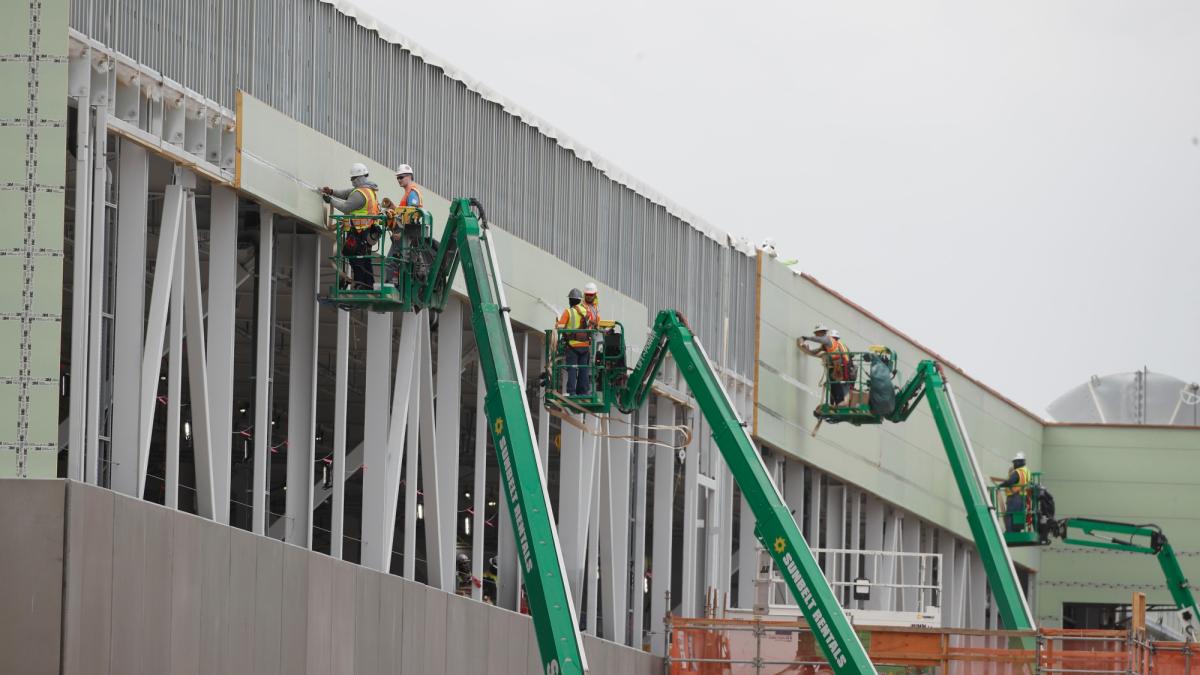
If you’ve been following the national conversation about the AI-driven data center build-out, you probably have some concerns. Like, how much water are these facilities going to slurp up? How much energy? Will they raise our utility bills? And what good is all of this, when AI is just going to steal our jobs and trap us in a dystopian hellscape where we can’t tell what’s real anymore?
Several of my colleagues have been reporting on those questions (the first few, anyway), looking into the realities of what is actually a very, very complicated picture that varies dramatically region by region and project by project.
Data centers do use a lot of water, both directly and indirectly through their power consumption. But just how much water depends on where they’re built and how they get their energy. In water-stressed Arizona, for instance, data centers don’t appear to have added major strain to the state’s water supply (yet).
And data centers do require a ton of power, stretching the capabilities of many states to provide it. But in most regions around the country, data centers are not the biggest forces driving energy bills up (yet). In some places they’ve even pushed consumer power bills down by shouldering some of the cost of infrastructure.
My colleague Naveena Sadasivam has been doing a lot of this work of trying to untangle the concerns data centers are raising for communities.
“From my own coverage, I think some pieces can come off as if I’m trying to say it’s not that big a deal, people are freaking out for no reason. And that is absolutely not the case,” Naveena told me. Concerns about localized pollution (including noise and heat pollution) as well as stress on the grid and other common resources are warranted, she said.
“From a climate perspective, the biggest concern I think is the build-out of natural gas that we’re seeing right now to power these data centers,” Naveena said. Because they have such high energy demand, and wait times to connect to the grid can be long, many data center developers are building their own power generation on-site, often using natural gas, and often with less efficiency than conventional power plants.
But it is worth noting that it doesn’t have to be that way. Data centers can run on clean energy, too, and some are building solar instead of natural gas.
One of the biggest problems is that, while there are ways to minimize the impacts of new data centers, there’s not much of a process in place to make sure that happens.
“What we’re seeing right now is kind of a piecemeal approach on both ends,” Naveena said. Utilities across the country are entering into a variety of different agreements with data center developers, with some trying to prevent strain on the grid and power bill increases. Cities and states are also considering a range of measures, including pauses in new development.
“And then on the other side of it, in terms of the community opposition, it’s also a piecemeal approach where every community is having to educate themselves on data centers and then build up capacity to fight back” or push for certain guarantees, Naveena said.
But that opposition has been mobilizing fast, and in my conversation with Naveena, we pondered whether that backlash could actually end up pushing developers on a large scale to be part of transforming communities for the better.
That’s partially the premise of a report from the policy think tank Searchlight Institute, which Naveena recently wrote about, offering a vision of a nationalized approach to ensuring the data center build-out will actually benefit society. It proposes setting up a fund that hyperscalers (the biggest data center operators) would pay into, in exchange for moving up the queue to connect to the grid and get the energy they need. The money would go toward a much-needed grid modernization effort, meeting the data centers’ demand while also supporting the broader movement to electrify our lives and prioritize clean, renewable power.
Essentially, the report argues, the amount of private funding that’s on the table right now creates an opportunity that we wouldn’t otherwise have to make sweeping updates to our aging grid, lifting all boats in the process.
It is somewhat of a lofty idea. But the report’s framing could also inform the more piecemeal approach that many cities, states, and communities are already taking to not only oppose data centers, but negotiate with them. That may be for grid improvements, new clean energy, or something else. In one example in Medina County, Texas, residents were primarily concerned about increased traffic; officials negotiated a deal with the incoming data centers that included paying for road improvements.
The overall takeaway may be that communities do have power in the data center conversation, and there may yet be room to make the build-out work more to their benefit — even if it doesn’t end up looking like the unified approach that Searchlight’s report suggests.
“I see it more as a conversation starter,” Naveena said, “kind of helping us reframe this moment a little bit.”
Dive deeper:
- Data centers are straining the grid. Can they be forced to pay for it?
- What’s behind your eye-popping power bill? We broke it down, region by region.
Earth Month scavenger hunt

OK, crew. There’s the current leaderboard, heading into our final week of this Earth Month scavenger hunt! Are you ready for your last guessing prompt?
Take a moment to sit with this photo:

Do you think this photo is in:
- Antarctica
- Norway
- Canada
- Greenland
- Iceland
>>> Submit your answer here. (And follow the instructions to get your points for this final week!)
More from Grist
⚖️ At the forum
This week, delegates are gathering in New York for the U.N. Permanent Forum on Indigenous Issues. One challenge on the table: how to translate legal victories and obligations into real action for global climate justice. Read more
☀️ Coming soon to a balcony near you
Utah became the first U.S. state to legalize balcony solar last year. Now, 30 more states have drafted similar bills to facilitate the spread of this technology, even as Utah continues to figure out the remaining hurdles to making it a reality. Read more
🟢 Green new year, green new me
Remember the Green New Deal? The much ballyhooed policy framework has been born again — now as the “working-class climate agenda,” emphasizing how climate action and affordability measures can go hand-in-hand. Read more
🌎 And one more thing
Boston is holding its first Climate Week, May 3-10, and Grist will be there leading a conversation on how low-carbon transportation and mobility solutions are taking root in the Boston area. The session is hosted at ClimaTech and you can get tickets here. Use discount code GRIST2026 for 15 percent off. (ClimaTech is a two-day summit that includes a ton of sessions and is priced accordingly. Grist is committed to inclusive access to this event — please email [email protected] to request a complimentary ticket if the price is a barrier.)
Not in Boston? Find a Climate Week near you here! (And if you don’t see your hometown on the list, click “partner with us” to organize a Climate Week where you live.)
In other news
- Following the historic fires and recent major storms, community groups are rebuilding Lahaina, Hawai’i — for locals, not tourists (The Guardian)
- New research finds that rainforest ecosystems may be able to rebound much more quickly than previously thought (The New York Times)
- This venture capital firm says it’s the first one focused on biodiversity and maximizing ‘ecological returns’ (Vox)
- A mineral known as perovskite could supercharge solar panels. A new factory just opened to bring the tech to market. (Canary Media)
- Famed botanist and author Robin Wall Kimmerer is igniting a new restoration movement with the motto ‘plant, baby, plant’ (Atmos)
And finally, looking forward to …
… heck, let’s indulge in imagining a future where our benevolent AI overlords actually do save the planet for us all — even if the result is a little spooky. This drabble, titled “The Planetary Counsel,” was sent in by Looking Forward reader Susmita Ramani.
0️⃣0️⃣1️⃣
After reading the bulletin on their door, Willow sighed. “We have to meet with the Machine.”
“What’s that again?” Laurel asked.
“The world’s combined computers,” Willow said. “Scientists gave it a set of rules, asking it to make the planet healthy. The Machine made itself the lawyer for forests, oceans, rivers, and wetlands. It’s irreversible. Humans are deprioritized.”
“Do we have to meet because of what I did?” Laurel asked.
Willow nodded. “Don’t worry, sweetie. Just never put glitter into a river again, or we might get cut off from technology and have to live off-grid like your uncles.”
— a drabble by Susmita Ramani
0️⃣0️⃣1️⃣
A drabble is a 100-word piece of fiction — in this case, offering a tiny glimpse of what a clean, green, just future might look like. Want to try writing your own (and see it featured in a future newsletter)? We would love to hear from you! Please send us your visions for our climate future, in drabble form, at [email protected]
👋 See you next week!