Skip to content
Grist home
Grist home

Climate Food and Agriculture

Amelia K. Bates / Grist
Special Series

Climate + Food and Agriculture

EDITOR’S NOTE

Grist has acquired the archive and brand assets of The Counter, a decorated nonprofit food and agriculture publication that we long admired, but that sadly ceased publishing in May of 2022.

The Counter had hit on a rich vein to report on, and we’re excited to not only ensure the work of the staffers and contractors of that publication is available for posterity, but to build on it. So we’re relaunching The Counter as a food and agriculture vertical within Grist, continuing their smart and provocative reporting on food systems, specifically where it intersects with climate and environmental issues. We’ve also hired two amazing new reporters to make our plan a reality.

Being back on the food and agriculture beat in a big way is critical to Grist’s mission to lead the conversation, highlight climate solutions, and uncover environmental injustices. What we eat and how it’s produced is one of the easiest entry points into the wider climate conversation. And from this point of view, climate change literally transforms into a kitchen table issue.

Latest Articles

  • Popular fumigant found to be a potent greenhouse gas

    Update [2009-3-14 16:17:10 by Tom Philpott]:The original version of this post, titled "Strawberry Surprise," contained errors that I regret. I had mistakenly read the below-linked account of an MIT study to mean that sulfuryl fluoride was registered for use by the EPA as a pre-planting fumigant for strawberries. Actually, the chemical is registered only for post-harvest use on food, as well as a structural fumigant for termites. I also reversed the phrases "methyl bromide" and "methyl iodide" on two occasions. Again, I regret these errors.

    -----------------

    Chemical fumigants are a staple of the industrial-food system. They're used to sterilize soil before planting large monocrops, and also to control pests in stored food like grain and dried fruit. The building industry, too, uses them, mainly to fight termites. In the past, fumigants have caused much environmental damage, and tend to be quite toxic for humans, too. Now comes news that the building industry's new favorite fumigant -- sulfuryl fluoride -- is a greenhouse gas 4,800 times more potent than carbon dioxide, according to a recent MIT study.

  • Paul Roberts' MoJo article on farming gets big idea right and details wrong

    I like Paul Roberts. I liked his book The End of Food. But I must admit that I was a bit underwhelmed by his recent article on sustainable farming in Mother Jones, "Spoiled: Organic and Local Is So 2008." That's not to say there's nothing to recommend it. His central premise -- that we way we're farming today isn't sustainable and that no large-scale model of what sustainable agriculture would look like currently exists -- is valid and important (as anyone who hangs out around here is well aware).

    And any article that gets its money quote from sustainable ag guru Fred Kirschenmann is certainly on the right track. Said Kirschenmann, "We've come to see sustainability as some kind of fixed prescription -- if you just do these 10 things, you will be sustainable, and you won't need to worry about it anymore." Which isn't true, of course.

    But that title! Shouldn't it be "conventional agriculture" that's so 2008? Meanwhile, there were far too many straw men in the article for my tastes (ever eaten a straw man? Blech!) Take, for example, the thought experiment supplied by environmental scientist Vaclav Smil on the effect of totally eliminating the use of synthetic fertilizer:

    Such an expansion, Smil notes, "would require complete elimination of all tropical rainforests, conversion of a large part of tropical and subtropical grasslands to cropland, and the return of a substantial share of the labor force to field farming -- making this clearly only a theoretical notion."

    That's probably accurate as far as it goes. But it's unclear how he modeled this version of organic agriculture - at a minimum it appears to be a vast oversimplification. And his conclusion then becomes the basis upon which to reject the whole organic concept. Meanwhile, look at one of Smil's central assumptions -- that "dietary habits remain constant," i.e. in his experiment we're all eating as much meat, high-fructose corn syrup, and processed foods as we are now. Well, to take one example, you don't have to look far to find folks who will tell you that current meat consumption, especially red meat consumption, is the sine qua non of unsustainability -- Roberts himself held forth at length on that very point in his book. By holding that constant, you've just pre-determined the outcome of your thought experiment. And look at a crucial element in Smil's calculation -- that he's trying to determine "the extra land we'd need for cover crops or forage (to feed the animals to make the manure)." Now I don't know for sure if he presumes the forage will be pasture or cereal (aka corn), but either way that's a pretty high bar he's set.

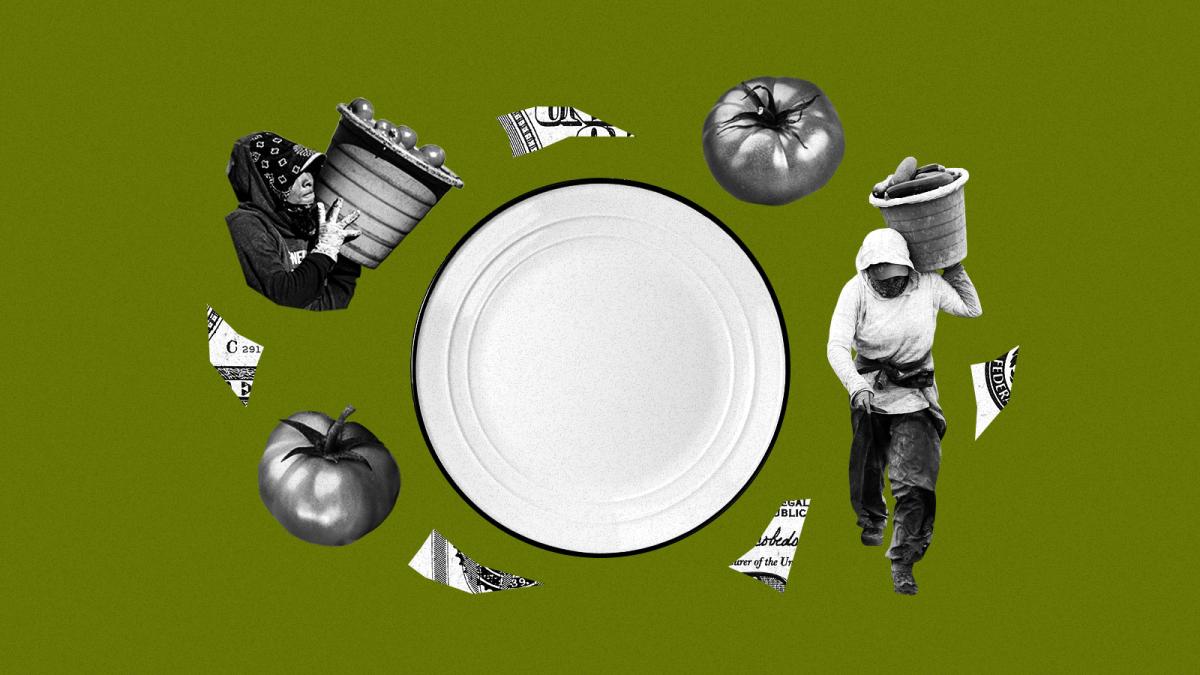
  • The human cost of industrial tomatoes

    Do you know who picks your tomatoes? As Tom Philpott discovers during a trip to Florida tomato country, farmworkers suffer low wages, squalid living conditions, and even slavery.

  • Alice Waters' move into the political sphere is hitting some bumps

    I'm hesitant to step in the middle of any debate over Alice Waters' contributions to food policy. But suffice it to say that, as she moves more and more aggressively into politics, she is taking some hits. Ezra Klein sums up the Alice Waters paradox this way:

    Good food -- the sort Waters features at her restaurant -- is considered a luxury of the rich rather than a social justice issue. As Waters frequently argues, no one is worse served by our current food policy than a low-income family using food stamps to purchase rotted produce at the marked-up convenience store. Her vision is classically populist: It democratizes the concrete advantages -- health, pleasure, nutrition -- that our current food system gives mainly to the wealthy. But her language is suffused with the values and the symbols of, well, the sort of people who already eat at Waters' restaurant. Thus, in promoting an agenda that benefits poor people with little access to fresh food, Waters tends to communicate mainly with rich people interested in fine dining.

    She's been fighting the elitist tag for some time -- as well as a reputation for being a bit, well, overbearing. According to a recent article in Gourmet, she overwhelmed even former President Clinton years ago with her passion over a White House vegetable garden. After receiving a letter from the Clintons suggesting that a front-lawn vegetable garden wasn't in keeping with the formal landscaping of the White House, Waters couldn't restrain herself:

    [S]he fired off another letter. Apologizing for "being so insistent," she begged to differ, reminding him that "L'Enfant's original plan for the capital city was inspired by the layout of Versailles, and at Versailles the royal kitchen garden is itself a national monument: historically accurate, productive, and breathtakingly beautiful throughout the year."

    It was the end of their correspondence.

    Ouch. And the Obamas, while unfailingly polite in person, have so far resisted Waters' attempts to be pulled into their circle of informal advisors. Having nothing to do with Waters, it's well-known that hobnobbing with aesthetes can be dangerous to your electoral prospects and the fact remains that Waters is, at heart, just that.

  • Checking out the scene in the nation's industrial-tomato capital

    Tomorrow, I'm heading down to Immokalee, Florida, to check out conditions in our nation's tomato basket. During the growing season -- between December and May -- something like 90 percent of tomatoes consumed in the U.S. come from the area in south Florida anchored by Immokalee.

    I'm going as part of a delegation of food-oriented writers and activists including authors Frances Moore Lappé and Raj Patel, Slow Food USA president Josh Viertel, and others.

    For decades, working conditions in South Florida's prodigious tomato fields have ranged from ruthlessly exploitative to outright slavery. Even under the best conditions, wages are stagnant and workers live in poverty.

    Yet workers in the area, represented by the Coalition of Immokalee Workers, have made headlines in recent years by forcing gigantic tomato buyers like Taco Bell and Burger King to pony up an extra penny a pound -- which would cost fast-food companies a tiny sliver of profit, but represent the first substantial wage gain for pickers in decades.

    There's a catch: the state's growers cooperative, the Florida Tomato Growers Exchange, refuses to pass on the raise to workers. Thus workers still get 45 cents for every 32-pound basket they fill -- a wage that hasn't budged in years, eroded by steady inflation.

    Immokalee is one of the hotspots of of a globalized, industrial food system. The plight of its workers -- many of them refugees from small farms in Mexico and Central America that have collapsed under the weight of that same system -- represents just another externalized cost of stocking supermarkets, fast-food outlets, and school cafeterias with "cheap" food.

    For a great brief backgrounder on the Immokalee situation, check out Barry Estabrook's piece in the current Gourmet.

    Look for a wrap-up of my Immokalee trip on Friday.

  • The president's budget hints at a coming battle over one kind of ag subsidy

    When President Barack Obama said during his recent address to Congress that "in this budget, we will... end direct payments to large agribusinesses that don't need them," he set off a firestorm of speculation. Now that the budget outline has been published, we finally have an understanding of what he meant. Yes, as we suspected, he was indeed referring to a specific subsidy program called "direct payments." Jill Richardson explains:

    Direct payments are a result of the 1996 farm bill. Prior to that, subsidies were given based on need. If you couldn't sell your crops at a price the government thought was fair, you got a subsidy to make up the difference...

    If you own land where commodities were grown (by you or someone else) in the past, you get a direct payment whether you grow anything or not. You could do nothing, potentially, and still receive a direct payment. Does that sound stupid? I think so too.

    Your direct payment is calculated on your "base acres." They keep a running average of how much you grew on your land (or how much somebody grew on your land if it wasn't you), and that yield determines how much you get in government cash. During the past farm bill debate, grain prices were high and farmers were doing well, but the direct payments kept flowing in.

    Meanwhile, the budget language looks like this [PDF]:

    As part of an effort to transition large farms from direct payments provided to owners of base acres to increased income from revenue derived from emerging markets for environmental services, the President's Budget phases out direct payments over three years to farmers with sales revenue of more than $500,000 annually... Large farmers are well positioned to replace those payments with alternate sources of income from emerging markets for environmental services, such as carbon sequestration, renewable energy production, and providing clean air, clean water, and wildlife habitat.

  • A new low-carbon (if not low-carb) way to cook the Italian staple

    When it comes to Italian cooking, I'm very Church of Marcella Hazan, orthodox sect.

    What the exacting doyenne of Italian food tells me to do in her Essentials of Classic Italian Cooking, I do. No questions asked. In her celebrated chapter on pasta -- which I revere like Christians revere the Gospels -- Hazan had this to say about the role of water:

    Pasta needs lots of water to move around in, or it becomes gummy. Four quarts of water are required for a pound of pasta. Never use less than three quarts, even for a small amount of pasta.

    She also laid down the law on salt in pasta cookery.

    For every pound of pasta, put in no less than 1 1/2 tablespoons of salt... Add the salt when the water comes to a boil.

    For about 15 years, through literally hundreds of pounds of pasta (I conservatively estimate 650 pounds), I followed these instructions. The great results I got were like worldly riches to a Calvinist -- proof that I had chosen the right path.

    Now everything has changed. Reality has been overturned. In a recent New York Times article, the eminent food-science writer Harold McGee issued a decree tantamount to a papal renunciation of the Immaculate Conception.

    Turns out, you don't need "lots of water" for pasta -- two quarts will do. As for salt, two teaspoons is enough. (Although, in terms of salt-per-water, McGee's suggestion is only a little less than Hazan's.) Moreover -- this is the part that really sent a cold chill of apostasy down my spine -- you can put the pasta in the water before it boils; while it's cold, in fact.

    For the non-food-obsessed, there is a green angle here.

  • Why isn’t ‘organic pesticide’ an oxymoron?

    In Checkout Line, Lou Bendrick cooks up answers to reader questions about how to green their food choices and other diet-related quandaries. Lettuce know what food worries keep you up at night. Ms. Bendrick, I have a question about pesticides and organic food. I buy organic both to encourage the right kind of farming and […]

  • Kathleen Merrigan is a progressive's dream pick for the USDA

    I guess this whole "activism" thing sometimes works. To have Kathleen Merrigan, one of Food Democracy Now's Sustainable Dozen, named deputy secretary of agriculture is, as Tom Philpott suggests, a huge win for progressives. Say what you will about the USDA Organic program, but Merrigan, as its author and later its enforcer, has been without question battle-tested.

    In his post, Tom linked to Samuel Fromartz's perspective on Merrigan from back in November. But it's worth digging in to the comments as well. There you'll find none other than Frank Kirschenmann (another Sustainable Dozener about whom I've written) giving Merrigan his hearty endorsement.

    Further down is evidence in the form of a WaPo profile from 2000 (now behind a firewall) that Merrigan didn't shy away from battles. I was particularly struck by her conflicts with the various agricultural advisory committees -- a bunch of guys who clearly lacked both social graces as well as a sense of humor:

    After Merrigan was appointed in June, she immediately launched a controversial crusade to diversify those white-male-dominated advisory committees, forcing them to establish outreach plans to recruit women, minorities and disabled people. In many cases, she refused to forward their nomination slates to Agriculture Secretary Dan Glickman until she was satisfied with their commitment to diversity.

    After she blocked nominations to the Florida Tomato Committee, complaining that it hadn't made a "significant effort" to attract women and minorities, the Weekly Standard, a conservative magazine, lampooned her in an article titled "Attack of the Tomato Killers." The Packer, an agricultural publication, described her crusade as "Beltway Blindness." In a nasty letter to Glickman, committee manager Wayne Hawkins said he was resigning and going into business: "I plan to find a female Afro-American who is confined to a wheelchair to be my partner. This way I will meet all of the government diversification requirements."

  • Let's mend, not end, ag subsidies

    "It's a dead end to try and eliminate subsidies, because then you get all of America's farmers, who have political power out of all proportion of their number, unified against change. Right now the incentives are to produce as much as possible, whatever the costs to the environment and our health. But you can imagine another set of assumptions, so that they're getting incentives to sequester carbon. Or clean the water that leaves their farm, or for the quality, not the quantity, of the food they're growing."

    -- Michael Pollan, reflecting a growing consensus