Skip to content Skip to site navigation

Food

Comments

One ag-gag bill is dead in California, another is approved in Tennessee

Animal activists will be able to secretly document systematic animal abuse in California without violating state law.
Shutterstock
This little piggy might be better off in the Golden State.

A California state lawmaker withdrew a bill Wednesday that would have prevented animal activists from documenting systematic cruelty inflicted upon farm animals.

Unlike in other states, where similar ag-gag bills have been approved or are winding their way through legislatures with little public fanfare, the bill sponsored by Rep. Jim Patterson (R) triggered an outcry of opposition in California.

Patterson's legislation had been pushed by the California Cattlemen's Association, a lobbying group that represents ranchers and beef producers. The bill was was disingenuously framed as an effort to clamp down on animal cruelty -- kind of a war-is-peace deal, except on animal farms.

The latest version of the legislation, before it was yanked, would have required anybody who filmed or photographed abuse of livestock to turn over the evidence to law enforcement authorities within five days. That was framed as an effort to immediately rectify abuses. Because Patterson and the California Cattlemen's Association love animals so, so much. In reality, it would have made it almost impossible for animal activists to legally document long-running, systematic patterns of animal abuse; instead they would have been forced to blow their cover every time they filmed a single transgression or else risk being prosecuted and fined.

Comments

What I learned from a month of eating vegan

vegetable face plate
Shutterstock

A little more than a month ago, I expanded Team Greenie Pig to four and set out on a month-long challenge to eliminate animal products from our diets. Would we discover an entirely new way of eating? Experience a miraculous increase in vitality? Or crash and burn spectacularly over an irresistible salumi plate? And would any of us end up converting wholly to veganism?

One thing we all agreed on: We learned a lot. Now it’s your turn: I encourage -- nay, dare -- you to try the vegan experiment yourself. It’s challenging, surprising, and utterly worthwhile. But before you do, here are some of those lessons we learned along the way.

It’s hard.

Surprise, surprise: Departing from the eating and cooking habits you’ve developed over decades -- particularly if you developed them in contemporary, fast-food-lovin’, steak-and-potatoes-havin’, pizza-partyin’ America -- is challenging. I normally eat meat sparingly and front-load my plate with veggies anyway, and still I found the strict vegan thing to be hard.

It’s the little things: I missed butter and cheese (way more than meat). A bunch of my favorite whole-grain products were blacklisted for their honey content. I struggled with suddenly becoming the “difficult" guest at dinner parties and evenings out. Convenience foods got a whole lot less convenient. And eating well requires research: “The real start-up cost to veganism is a massive increase in the amount of time it takes to evaluate, plan, and execute great food,” notes my fellow vegan-for-a-month, Matt.

I’m sure this gets easier with practice. But insisting that a paradigm shift in dietary habits isn’t hard is a real disservice to anyone who’s struggling to adjust to it.

But not that hard.

Read more: Food, Living

Comments

Fertilizer facility blast in Texas claims multiple lives, destroys homes

A fertilizer mixing and storage facility exploded in rural Texas on Wednesday evening, killing at least five people, injuring more than 160 others, destroying homes, and filling the air with noxious fumes.

burning fertilizer plant
Reuters / Mike Stone

As many as 15 are feared dead, including five firefighters who responded to the fire that preceded the extraordinary blast at the facility in the small town of West, near Waco.

From The New York Times:

Homes and businesses were leveled in the normally quiet town of West, and there was widespread destruction in the downtown area, Sgt. W. Patrick Swanton of the Waco Police Department said Thursday morning.

“At some point this will turn into a recovery operation, but at this point, we are still in search and rescue,” he said.

Five to 15 people were killed and more than 160 people were being treated at area hospitals, Sergeant Swanton said, while also emphasizing that those early estimates could change. As many as five firefighters are still missing, he said.

Comments

It’s official: Just the taste of beer makes your brain happy

"Are you sure this is the fastest way to put beer in our brain?"

In an ongoing quest to Prove All The Things We Already Know To Be True, Science™ has just confirmed that a single sip of beer is all it takes to make our brains soar with sozzled joy. Really, Science? I could've told you that. I just did that science last night! And maybe a little at breakfast! And it's possible I'm doing that science RIGHT NOW AS I'M TYPING.

Read more: Food, Living

Comments

What’s bugging your meat? Shit and antibiotics, probably

meat shelf
Shutterstock

Take a deep breath, carnivores: 87 percent of supermarket meat -- including beef, pork, chicken, and turkey products -- tests positive for normal and antibiotic-resistant forms of Enterococcus bacteria. Fifty percent of ground turkey contains resistant E. coli, 10 percent of chicken parts and ground turkey tests positive for resistant salmonella, and 26 percent of chicken parts come contaminated with resistant campylobacter. Resistant or not, the mere presence of these types of microbes means the majority of our meat comes into contact with fecal matter at some point. Not very appetizing, is it?

The government recently admitted something a lot of conscious eaters probably already suspect: A significant majority of supermarket meat is contaminated with antibiotic-resistant bacteria. But it did so vewwy, vewwy quietly. It came buried in the FDA’s 2011 Retail Meat Report, which reveals the results from periodic testing of common supermarket meat products for bacterial contamination and bacterial resistance to multiple antibiotics. The FDA leaves these numbers opaque, but thanks to calculations by the Environmental Working Group (EWG) using the government’s data, we know just how terrifying these results are.

The threat of these superbugs goes beyond the academic. Three of the bugs listed above cause tens of thousands of illnesses and hundreds of deaths a year. Resistant salmonella-tainted meat recently caused several outbreaks, one of them quite deadly. And E. coli from supermarket chicken has been linked to millions of antibiotic-resistant urinary tract infections in women.

Comments

Soon enough farmers will just breed chicken with no bones

chicken
stopthegears

There are a lot of not-so-nice things that one might say about KFC. But at least this factory for dispensing fried chicken serves food that sometimes, sort of, actually resembles food -- chicken with bones in it. Because, yes, chicken doesn't come in nuggets or in strips or boneless, skinless chicken breasts. It comes from a chicken, and chickens have bones.

And that idea, to customers of a certain age, is just too freaky. So KFC is going to start selling "off-the-bone chicken." Time reports:

Marker acknowledges that the chain’s customer base is aging, and that off-the-bone chicken is critical if the brand is to stay relevant and contemporary. “We joke a lot that young people today barely know that chicken has bones in it because of all the forms and formats that we eat it in,” he says. “

Read more: Food, Living

Comments

A newbie vegan asks: Should you fake your steak?

Tofurky time!
Jon Starbuck
Tofurky time!

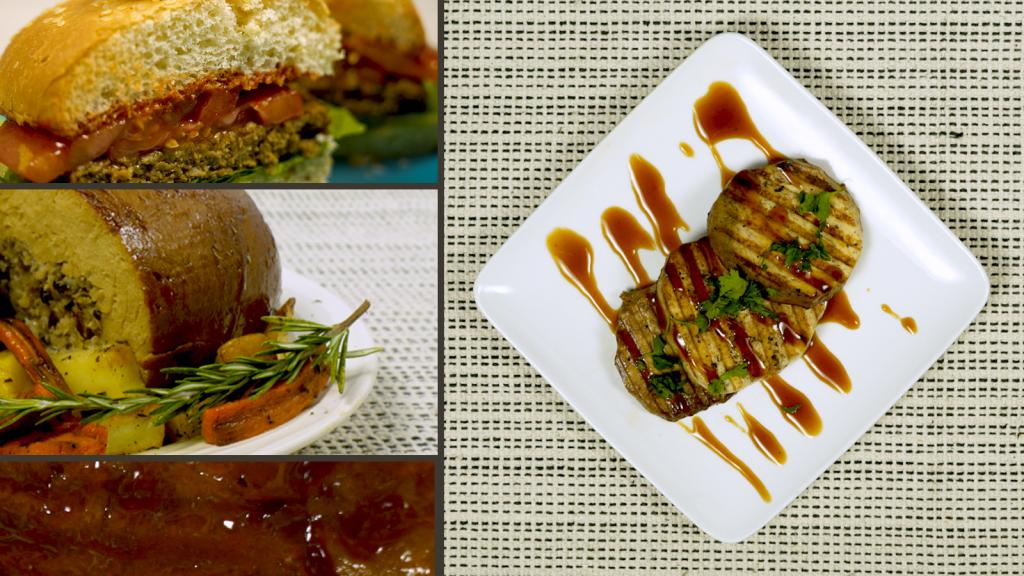
There comes a time in every would-be vegan’s life when the question arises: to fake it or not to fake it? I’m talking about meat, and not meat meat, you guys -- fake meat: various slurries concocted from beans, soy, mushrooms, and vital wheat gluten and shaped to resemble burgers, hot dogs, meat loaves, and sausages. And we mustn’t forget the other substitutes, either: vegan mayonnaises, butters, eggs, milks, and (shudder) cheeses.

So, to fake it or not to fake it? Do I need them as a protein source? Do they taste remotely like my ham ‘n’ eggs from the days of yore? Or is that missing the point of these convenience foods entirely?

Before I set out with three friends to eat a strictly vegan diet for a month, my position on fake animal products was mixed at best. I’ve been known to order a veggie burger just because I didn’t feel like beef that day, and I actually like pretty much every variety of milk substitute out there. But imposter hot dogs? Tofurky? What’s the point? I’d rather just enjoy the essence of grains, beans, and fungi for themselves. Otherwise, if you’ll pardon the expression, it’s like putting lipstick on a pig, then also putting that pig in a pair of Spanx and a sequined dress and making her trot around on Dancing with the Stars. Is it any wonder if she doesn’t make the final round?

Read more: Food, Living

Comments

This Tumblr will tell you what to do with all that weird food cluttering your cupboard

No matter how simply you try to live, you will eventually accumulate strange food items that sit in your cupboard or refrigerator forever. Possibly some kitchens generate them spontaneously. (For about a year, mine was a jar of Manischewitz Moroccan fish balls. They were a gift. We never ate them.) Thankfully, NPR has a new project called “Cook Your Cupboard" that's trying to help home chefs actually use these orphaned products.

To participate, you submit a picture of one to three of these mystery items to this site and wait for the advice to flow in. A few lucky cooks will get their problem featured on the radio and solved by a famous chef.

Some of the ideas are good -- one entry suggested turning artificial Orange Crush-flavored dessert topping, which really should have been thrown out BEFORE being bought, into a genuinely edible-sounding frozen daiquiri. Others are not.

Read more: Food, Living

Comments

The secret to bigger, healthier crops may be urine

toilet_planter
Philip Pessar

Manure is a very popular fertilizer. We all know about manure and how well it fertilizes things. But as it turns out, urine may be a good fertilizer too. What we're hearing is that we'd be doing the world a favor if we stopped using toilets and just dropped trou in a field.

Read more: Food

Comments

To survive, fast food will have to think fresh

vegetable burger lettuce
Shutterstock

We all know what Bad Fast Food looks like (I’m looking at you, KFC Double Down!) And we all know that tens of millions of Americans eat the stuff anyway -- whether out of choice or necessity. So can there be such a thing as “Good Fast Food”? There had better be -- or else the fast food biz is in real trouble.

Here’s food writer Mark Bittman, writing in the latest issue of the New York Times Magazine:

Soda consumption is down; meat consumption is down; sales of organic foods are up; more people are expressing concern about G.M.O.s, additives, pesticides and animal welfare. The lines out the door -- first at Chipotle and now at Maoz, Chop’t, Tender Greens and Veggie Grill -- don’t lie. According to a report in Advertising Age, McDonald’s no longer ranks in the top 10 favorite restaurants of Millennials, a group that comprises as many as 80 million people.

Fast food companies understand that Bad Fast Food might be approaching its expiration date. Rather than clinging ever tighter to their fattening products like Coca Cola did, they’re remixing them. Some of it is just window dressing: Bittman offers the example of McDonald’s heavily sweetened yogurt parfait, which just replaces fat with sugar. Other outfits toss a few salads at customers, or push healthier items off to the side as if embarrassed by their existence. After all, having healthier options means admitting your main offerings aren't, well, healthy.

But Taco Bell just announced a new effort to remake its menu along healthier lines. And Chipotle, which has been called the Apple of fast food, is nipping at the big dogs’ heels. The company bills itself as serving “food with integrity,” cares about animal welfare and to some extent the plight of farmworkers, and yet has $3 billion in annual sales with double-digit annual growth. Other fresh competitors are popping up like superweeds.

Donate by May 21st and win the ultimate electric propelled utility bicycle!
1640
Don't miss a green thing!
Get Grist in your inbox every morning.